



One account and a light message load need no software. Trouble starts when three reps chase the same leads, support cannot see what sales promised, or buyers sit in several countries.
A WhatsApp CRM ties those chats to lead ownership, customer records, follow-ups, and automation. Approaches differ. Here are five.
What Actually Separates One WhatsApp CRM From Another?
Every vendor lists the same things: shared inbox, automation, customer records, chatbots, team access. What differs is how the parts connect. Six questions sort the field:
- Sales, support, or both?
- One number, or several accounts?
- An existing CRM of record?
- Buyers across languages and countries?
- Do AI replies actually save time?
- Pipeline stages, or conversations?
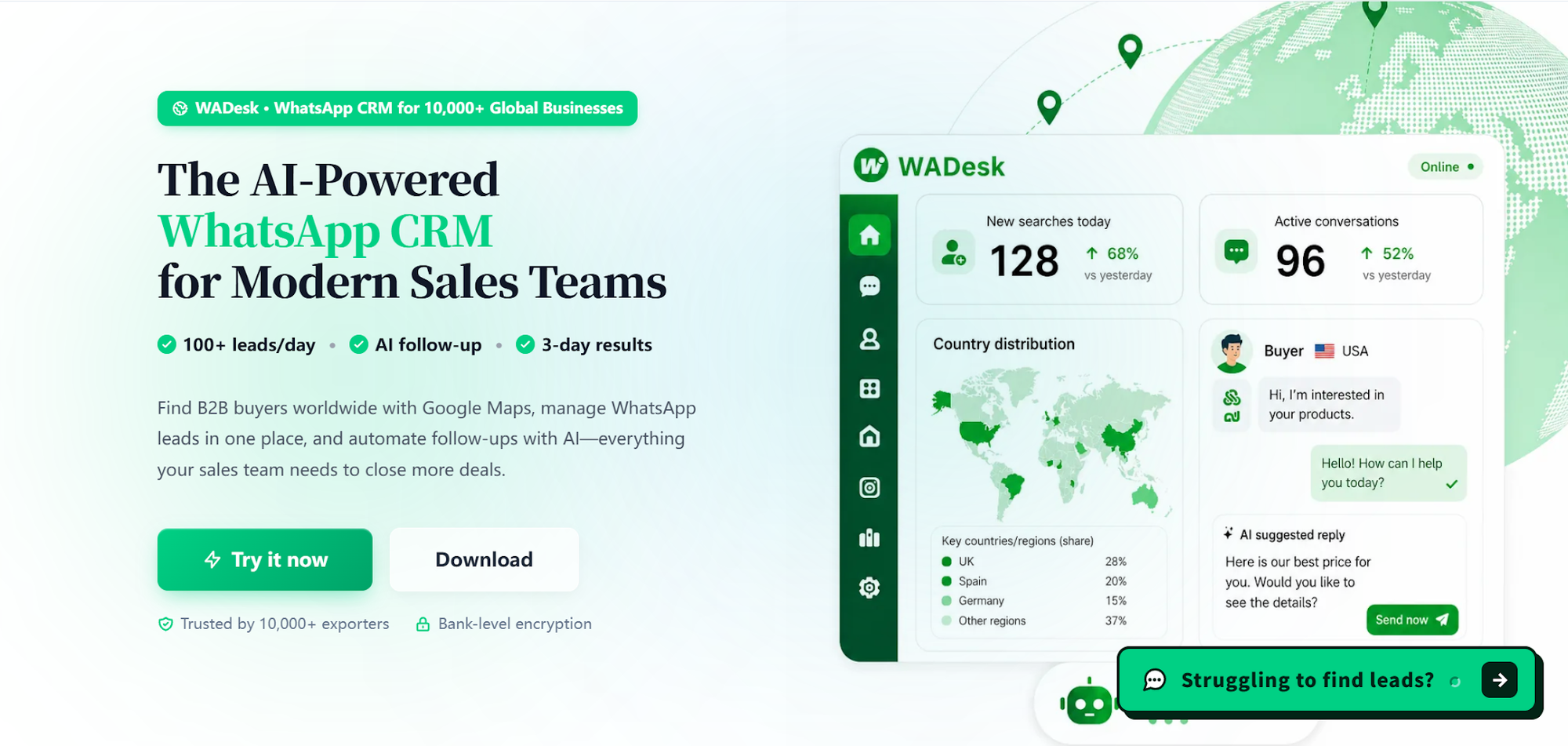
1. WADesk: For International Sales and Multi-Account Teams
WADesk is WhatsApp-first, built for teams winning and keeping overseas buyers. Its WhatsApp CRM for international sales brings lead development, customer conversations, multiple WhatsApp accounts, sales follow-ups, AI assistance, translation, and team collaboration into one workspace.
The unusual part: work can start before the buyer messages. Prospect discovery through sources like Google Maps, buyer validation, and contact importing feed outreach.
Where WADesk Stands Out
Multiple WhatsApp Accounts
Reps, markets, and numbers live in one workspace instead of a dozen open sessions.
International Communication
Translation runs in real time, built around cross-border sales conversations.
AI-Assisted Follow-up
Reply suggestions, automated responses, knowledge-based chatbots, and scheduled follow-ups take repetitive work off reps.
Lead and Team Management
Profiles, assignments, and follow-up records cut duplicate outreach. When someone leaves, the customer history stays put.
2. Respond.io: For Connecting WhatsApp to an Existing CRM
Respond.io sits between messaging channels and whatever CRM a company runs. It pulls WhatsApp, Instagram, Messenger, and TikTok into one place, adds workflows, routing, and AI agents, then feeds the result into HubSpot or Salesforce.
Where Respond.io Fits Best
A company with years of process built inside HubSpot has little reason to tear it out. Respond.io handles conversations while HubSpot stays the system of record. If WhatsApp is the whole sales motion, that layer is extra machinery.
3. Wati: For WhatsApp-Centric Automation Across Teams
Wati is centered on WhatsApp but keeps widening: a unified inbox, AI conversational tools, lead qualification, chatbots, and automation across marketing, sales, and support.
Where Wati Stands Out
On the official WhatsApp Business API, Wati absorbs jobs that usually need two or three tools: campaigns, assignment, automated replies. It also handles website chat, Instagram, Facebook, and SMS, which makes it an engagement platform more than a sales CRM.
4. Interakt: For Conversational Sales and E-Commerce
Interakt moves a lead through a sale without leaving the chat. Its WhatsApp Sales CRM handles lead capture, qualification, automated follow-ups, assignment, and stages from New Lead to Closed Won.
Where Interakt Fits Best
Picture a consumer brand: capture the lead, send the catalogue, drop a payment link, re-engage weeks later. Interakt builds team roles, campaigns, payments, and integrations around that loop. B2B prospectors need a different mix.
5. Kommo: For CRM Pipeline Management with WhatsApp Built in
Kommo comes at this from the CRM side. WhatsApp and other channels sit inside the CRM, with a unified inbox, pipeline stages, automated replies, and AI-assisted conversations.
Where Kommo Stands Out
Leads move through stages while Salesbot collects information, sends messages, and sets tasks. WhatsApp ends up as one lead source alongside Instagram, TikTok, and web forms, which suits teams who think in deals.
Quick comparison: Which Approach Fits Which Team?
Choose Based on Your Existing Sales Process
A rollout stalls when the software assumes a process the team does not run.
If WhatsApp is the Main sales Channel
Reps who live in WhatsApp need multi-account management, clear ownership, customer history, translation, and clean handovers. Exporters feel this first.
If You Already Have a Major CRM
When HubSpot, Salesforce, or Zoho holds the record, connecting WhatsApp to it hurts less than replacing it.
If Sales Begin with Campaigns and E-Commerce
Leads from ads, product enquiries, and online stores reward API automation, payments, and broadcasts.
If Pipeline Management Comes First
Teams that think in stages, tasks, and closed deals are happier in a broader CRM.
AI Features Need to Solve a Real Workflow Problem
Every platform here has AI, so the label tells you nothing. Ask which repetitive job it removes: qualifying leads, drafting replies, answering the same question for the ninetieth time, translating.
For an exporter, translation beats a marketing chatbot. For a support team clearing hundreds of tickets, routing matters more.
Multi-Account Management Can be More Important Than it Sounds
Most comparisons assume one company, one number. Growing businesses rarely stay there. Accounts multiply by rep, market, product line, office.
Ownership breaks first. Who owns this lead, has anyone else contacted the buyer, and what happens when a rep resigns?
Multi-account support and handover belong in the core requirements.
The Best WhatsApp CRM Depends on Where the Complexity Lives
Respond.io suits a company that wants messaging organized around an existing CRM. Wati covers WhatsApp automation across marketing and service. Interakt ties conversational selling to commerce. Kommo puts WhatsApp inside a traditional pipeline.
WADesk aims at a narrower job: WhatsApp-driven international acquisition, with prospect discovery, multiple accounts, AI assistance, translation, and handover together.
The decision follows the bottleneck. An enterprise CRM of record points to integration, campaign volume to automation. Several accounts, several languages, and months of follow-up point to workflow depth.
Feature counts make a poor tiebreaker. Better test: can a manager open the tool on Monday and see who owns which buyer, and what happens next?


