AI video models are getting better at understanding prompts. Requests such as “wave at the camera,” “turn around and run,” or “perform a short dance” now produce far more usable results than they did a year ago.
But creators who need a specific performance still face a limitation: text can describe what should happen without fully specifying how the movement should unfold. The hard part is making a character move the way the creator actually intends.
When Text Descriptions Meet Specific Motion
Consider a prompt such as: “The character raises a coffee cup with the right hand, smiles, and offers it toward the camera.” It sounds precise, but the performance still contains information the sentence does not specify: how quickly the arm rises, the path of the cup, when the smile begins, how the head moves, and how long the gesture lasts.
A model may understand “raising a cup” while producing a different performance from the one the creator had in mind. Rewriting and regenerating may be acceptable for a one-off demo, but motion-specific scenes benefit from a more direct source of movement.
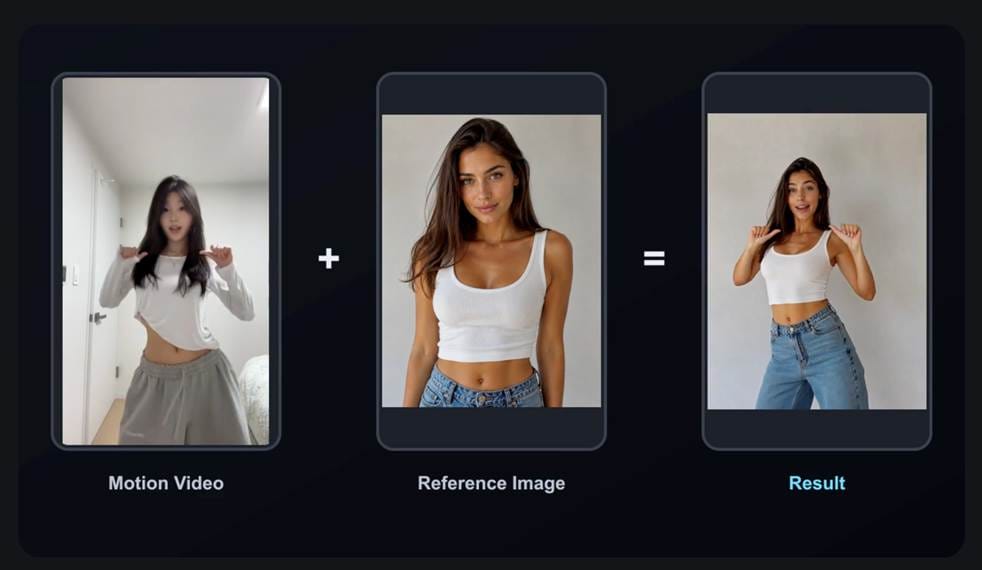
A motion reference defines the performance, while a character image defines who performs it.
Give AI a Performance, Not Just a Verb
Motion Control uses a simple idea: instead of explaining every movement in text, provide a video that already contains the motion. The inputs then take on clearer roles:
- Motion reference video: movement order, body posture, pacing, weight shifts, gestures, and timing.
- Character image: who should perform the motion and the intended visual identity.
- Prompt: scene, lighting, style, camera direction, or other creative context rather than every step of the movement.
This does not make prompting irrelevant. Once motion is represented by video, text can focus more on direction and less on reconstructing the performance.
Separate the Character From the Performance
This separation becomes especially useful when the target character is not the person in the motion reference. A creator can record a simple performance with a phone, then use that movement as guidance for a completely different subject—an illustrated character, game hero, mascot, or another stylized identity.
The value is not simply that an AI character can dance. Performance becomes reusable: the same character can receive new performances, or one movement structure can be explored across different characters.
Where Motion Control Actually Helps
Short-form platforms are full of movement-driven formats: dances, meme gestures, reactions, and brief acting performances. A human creator can simply perform a trend again; a virtual character, animated IP, or brand mascot usually needs another animation step.
- Character-led social content: recurring virtual characters can take on new dances, reactions, gestures, or trend formats.
- Animated and game characters: motion references can help prototype performances during concept development and previsualization.
- Brand mascots and virtual IP: teams can test campaign actions, seasonal interactions, or social formats before committing to a full animation pipeline.
- Ad creative testing: teams can explore hooks, reactions, presentation gestures, and character treatments while reusing a motion concept.
From Prompt Control to Performance Control
This workflow is already appearing in production tools. In VidLux, for example, the motion control AI workflow combines a character image with a reference motion video so the target character can generate a new video based on the movement, posture, gestures, and performance information in the reference.
The important change is that character identity and performance no longer have to come from the same source. Creators can show the model a performance instead of describing every motion detail.
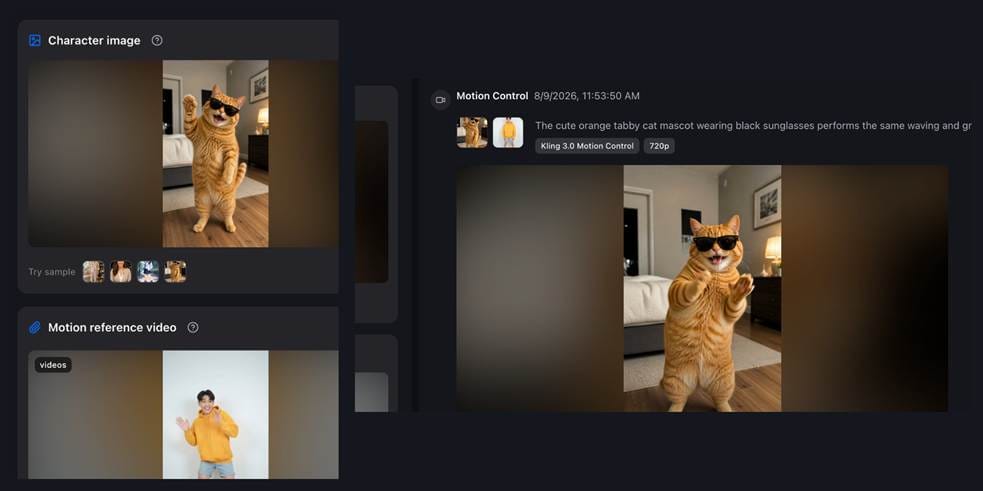
A real Motion Control workspace separates character identity, motion reference, and generated output into distinct parts of the workflow.
Motion Control Is Not Motion Capture
Motion Control can sound similar to professional motion capture, but they should not be treated as equivalents. Motion capture remains valuable when a production needs precise skeletal data, editable animation curves, rigged 3D characters, complex interactions, and detailed downstream control.
AI Motion Control is a lighter-weight option for social clips, character experiments, previsualization, and fast creative iteration. It sits between prompt-only generation and a full animation or motion-capture pipeline rather than replacing the latter.
Reference Motion Still Has Clear Limits
A reference video does not make AI motion perfectly controllable. Fast movement, heavy occlusion, complex hand actions, multiple people making contact, or large differences in body proportions can all make a result less stable. The source image matters too: if it only shows the upper body while the motion depends heavily on full-body movement, the model still has to infer missing information.
The practical value of motion reference is therefore not “perfect replication.” It is a more direct motion constraint. Instead of asking the model to guess what a written action should look like, the creator can provide an existing performance as a reference.
The Next Step May Be More Than Prompt Adherence
AI video models are often judged by prompt adherence: did the model follow the text instruction? That remains important. But motion-reference workflows introduce another practical question: did the generated character follow the intended performance closely enough to be useful?
For purely cinematic scenes, that may matter less. For virtual characters, animated IP, brand mascots, and ads that rely on specific gestures, it can determine whether the result is usable.
AI video is already getting much better at making a character move. The harder next step is giving creators more control over how that character performs. When text is not enough to communicate motion, reference video gives creators a more direct way to show the model what they mean.