



The typical building already has more cameras than anyone can watch. Lobbies, corridors, parking areas, and entrances are all covered, yet that footage mostly sits idle until an incident forces someone to scrub back through it. The idea behind a gun detection camera is to change that equation by adding a software layer that watches every feed continuously and flags a visible firearm the instant it appears. In most cases, there is no new camera involved at all; the “gun detection camera” is really your existing camera plus an AI analytic running behind it.
That distinction matters because it changes the economics. Ripping out and replacing a camera network is expensive and slow, and it is the reason many good security ideas never get deployed. A software-based approach to CCTV gun detection connects to standard IP camera streams, so the same hardware an organization already owns becomes an active sensor rather than a passive recorder. The practical requirement is usually just a camera that produces a standard video stream and enough placement and image quality that a person could recognize a weapon in the frame. If a human could see the gun on that feed, the analytic has a chance to see it too.
Once the software is in place, the workflow is what turns a detection into real-time firearm detection that people can act on. When a weapon detection camera analytic flags a likely firearm, it issues an alert in near real time and routes it to wherever the organization has decided it should go. Platforms such as ROC Watch fold that alert into a broader operational picture, so instead of a lone pop-up, operators get context: which camera, which location, and the ability to follow the threat across adjacent feeds. That situational layer is what separates a usable system from a noisy one.
What “turning CCTV into a sensor” really means
The upgrade is less about the camera and more about what happens to the video after it leaves the lens.
- Continuous watching. The analytic scans every frame from every connected feed, so coverage no longer depends on an operator staring at a wall of monitors.
- Detection of visible firearms. The model looks for brandished or otherwise visible handguns and long guns, including awkward angles and partly obscured views that real scenes produce.
- Near-instant alerting. A detection becomes an alert within roughly a second, delivered through channels the security team already uses.
- Tracking and context. Better systems associate a detection with the person carrying it and follow movement across cameras, so responders are not stuck with a single frozen frame.
None of this requires the camera itself to be “smart.” The intelligence lives in the software, which is why a decade-old fixed camera can participate in a modern gun detection system.
Honest expectations on accuracy and false alarms
Any vendor claiming a flawless detector should be treated with skepticism. These systems work with probabilities, and two failure modes matter. A missed detection is a weapon the model did not flag, often because it was concealed, out of frame, or too small in the image. A false positive is a harmless object flagged as a gun, such as a tool, a phone, or a toy at a bad angle.
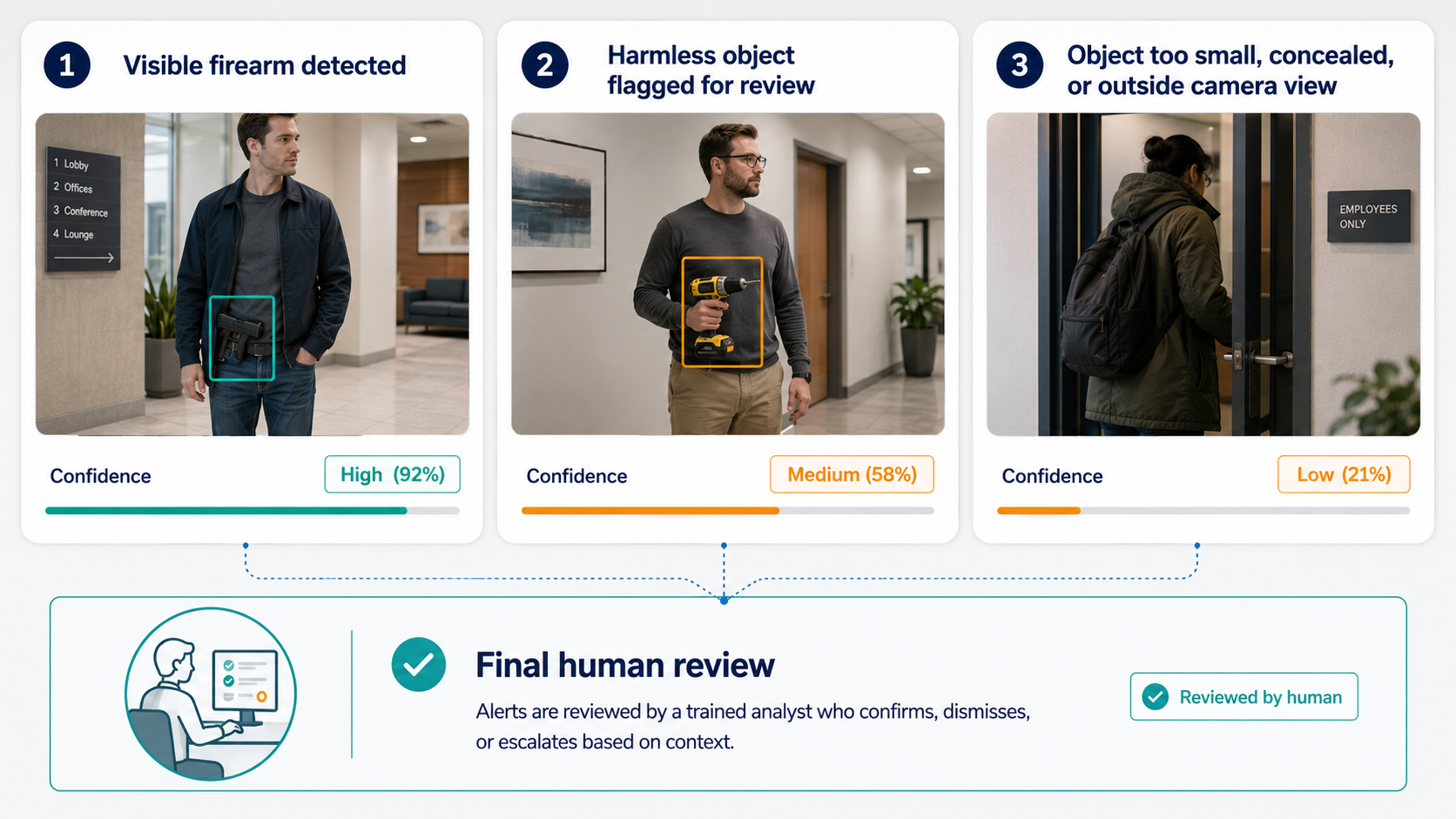
The way mature deployments manage this is with tuning and human review. Sensitivity can be adjusted to the environment, and alerts can be routed first to a trained operator who confirms or dismisses them before any broader response. That human-in-the-loop step is not a weakness; it is what keeps a false alarm from turning into an overreaction. Camera placement, resolution, and lighting also do a lot of the work, since a well-sited feed produces far cleaner detections than a dim, distant one.
Deployment considerations
A few practical questions decide whether a rollout succeeds.
Starting at the highest-value cameras, usually entries and approaches, gives the biggest safety return before expanding coverage across the network.
The bottom line
Gun detection cameras are best understood not as new hardware but as a new job for cameras that already exist: continuously watching for a visible firearm and raising a fast, reviewable alert when one appears. The technology is genuinely useful for shrinking the time between “a threat is present” and “the right people know,” provided buyers stay realistic about concealed weapons, false positives, and the need for human confirmation. ROC Watch is one example of a platform built to add that layer to existing CCTV responsibly, and it is a reasonable reference point for any team weighing how to make its current cameras do more.