



If you’ve ever looked at startup costs in cities like San Francisco or London, you know how high the cost of running a business and keeping it maintained is. That’s why more founders are turning their attention to Latin America.
Hiring talent can be 30–60% cheaper, you’re tapping into a growing middle class with real demand, and the region is close enough to the U.S. to make cross-border deals practical. Add steady foreign investment and booming tech hubs, and it starts to look like more than just a backup plan.
What makes it even more interesting is that some countries don’t just let you operate your business; their visa programs can actually put you on the path to permanent residency. That’s a big deal if you want to build long-term and turn business expansion into both a professional and personal foothold.
Here are five visas in Latin America that can grant startup founders permanent residency (PR) if you’re looking to grow your business, cut costs, and build a lasting base in the region.
1. Brazil: Entrepreneur Visa

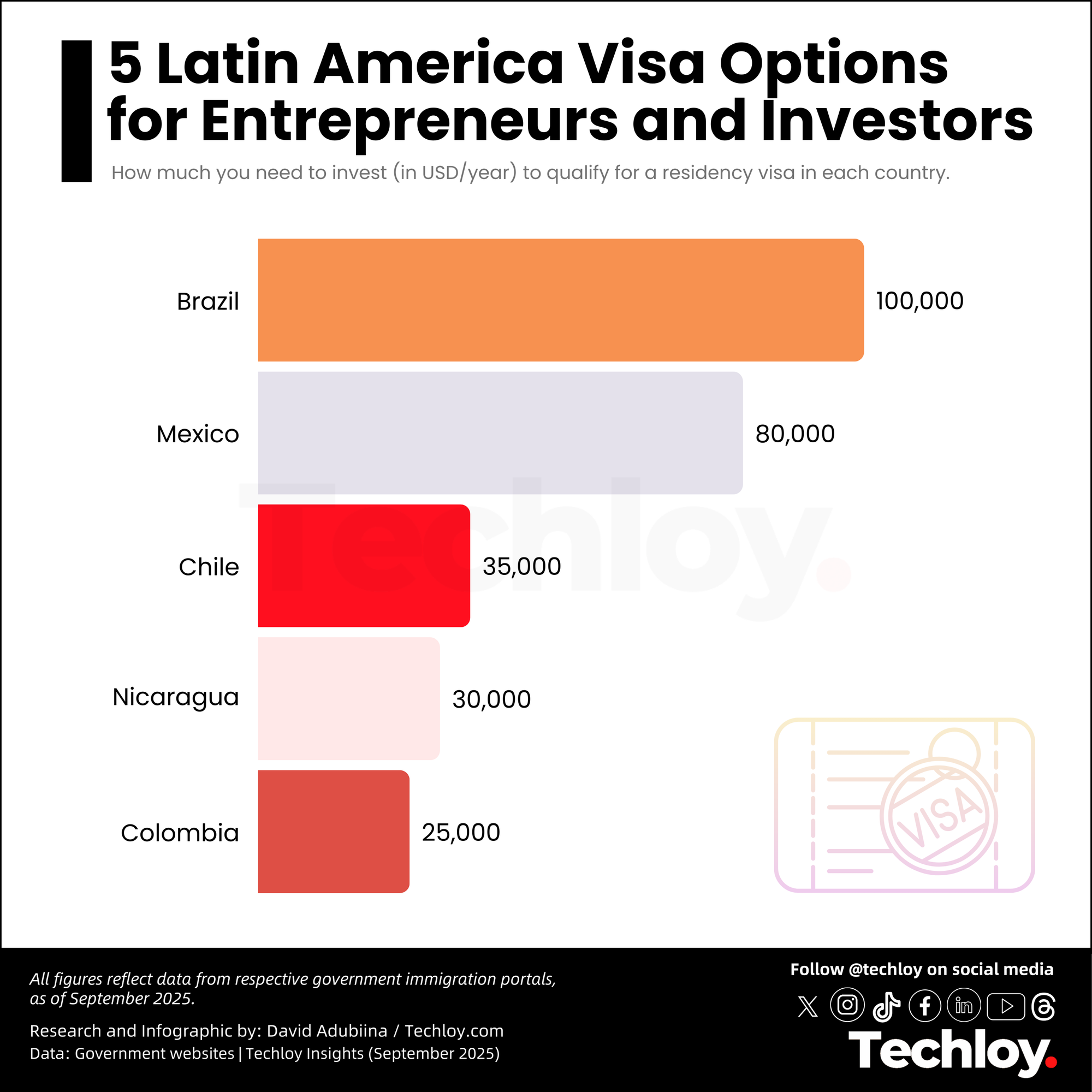
Brazil’s Entrepreneur Visa is designed to attract foreign investors and business owners who want to set up shop locally. To qualify, you’ll need to invest at least R$500,000 as an individual (around $100k USD) or R$600,000 through a Brazilian company. There’s some flexibility for innovation-focused businesses—if you’re in tech or research, or if you can create 10 jobs for locals, you may qualify with a smaller investment of R$150,000.
Path to PR: The visa is reviewed after three years, and as long as you’ve kept up your investment and visited at least once in the first two years, you’re on track to permanent residency.
2. Chile: Startup Visa

Chile’s Start-Up Chile program has become famous for turning Santiago into a startup hotspot. They offer a one-year visa to high-potential, scalable startups, along with equity-free funding, mentorship, and investor access. Although you don't need money up front, you can receive a grant of up to 25 million CLP (approximately USD $35,000) equity-free funding to cover eligible expenses for your business if you are selected for the program. The requirement is to dedicate yourself full-time to building your company in Chile during the program.
Path to PR: After a year on a temporary visa, you can apply for permanent residency if you’ve spent at least 185 days in Chile, kept your business active, and paid taxes. You’ll need to show ties to the country in your application, but once approved, Chile offers a strong base for both regional and global growth.
3. Nicaragua: Entrepreneur Residency Visa

If countries like Brazil or Chile feel out of reach, probably the investment minimums are too steep or the startup requirements too narrow; Nicaragua offers a much softer entry point. With just $30,000, you can qualify for its Entrepreneur Residency Visa. That money can go into a small business, real estate, or even an agricultural project, as long as it creates jobs for at least two locals.
Compared to Brazil’s R$500,000 requirement or Chile’s competitive startup program, Nicaragua’s offer feels more attainable for founders who aren’t sitting on a huge amount of capital but still want to establish a presence in Latin America. It’s the kind of option that makes sense if you’re testing the waters, running a lean operation, or simply looking for residency without burning through your runway.
Path to PR: As long as you’re physically present and actively running your business, this visa leads directly toward permanent residency.
4. Mexico: Temporary Resident Visa
Proximity to the U.S. is one thing that makes Mexico especially attractive for startups. Being right next door means easier access to the American market, smoother logistics, and stronger trade links — all while tapping into Mexico’s own 130 million–plus consumer base. Unlike countries that offer direct entrepreneur PR visas, Mexico doesn’t provide a direct “entrepreneur visa,” but the Temporary Resident Visa can work just as well. You qualify if you own shares worth at least MXN 1.4 million (~$80k USD) in a Mexican company, if your company owns property of that value, or if you employ at least three locals. The visa starts as a one-year permit but can be renewed for up to four years.
Path to PR: After four years of legal residency, you can apply for permanent residency. If you want to take it further, citizenship is possible after five years (or two if you’re from Spain, Portugal, or another Latin American country). Just be ready to show Spanish skills and pass a history and culture test.
5. Colombia: M and R Visas

When it comes to startup hubs, most founders or investors would consider São Paulo or Mexico City for their established ecosystems and bigger headlines. Colombia doesn’t usually make that first list, and that’s exactly why it deserves a closer look. It’s cheaper to get started, the market is on the rise, and the middle class keeps expanding. For someone who wants a lower barrier to entry but still enough space to grow, Colombia makes a quiet but solid case.
With an M-visa, you can get temporary residency by investing around US$25,000 in a business or US$75,000 in real estate. The visa runs for three years, giving you time to set up shop and see how the market treats you.
Path to PR: If you keep your investment going and hold the M-visa for five years, you can move up to an R-visa, basically permanent residency. From there, citizenship is possible after 10 years, though you’ll need Spanish proficiency and to avoid long absences of more than a year at a stretch.
Conclusion
If you are a founder or business owner looking to expand abroad, Latin America gives you something most regions don’t: the chance to turn a business bet into a life plan. These visas help you bridge between your startup goals and permanent roots in a new market. Depending on your risk appetite and investment, you can decide whether to play the long game with an established economy like Brazil or test the waters with a growing economy like Nicaragua.


