- Fortnite and Roblox, two of the world’s most popular gaming universes, froze mid-session.
- The downtime cost Fortnite and Roblox an estimated $2 million in combined revenue and creator losses.
- A more distributed cloud ecosystem, one that balances AWS with competitors like Google Cloud, Microsoft Azure, Cloudflare, and Oracle Cloud, could reduce the risk of global paralysis.
On October 20, 2025, Amazon Web Services (AWS), the invisible backbone of the modern internet, suffered a major outage in its US-EAST-1 region in Northern Virginia. What began as a small DNS error spread like wildfire, slowing Reddit, stalling Venmo, and even crashing Snapchat. But nowhere did the silence hit harder than in gaming.
Fortnite and Roblox, two of the world’s most popular gaming universes, froze mid-session. For millions of players, the sudden stillness felt like time had stopped. The always-on rhythm of online life had skipped a beat.
That moment exposed something bigger. AWS isn’t just another platform but the foundation of the internet’s daily pulse. From Prime Video to Lyft, Wordle to T-Mobile, countless apps depend on Amazon’s cloud. So, when it stumbles, the world shudders with it.
MORE INSIGHTS ON THIS TOPIC:
- PlayStation Plus expands its October 2025 lineup with new game titles
- EA apologizes after Battlefield 6 launch glitch locks out players
- GTA 6 fans think Rockstar just teased the next trailer
What was the cost of the digital silence caused by the AWS outage?
For Fortnite and Roblox, three hours offline wasn’t a blip—it was a blackout. Roblox, with more than 70 million players, earns roughly $9.86 million per day, while Fortnite brings in about $2.74 million.
During the outage, Roblox lost an estimated $1.23 million in direct revenue. Its creators, who earn up to 30% from in-game sales, missed out on around $369,000. Meanwhile, Fortnite lost about $342,000, plus more than $50,000 in refunds and creator-related costs.
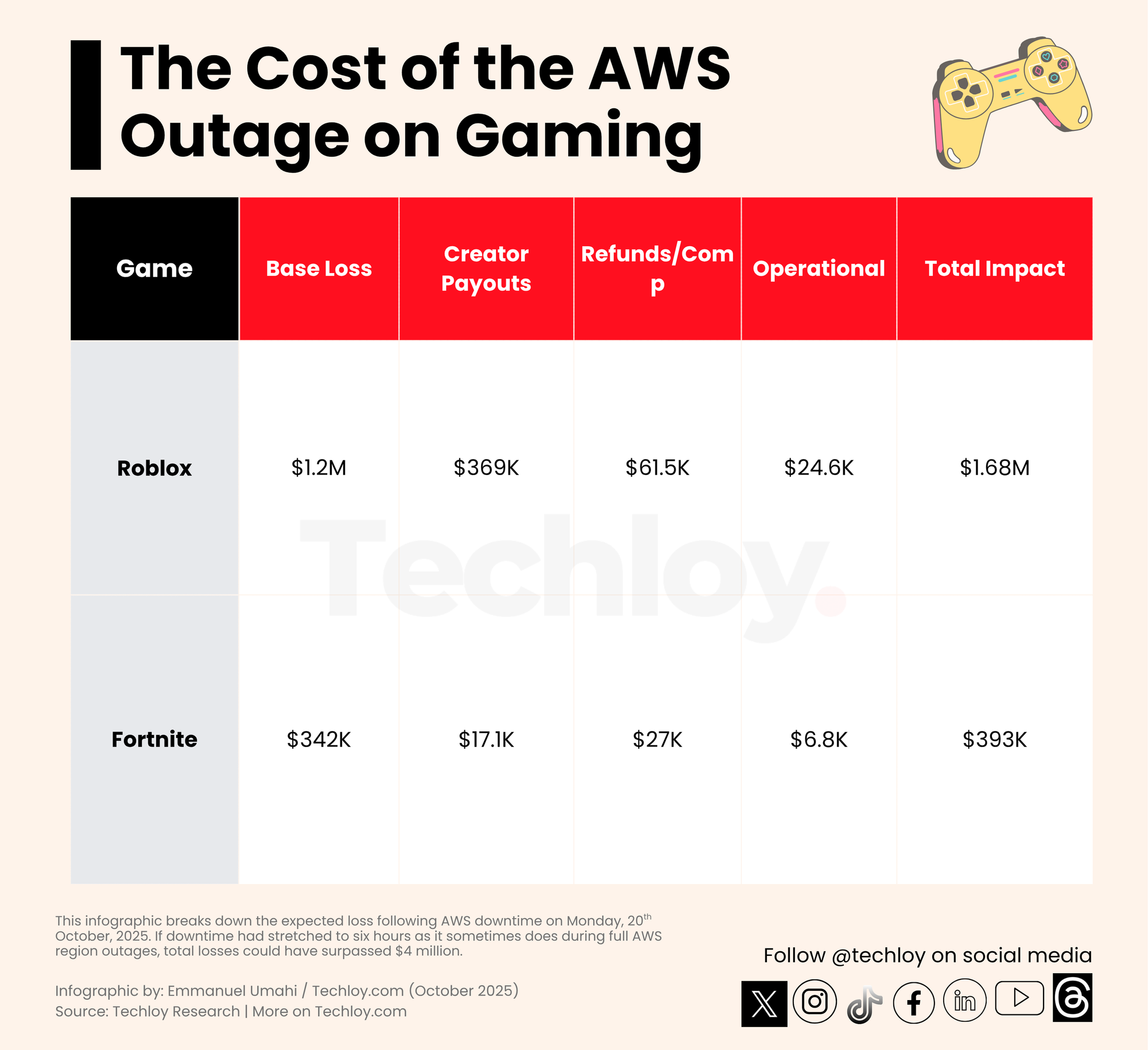
Combined, the outage erased roughly $2 million in just three hours, a figure that would have doubled had downtime stretched to six. Behind those numbers are developers, streamers, and small studios whose livelihoods depend on uptime. A canceled virtual concert, a delayed tournament, a missed event—all translate to real-world losses. For many young Roblox creators, it meant delayed payments and lost momentum.
Within hours, social media was filled with memes, disbelief, and frustration. Players traded downtime jokes while creators posted screenshots of frozen dashboards. The silence wasn’t only technical; it was cultural.
The fragile backbone of the internet
The cloud was built on the promise of being “always on.” Yet, each failure reminds us how fragile that promise is. Both Epic Games and Roblox Corp. spend millions annually on redundancy and security, but even their best systems rely on a single foundation.
AWS controls about 30% of the global cloud market in 2025, followed by Microsoft Azure at 20% and Google Cloud at 13% (via Statista). Nearly half of the world’s digital infrastructure lives inside Amazon’s ecosystem. That dominance makes innovation easier, but risk is inevitable.
If Fortnite or Roblox had been distributed across multiple providers, live servers on Azure, backups on Google Cloud, and edge delivery through Cloudflare, the impact might have been minimal. Instead, a single misconfiguration in Northern Virginia disrupted gaming in Lagos, Delhi, London, and Los Angeles.
A web that depends on one provider is a web waiting to fail. Multi-cloud strategies aren’t buzzwords; they’re digital survival plans. The lesson is simple: don’t build the future on one server.
 Techloy
Why is the AWS outage a wake-up call for the internet?
The 2025 AWS outage wasn’t just a technical failure. It was a global mirror moment, exposing how much of the world’s economy and culture depends on infrastructure owned by a handful of companies.
The early internet thrived on decentralization. Today, convenience has replaced resilience, and dependency has replaced diversity. The question isn’t whether AWS will fail again, but whether the internet will be ready when it does.
For gamers, it was a lost afternoon. For creators, a lost paycheck. For Amazon, a reminder that dominance doesn’t guarantee stability. The outage lasted a total of 15 hours, but its echo will last much longer: no single company should hold the keys to the world’s connection.
If the internet is humanity’s greatest collaboration, its infrastructure should reflect that—shared, balanced, and built to withstand the world it powers. Because when the cloud falters, the world shouldn’t have to stop with it.
 Louis Eriakha