Bringing a new electronic product to market is hard enough. Not every product founder has the option to design an embedded system on their own, so they have to rely on external teams such as Integra Sources. As an embedded electronics developer, we have helped dozens of startups and established businesses turn product concepts into production-ready devices. In this guide, we share useful tips that can help product founders choose the right hardware development partner.
An outsourcing team can help startups solve a number of problems:
- Not enough internal resources: A one-person startup can hardly handle a full-fledged hardware project. Even large companies with experienced development teams may be overloaded with other tasks. In both cases, outsourcing the project makes sense.
- When you need extra help, not a full team: Companies may face temporary spikes in workload. In this case, it makes no sense to hire additional developers since they will have nothing to do after the peak period. Instead, startups can outsource certain tasks rather than the whole project.
- Lack of in-house expertise: Compare these PCB layouts. The first one is a PCB with an 8-bit microcontroller. The second uses a 32-bit ARM SoC and is much more complex.
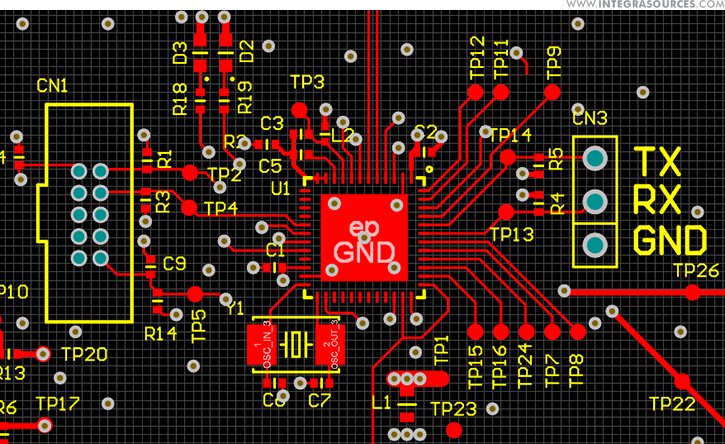
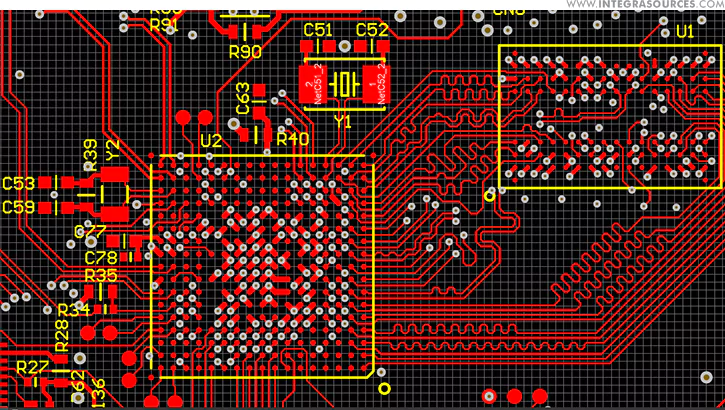
The point is that even large companies rarely have expertise in all domains of electronics design, let alone small startups. If your team is strong in one area but weak in another, you can fill those gaps by hiring a contractor.
Where to Look for Candidates
There are many ways to build a shortlist of candidates.
- Web search: Probably, any hardware development company has a website, so simple googling should surface dozens of potential contractors. Websites usually have a lot of useful information about the candidates: a list of services they offer, project portfolios, cooperation models, client logos, etc. Some even have blogs that can tell a lot about the team’s expertise and experience. For example, Integra Sources openly shares detailed case studies and describes their development workflow step by step. Studying a company’s website allows you to assess a company’s competence and communication style.
- Freelance platforms: Many individual engineers and large development companies are present on Upwork and similar marketplaces. Review their profiles to see their hourly rates, list of completed projects, and client feedback. You can also post a job description on the platform that tells the potential contractor what needs to be done and what skills are required. One of the benefits of freelance platforms is their built‑in payment and dispute mechanisms that protect both sides.
- Professional social networks: LinkedIn and XING are two examples of social networks designed to help professionals find partners in different industries. Companies typically provide the information about their services, expertise, team size, and more on their pages.
- Specialized communities and forums: There are hardware‑focused forums and industry communities for product founders, investors, and engineers. It’s a good place to ask for recommendations, find a candidate, and start a conversation—for example, by asking questions about your project.
How to Pick the Right Candidate
The next step is to evaluate the candidates from your list using the following key criteria. Some information necessary for this task can be obtained from open sources like the company’s LinkedIn page or website. For additional details, you can contact a contractor through a phone call or by texting in a messenger.
Developer’s Expertise
Find out which technologies and platforms the team specializes in. Make sure they use professional CAD tools for PCB and FPGA design as they are essential for smooth integration with manufacturers. Ask if the company has laboratory equipment for debugging the hardware. A professional developer should at least have access to laboratory power supplies, multimeters, oscilloscopes, signal generators, and logic analyzers suitable for your type of product. Also, ask the team to explain in detail how they test and validate electronics. A mature contractor has clear steps such as schematic and layout reviews, electrical rule and design rule checking, simulations where appropriate, test points on the PCB, and structured test scenarios.
Finally, make sure you will receive all deliverables required for mass production and further product development:
- schematic and PCB source files
- Gerber files for manufacturing
- assembly drawings
- Bill of Materials
- 3D models
- test procedures
Awards and Customer Feedback
Reputation is one of the easiest ways to sanity‑check a potential partner. Check available independent reviews and ratings. You can find them on general B2B review sites or freelance platforms where the company has profiles. Individual reviews on the firm’s website also count, although they can be subjective.
Portfolio of Projects
It is best to outsource your project to a contractor that has already dealt with similar products. If the company’s portfolio has a case study of a similar project, the team most likely knows what issues to expect and how to handle them.
Pricing
Rates vary significantly depending on a contractor’s level of expertise and location. Note that engineers in some regions charge less than their colleagues in the US or Western Europe while they have the same skill level. So, it may be a smart move to outsource to a company in Eastern Europe or Asia. In any case, treat prices as just one factor among many.
Payment Models
The most common options here are fixed price and time-and-materials.
In a fixed-price contract, the scope, deliverables, and deadlines are clearly defined. The vendor commits to delivering the agreed results for the agreed-upon price, which gives you more predictability but less flexibility. This model suits projects with clear requirements.
In a time-and-materials arrangement, you pay for actual hours spent. It works well for R&D or projects where requirements may change and the exact scope is hard to predict. This model gives flexibility and supports iterative development, but you must actively manage priorities and budget.
Some companies also offer hybrid models.
Communication and Management

Ask early who exactly will be involved in your project. A mature developer usually has a technical lead responsible for engineering quality, a project manager tracking scope, schedule, and risks, and an account manager handling commercial and relationship issues.
Make sure key team members can communicate fluently in English (or your working language), not just salespeople, so you can discuss requirements, trade‑offs, and issues without confusion.
Finally, ask which tools the team uses for task tracking, documentation, and real‑time communication, how often they report progress, and what their escalation path looks like if something goes off track.
Working Process
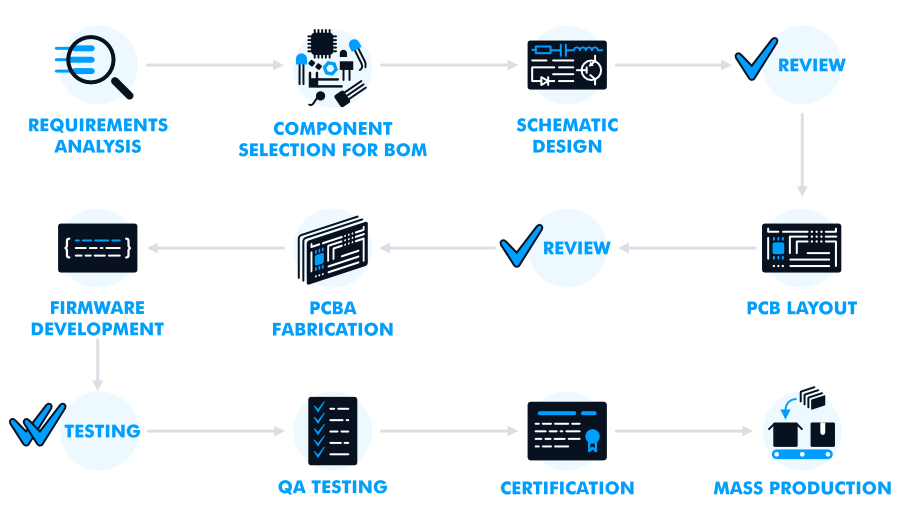
Ask the vendor to walk you through their typical process for electronics projects and what phases they expect. It typically includes requirements clarification, architecture and component selection, schematic design, PCB layout, prototyping, testing, and design updates. Good partners will be transparent that hardware work is iterative, and that issues found during reviews or testing may require revisiting earlier stages such as schematic or layout.
IP Rights and Product Ownership
Intellectual property is one of the most critical points to clarify when you outsource electronics design. Work with an IP-savvy lawyer to review your contract and make sure you have a solid NDA in place before sharing detailed information about your product. Your main agreement should explicitly state that all IP created for the project will belong to you once you’ve paid in full.
7 Red Flags to Watch Out For
- Very low price and vague promises. The candidate either underestimates the work or plans to push for change requests later.
- No clarifying questions about your project. A team that quotes quickly but barely asks anything about project goals, requirements, or constraints is not doing serious analysis. Expect major surprises once development starts.
- Unclear project scope and boundaries. It indicates that the vendor lacks experience, and your project is heading toward uncontrolled scope creep.
- No transparency about the team. There’s a risk you will end up with a completely different team than the one you met in sales calls. This makes quality and continuity hard to control.
- Agreeing to everything without pushback. Either the team does not understand the complexity of the job or they are desperate enough to take on any risks.
- Reluctance to clarify IP and ownership. A trustworthy vendor is willing to discuss IP ownership, access to source files, and handover terms in detail. Otherwise, they’re probably up to no good.
- Resistance to reviews. If a team is uncomfortable with sharing intermediate development results, it suggests they may not be confident in their engineering practices.
To sum up, a reliable outsourcing partner will not eliminate the complexity of hardware development. But the right choice can make it manageable and predictable instead of chaotic and risky.