



This week, a fintech with no product, no banking license, and no revenue closed $230 million in seed funding—the largest in Middle East and Africa history. That’s more than what most regional unicorns raise across their entire lifecycle.
Abu Dhabi’s Mal secured the record round from BlueFive Capital. Founder Abdallah Abu-Sheikh, who sold his Astra Tech stake to G42 in 2024, is building an AI-native Islamic digital bank targeting the $7 trillion Islamic finance market. The platform hasn’t launched. Licenses are pending across the UAE, the Middle East, and Asia. But former Revolut and Nubank executives joined, and institutional capital came in at a valuation that puts Mal ahead of most established regional fintechs.
The rest of the week’s deals tell a different story—smaller checks solving tangible problems right now.
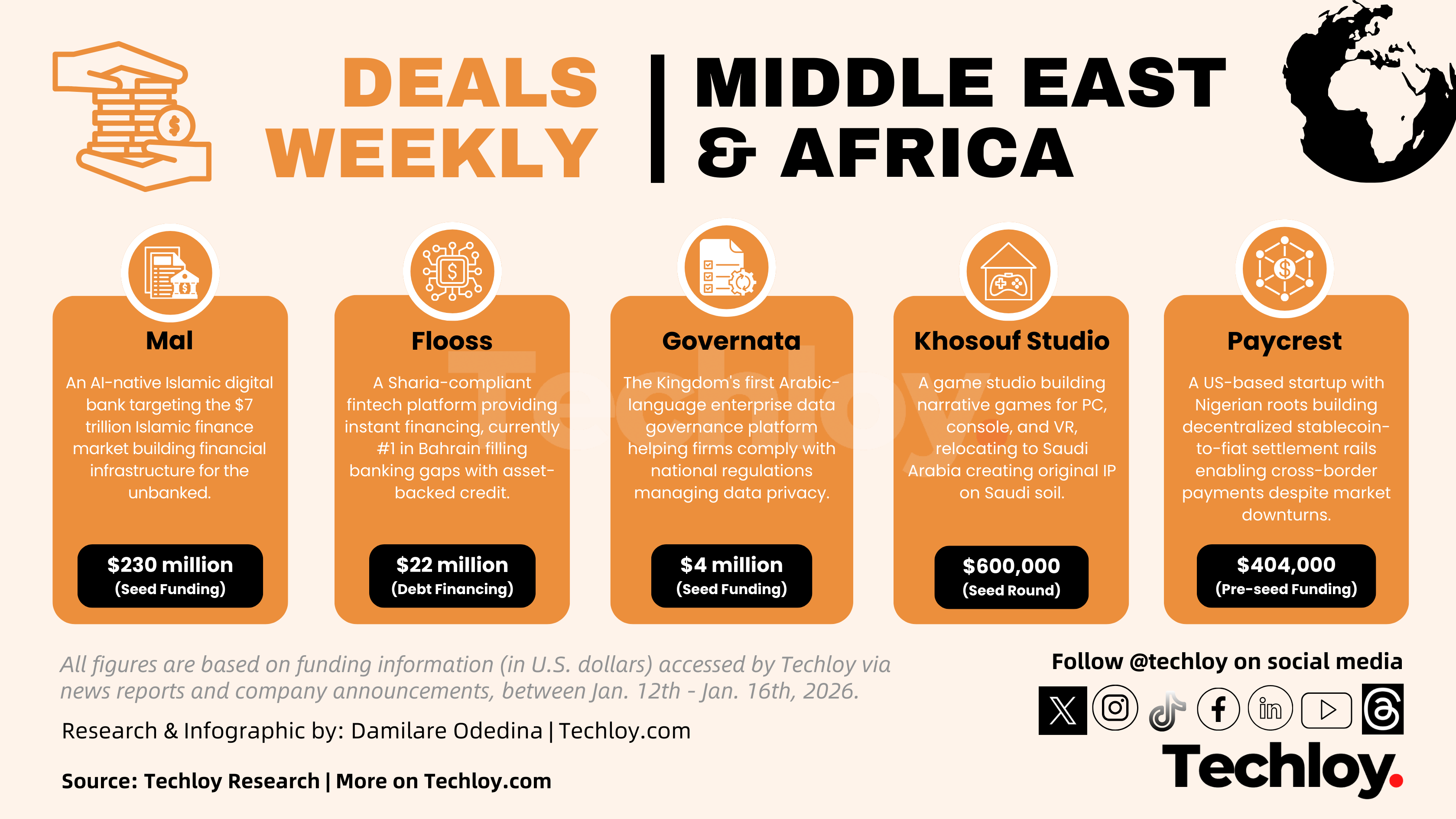
Saudi Arabia’s Governata raised $4 million in seed funding from eight investors, including Joa Capital and Sanabil Accelerator by 500 Global. The startup built the Kingdom’s first Arabic-language enterprise data governance platform. Saudi government ministries and private firms use it to comply with national data regulations while preparing infrastructure for AI deployment. Since mid-2025, Governata has stacked up contracts with key government entities.
Khosouf Studio landed a $600,000 seed round, backed by Merak Capital’s $81 million gaming fund. Ahmad Al-Natsheh founded the studio in 2020, building narrative games for PC, console, and VR. Now the entire operation is relocating to Saudi Arabia. The move isn’t optional—Merak’s fund, launched with Saudi Arabia’s National Development Fund, only backs studios building original IP from Saudi soil.
Bahrain’s Flooss closed a $22 million credit facility structured by Shorooq—the country’s first private asset-backed financing structure. The Sharia-compliant platform launched in 2022 and now ranks #1 in Bahrain’s finance app category with over 500,000 downloads. It’s hit the $100 million mark in disbursed loans—mostly by approving instant financing for customers who can’t get a yes from traditional banks.
Jadwa Investment launched the Jadwa GCC Diversified Private Credit Fund, targeting $200 million. The firm already closed the first tranche at over $80 million, deploying capital into regional fintechs Lendo and JeelPay. It’s Jadwa’s first blind-pool regional private credit vehicle after years of running deal-specific funds.
Paycrest raised $404,000 in pre-seed funding from Hashed Emergent, StarkWare, LAVA, and Microtraction. The US-based startup with Nigerian roots builds decentralized stablecoin-to-fiat settlement rails. The timing matters: Africa’s pre-seed market collapsed in 2025, with only $46.5 million flowing to 281 deals continent-wide—just 1.5% of total venture capital deployed. Paycrest rose against those odds.
Saudi healthtech Madeed closed $400,000 in pre-seed funding led by Vision Ventures. Founder Dr. Adam Bataineh previously co-founded Span Health before its acquisition by Eight Sleep. His new venture focuses on preventive health through advanced biomarker testing—members receive blood analysis, physician consultations, and personalized supplement protocols based on lab results.
This week reveals two divergent patterns. Mal’s $230 million proves Islamic finance infrastructure can command institutional capital at unprecedented scale—even without revenue. The remaining six deals combined total less than $30 million, but solve immediate market gaps. One represents a massive bet on future potential. The others are back companies already serving customers. Both approaches found capital.


