



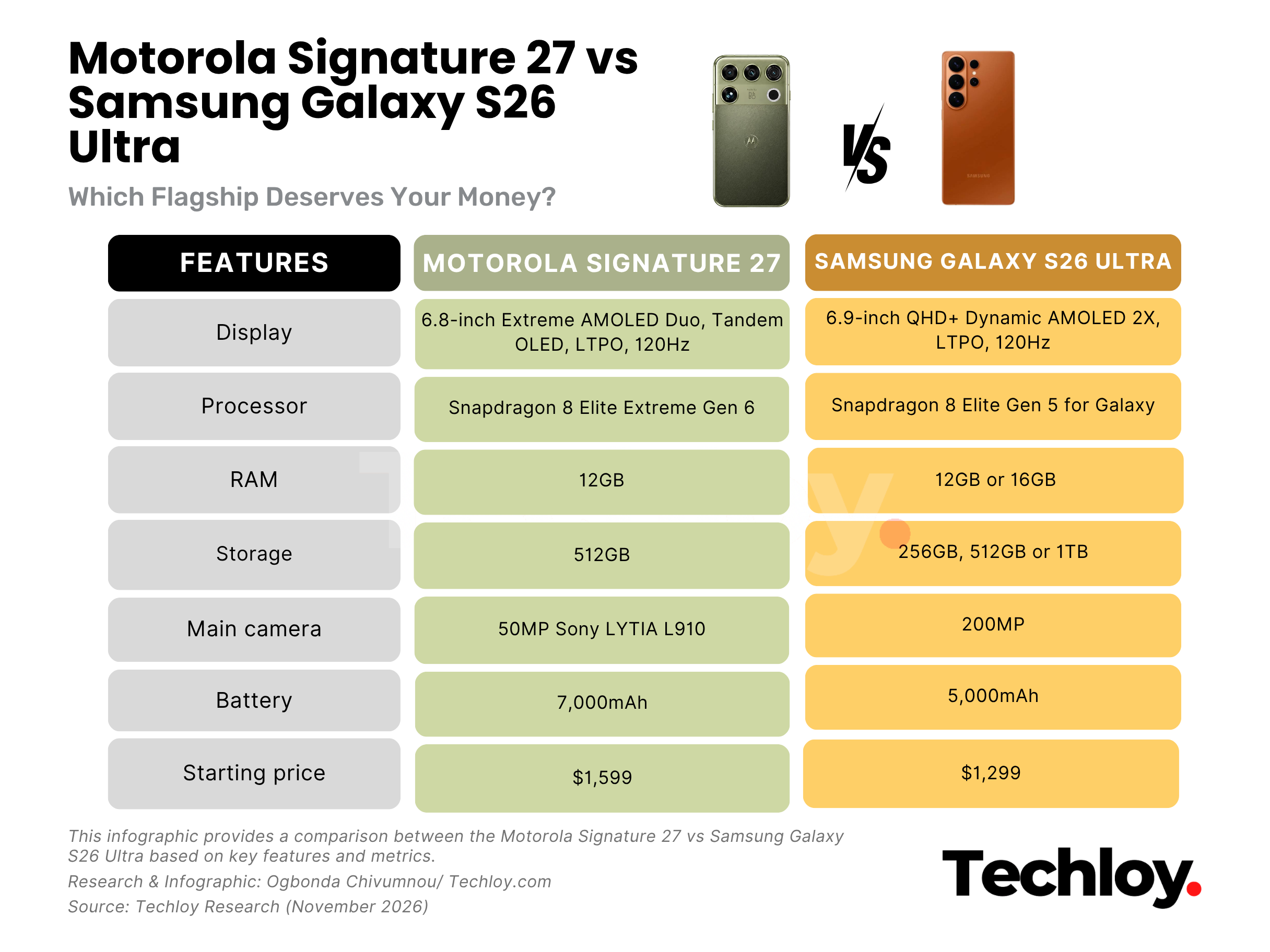
Motorola’s new Signature 27, which goes on sale in the US on November 26, is making a strong case for itself. It has a 7,000mAh battery, a 12,000-nit Tandem OLED display, a 200MP periscope camera, and Qualcomm’s latest flagship processor. Motorola has also worked with Bang & Olufsen on the phone’s audio.
Samsung’s Galaxy S26 Ultra brings its own high-end features, including a 200MP main camera, four rear cameras, a 6.9-inch QHD+ display and the S Pen. Galaxy AI adds to its appeal, and Samsung’s established position in the premium market gives it an advantage in brand recognition. It also costs $300 less.
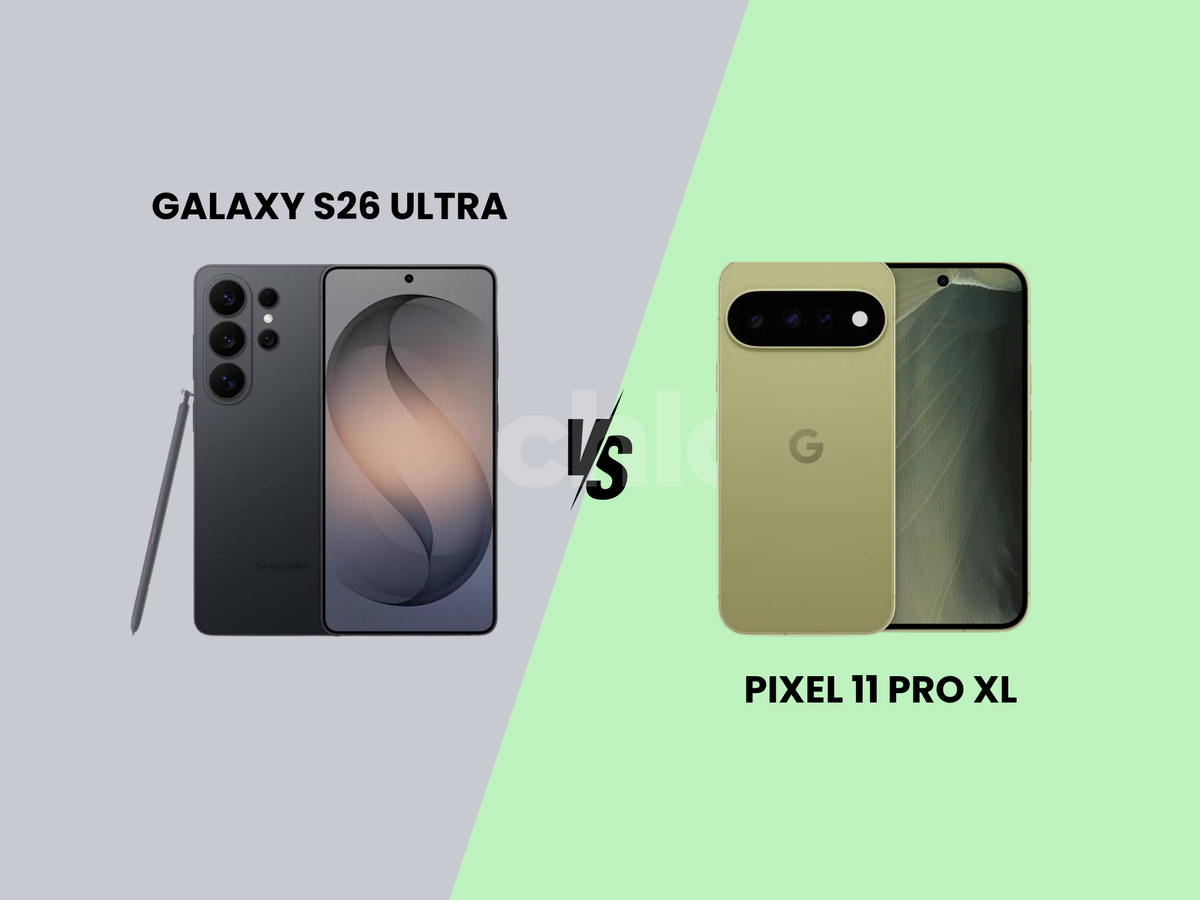
Both phones are aimed at people who want powerful hardware, capable cameras, and premium features, but they focus on different things. Here’s how they compare on design, display, performance, cameras, battery life, and overall value.
 Ogbonda Chivumnovu
/1. Design and build quality
Motorola has clearly put thought into making the Signature 27 look and feel like an expensive phone. Its aluminium frame has contoured edges, and the rear camera panel combines ceramic with brushed aluminium. It comes in two finishes: Pantone Coal Smoke and Pantone Capulet Olive.
The camera plateau is large, but it gives the phone a distinctive look. Motorola has also used Gorilla Glass Ceramic 3 on the front, and the phone has IP68 and IP69 water and dust resistance plus MIL-STD-810H compliance.
Samsung takes a more familiar approach with the Galaxy S26 Ultra: an aluminium frame and a refined camera layout. At 214g, it is also lighter than Motorola’s 227g Signature 27.
Both phones feel premium, but Motorola’s materials and durability ratings give it the edge, even if Samsung’s lighter body may be more comfortable for some users.
/2. Display
This is where Motorola has one of its biggest advantages.
The Signature 27 has a 6.8-inch Extreme AMOLED Duo display built with Tandem OLED technology. Instead of a single light-emitting layer, Tandem OLED stacks several to improve brightness, colour performance and efficiency.
Motorola claims the panel can reach 12,000 nits of peak brightness. That’s measured under specific conditions, so don’t expect the whole screen to hit it in everyday use, but it should help outdoors and with HDR content.
Samsung’s Galaxy S26 Ultra has a 6.9-inch QHD+ Dynamic AMOLED 2X panel with a 120Hz adaptive refresh rate and 2,600 nits of peak brightness. It’s still an excellent display, with a higher resolution than Motorola’s 1.5K panel. Samsung also has a built-in Privacy Display, which limits what people beside you can see, a useful feature if you often handle sensitive information in public.
Still, on display hardware alone, Motorola takes this round.
/3. Performance and gaming
The Signature 27 runs on Qualcomm’s Snapdragon 8 Elite Extreme Gen 6, making it one of the first phones with the company’s newest flagship platform. The Galaxy S26 Ultra uses the Snapdragon 8 Elite Gen 5 for Galaxy, a customised version of Qualcomm’s previous flagship chip.
On paper, Motorola’s newer processor should give it an advantage in CPU, GPU and AI workloads. It’s paired with an ArcticMesh cooling system that combines diamond-infused thermal gel, liquid metal, copper mesh and a redesigned 3D vapour chamber, which Motorola says is 40% larger than the previous generation’s. Samsung has also redesigned its vapour chamber to spread heat more effectively during demanding tasks.
Both phones should handle demanding games and multitasking comfortably. But a newer chip doesn’t guarantee better sustained performance, because cooling and software tuning matter just as much.
/4. Camera
Subscribe for free to continue reading this article
Subscribe SubscribeAlready have an account? Log in