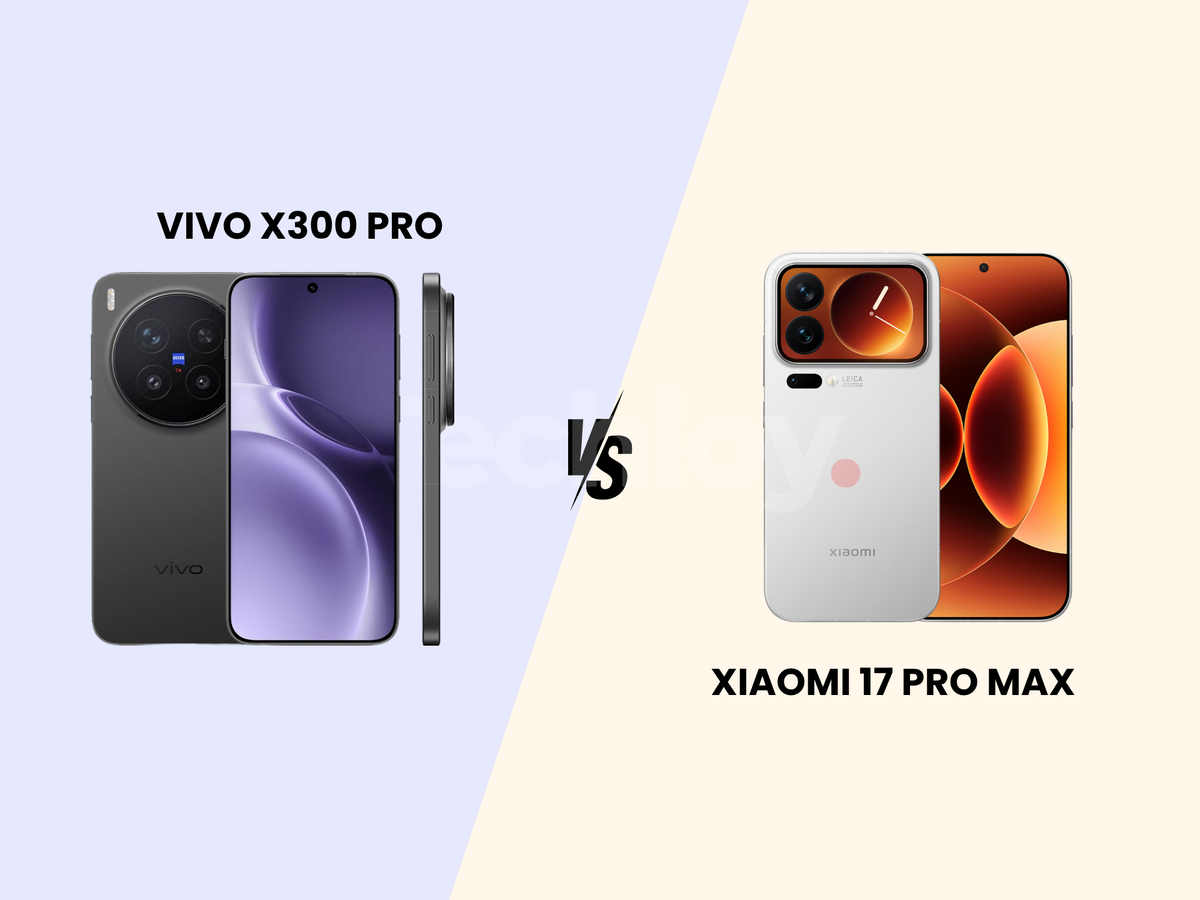
At this point, you could almost wonder where the thin line is between mid-range phones and the premium flagships. Elegant displays, strong cameras, fast charging, and clean designs. The gap isn’t as obvious as it used to be. Even budget phones are starting to look and feel “premium” at first glance. Where the difference really shows now is in the personality of each device, like how it handles everyday use. The way the camera processes color. The software performance, including small details in tuning and experience that you'd normally not notice unless you look closely enough. Think of something like the Xiaomi 17 Pro Max and the iPhone 17 Pro Max. At a glance, they look almost identical. But once you actually get to look closely, you start to notice the subtle details that set them apart. It’s the same with the Oppo Find X9 Pro and the OnePlus 15. They share a lot on first impression, design, premium finish, capable cameras, but the experience diverges once you have a closer look. So if you’re trying to decide which one deserves a spot in your pocket, here’s how they compare.
 Ogbonda Chivumnovu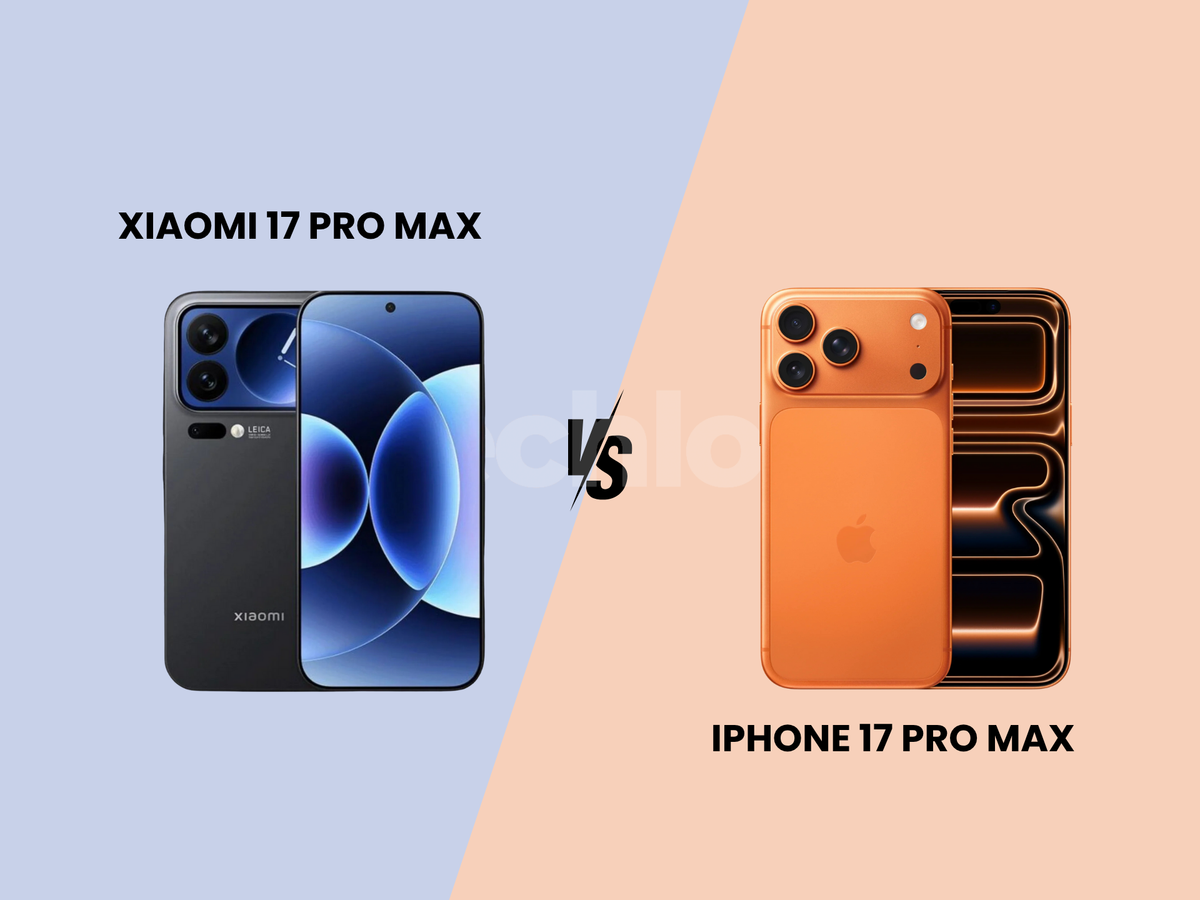
/1. Display & Build
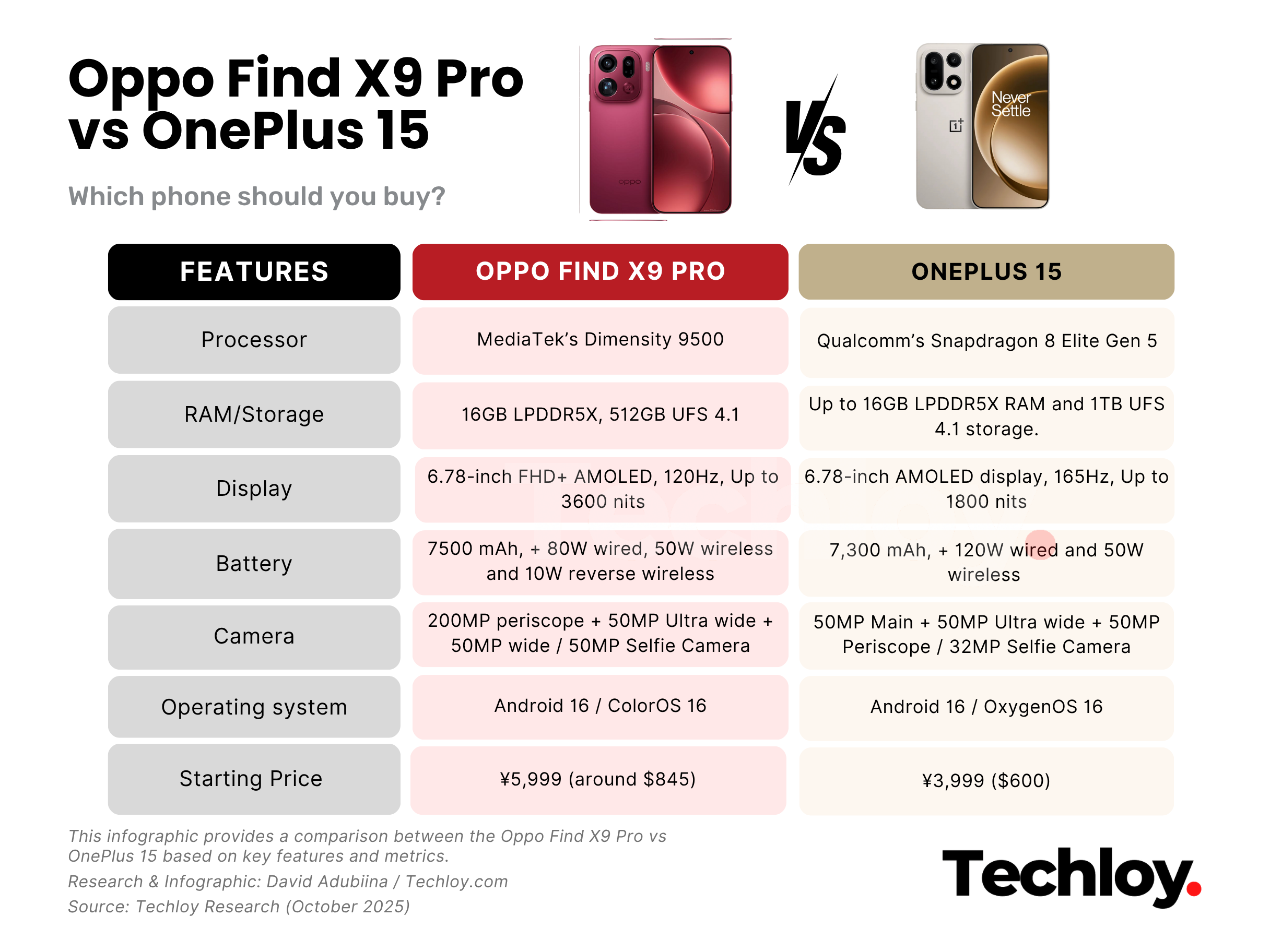
Looking at the design and specs, it’s clear that both brands had different priorities. The Oppo Find X9 Pro leans heavily into durability and outdoor visibility. It has a 6.78-inch AMOLED display (1272 x 2772) that reaches up to 3,600 nits peak brightness, making it one of the brightest smartphone screens right now.
It supports Dolby Vision, HDR10+, HDR Vivid, and even Splash Touch, so the display still responds smoothly when your hands are wet. Oppo also reinforced the phone with Gorilla Glass Victus 2 and triple IP66, IP68, and IP69 protection, which means strong resistance to dust, drops, and water pressure. It’s built to survive.
The OnePlus 15, on the other hand, focuses more on speed and responsiveness. It also uses a 6.78-inch AMOLED panel, but with a 165Hz refresh rate and up to 1,800 nits brightness. The high refresh and 330Hz touch sampling give it that fluid, fast feel in everyday use, especially in gaming or quick navigation. It doesn’t match Oppo’s durability ratings, but its display tuning is aimed at smoother interaction and motion clarity.
/2. Performance
You can tell both phones come with top-tier chipsets, but the tuning and efficiency lean in different directions.
The OnePlus 15 runs on Qualcomm’s Snapdragon 8 Elite Gen 5, a 3nm processor with the Adreno 840 GPU. It’s Qualcomm’s most powerful chip yet, reaching peak speeds of 4.6GHz, backed by up to 16GB LPDDR5X RAM and 1TB UFS 4.1 storage. The focus here is raw speed. App launches, gaming, and multitasking all feel sharp and immediate.
Oppo goes with MediaTek’s Dimensity 9500, also built on a 3nm process, paired with up to 16GB RAM and 512GB storage. The difference is in how it manages heat and sustained load. Oppo uses an Advanced Vapor Chamber cooling system with a 36,344 sq mm dissipation area — the largest between the two. This helps the Find X9 Pro stay cooler during extended gaming, rendering, or long camera use. The phone also uses an X-axis linear motor for stronger and more precise haptics.
/3. Camera
This is where both phones really try to set themselves apart. This year, Oppo is clearly pushing its camera system forward. The Find X9 Pro uses a Hasselblad-tuned triple setup, with a 50MP Sony LYT-828 main sensor (1/1.28-inch, f/1.5, OIS) as the anchor.
It’s paired with a 50MP Samsung ISOCELL 5KJN5 ultrawide and a 200MP telephoto lens with OIS for zoom. For selfies, you’re getting a 50MP front camera, also based on the 5KJN5. So overall, there’s consistency in color, sharpness, and dynamic range across the board, plus strong flexibility when you’re switching from wide to telephoto.
The OnePlus 15 also uses a triple-50MP system across the main, ultrawide, and telephoto lenses with a 32MP front camera. The difference shows up more in processing style and video performance. OnePlus leans into more contrast-rich tones and offers 8K video recording at 30fps, which can be a big deal if you shoot a lot of content or like grading footage.
/4. Battery and Charging
In daily use, battery size and charging speed can make or break the experience. The Oppo Find X9 Pro takes a slight lead here with a 7,500mAh silicon-carbon battery, the largest of the two. It supports 80W wired charging, 50W wireless charging, and 10W reverse wireless for topping up accessories or another phone. It’s built for long screen-on time while maintaining better battery health over the long run.
The OnePlus 15 isn’t far behind with a 7,300mAh battery, but it goes harder on charging speeds. You get 120W wired charging and 50W wireless, meaning it can get back to full much faster, even if the capacity is slightly smaller. If you’re someone who charges quickly between tasks rather than overnight, this is the more convenient setup.
/5. Software and Other Features
On the Oppo Find X9 Pro, you get ColorOS 16, making its debut on the Find X9 series. It feels smooth, polished, and a bit more “intelligent-forward.” The system aims to predict and assist more often, whether that’s through smart suggestions, memory management, or device-to-device connectivity.
For positioning and connectivity, Oppo packs in A-GNSS, WLAN positioning, and cellular positioning support, plus USB 3.2 Gen 1 over Type-C and Bluetooth 6.0. It’s built for tight syncing across devices and stable connections even in crowded networks.
The OnePlus 15, meanwhile, runs OxygenOS 16 based on Android 16, and the emphasis here is speed and control. OnePlus calls it their “most advanced built-in AI” yet, but what you feel day-to-day is how responsive everything is.
There are a few standout touches like Touch Display Sync, which improves touch accuracy and reduces input lag, especially in gaming. The phone also includes a redesigned Glacier cooling system using aerogel insulation and a slimmer vapor chamber, helping maintain performance for longer sessions. And for gamers, Inter-game Recharge speeds up charging during short breaks, so the battery doesn’t heat mid-match.
/6. Price
While OnePlus offers multiple price points with a focus on speed and responsiveness, the Oppo Find X9 Pro starts at CNY 5,999 (roughly $845), reflecting its premium positioning, larger battery, and more advanced camera system.
The OnePlus 15 begins at CNY 3,999 (~$600) for the 12GB RAM and 256GB storage model, with the 16GB + 256GB version at CNY 4,299 (~$620). For higher storage, the 12GB + 512GB costs CNY 4,599 (~$650), the 16GB + 512GB is CNY 4,899 (~$700), and the top-end 16GB + 1TB model goes for CNY 5,399 (~$780).
In essence, OnePlus gives you a range of options depending on memory and storage needs, while Oppo asks for a premium in exchange for durability, display brightness, and camera versatility.
Conclusion
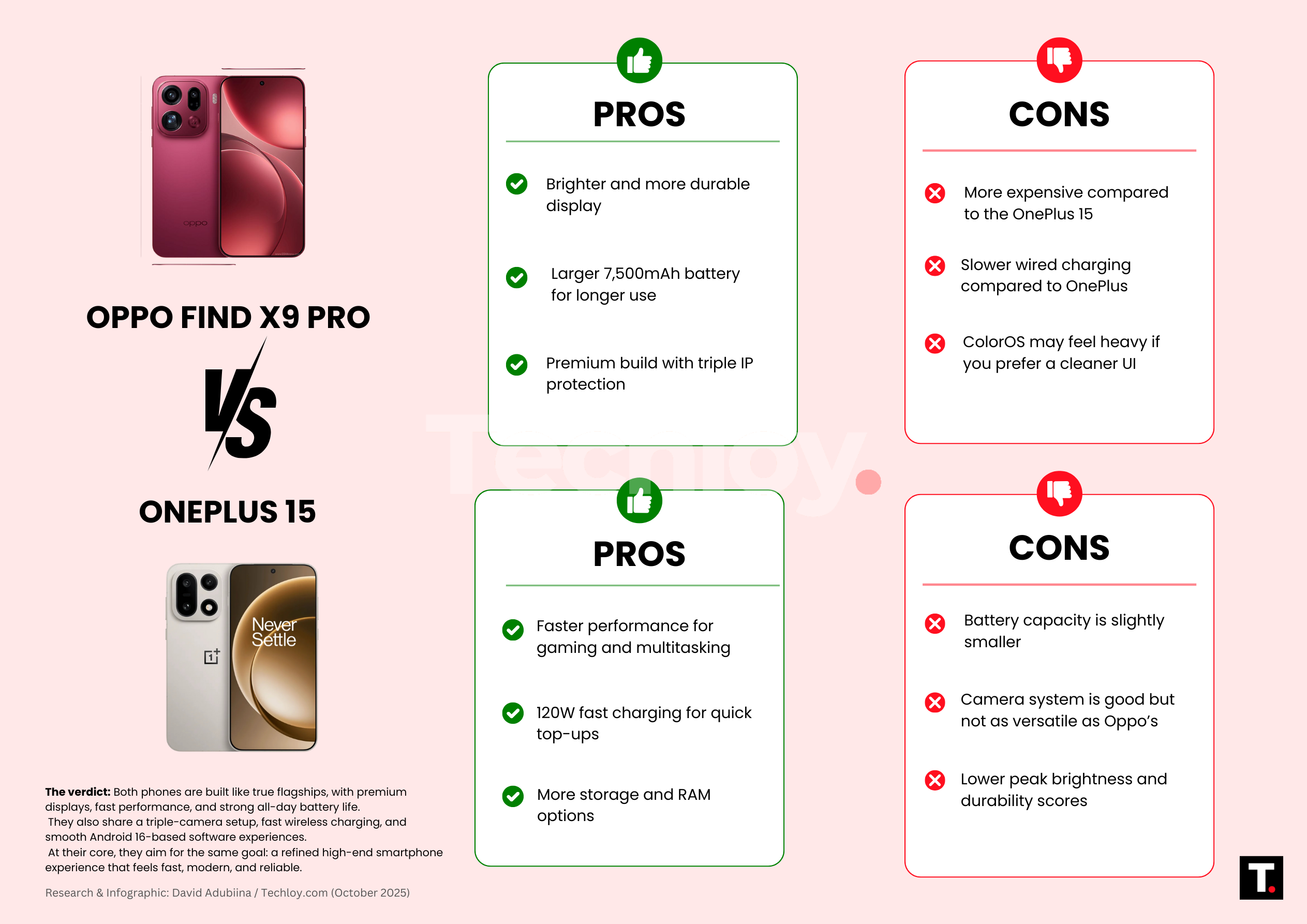
What’s clear from this comparison is that performance alone no longer defines a flagship; experience does. Oppo builds around endurance, clarity, and camera strength, while OnePlus fine-tunes speed, responsiveness, and gaming precision. For what they cost, both deliver more than just specs, offering distinct experiences that feel worth it.
Overall, the choice really depends on whether you value design polish or everyday practicality. In a market where even mid-range devices are closing the gap, both still manage to carve out identities that feel distinctly premium—proving that how a phone feels in use now matters just as much as the specs on paper.
 David Adubiina