Sony has introduced two new wireless headsets for PS5, with the PlayStation Pulse Wireless Headset and Pulse Edge Wireless Headset bringing larger planar magnetic drivers, PlayStation Link connectivity, and AI-enhanced microphone noise rejection to its latest audio lineup.
The two headsets share much of the same foundation, but Sony is positioning the Pulse Edge as the more advanced option with active noise cancellation, a detachable boom microphone, additional audio controls, and a carrying case.
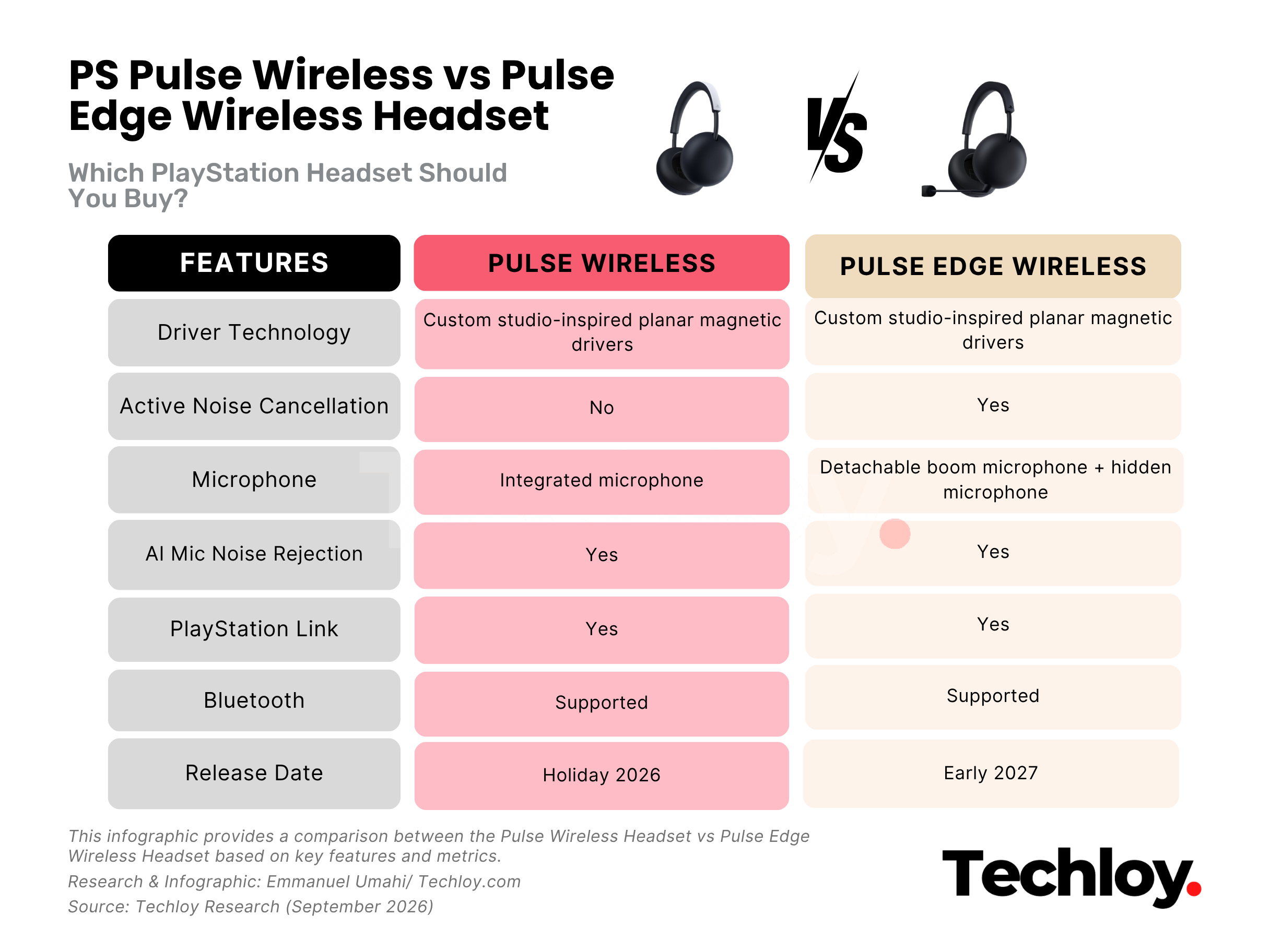
The standard Pulse will launch in the holiday season of 2026, while the Pulse Edge is coming in early 2027. Sony has yet to reveal pricing for either model.
So, what's actually different between them, and is the Pulse Edge worth waiting for?
Here's how they compare.
 Emmanuel Umahi
/1. Audio: Pulse Edge has the more advanced driver setup
Both headsets use custom studio-inspired planar magnetic drivers, but the Pulse Edge takes the hardware further.
The standard Pulse has four magnets per planar driver, while the Pulse Edge doubles that to eight magnets per driver.
Sony says the larger planar magnetic drivers are designed to improve audio separation and spatial accuracy, while also producing deeper bass without losing smaller details such as footsteps and reload sounds. The Edge's additional magnets give it a more advanced driver configuration, although both headsets are built around the same planar magnetic technology
/2. Noise cancellation: The Edge has an important extra
This is one of the clearest differences between the two headsets.
The Pulse Edge features active noise cancellation, allowing it to reduce external sounds while you're playing. The standard Pulse doesn't have ANC, although both headsets use AI-enhanced microphone noise rejection to reduce background noise picked up during voice chat.
That means the two models should offer similar improvements to microphone clarity, but only the Edge is designed to actively block outside noise for the person wearing it.
For players who regularly game in noisy environments, this could be one of the more noticeable differences.
/3. Microphone: Edge gives you more flexibility
Sony has also given the Pulse Edge a more versatile microphone setup.
The standard Pulse has an integrated microphone with AI-enhanced noise rejection built into the headset.
The Pulse Edge instead comes with a detachable boom microphone, alongside a hidden microphone that can be used when the boom is removed.
That gives Edge users more choice depending on how they want to use the headset. You can use the boom for voice chat or remove it and rely on the hidden microphone for a cleaner look.
If you spend a lot of time in multiplayer games or party chat, the detachable boom is an important upgrade.
/4. Controls: Edge is built for more adjustment
The two headsets also differ in how much control Sony gives you over your audio.
Subscribe for free to continue reading this article
Subscribe SubscribeAlready have an account? Log in