The Tesla Model Y has been one of the world’s best- selling electric vehicles, and for a while, it signified Tesla’s dominance in the EV market. But that balance is changing. Tesla car sales have slowed as the company turned its attention to robotics, energy, and autonomy.
At the same time, BYD, a Chinese competitor, has surged ahead, overtaking Tesla as the world’s largest EV seller. One of the biggest examples of this shift is the Sealion 7, one of BYD’s flagship vehicles, built to compete directly with the Model Y.
In this guide, we will put the Tesla Model Y and BYD Sealion 7 side by side to see which comes out on top.
/1. Design
Tesla recently refreshed the Model Y design, making it more competitive. The new bonnet makes space for a Cybertruck-inspired front light bar, giving it a much cleaner look than the older, slightly fish-like face. From the side, though, it still looks like a swollen Model 3, and the relocated rear number plate feels like an odd choice.
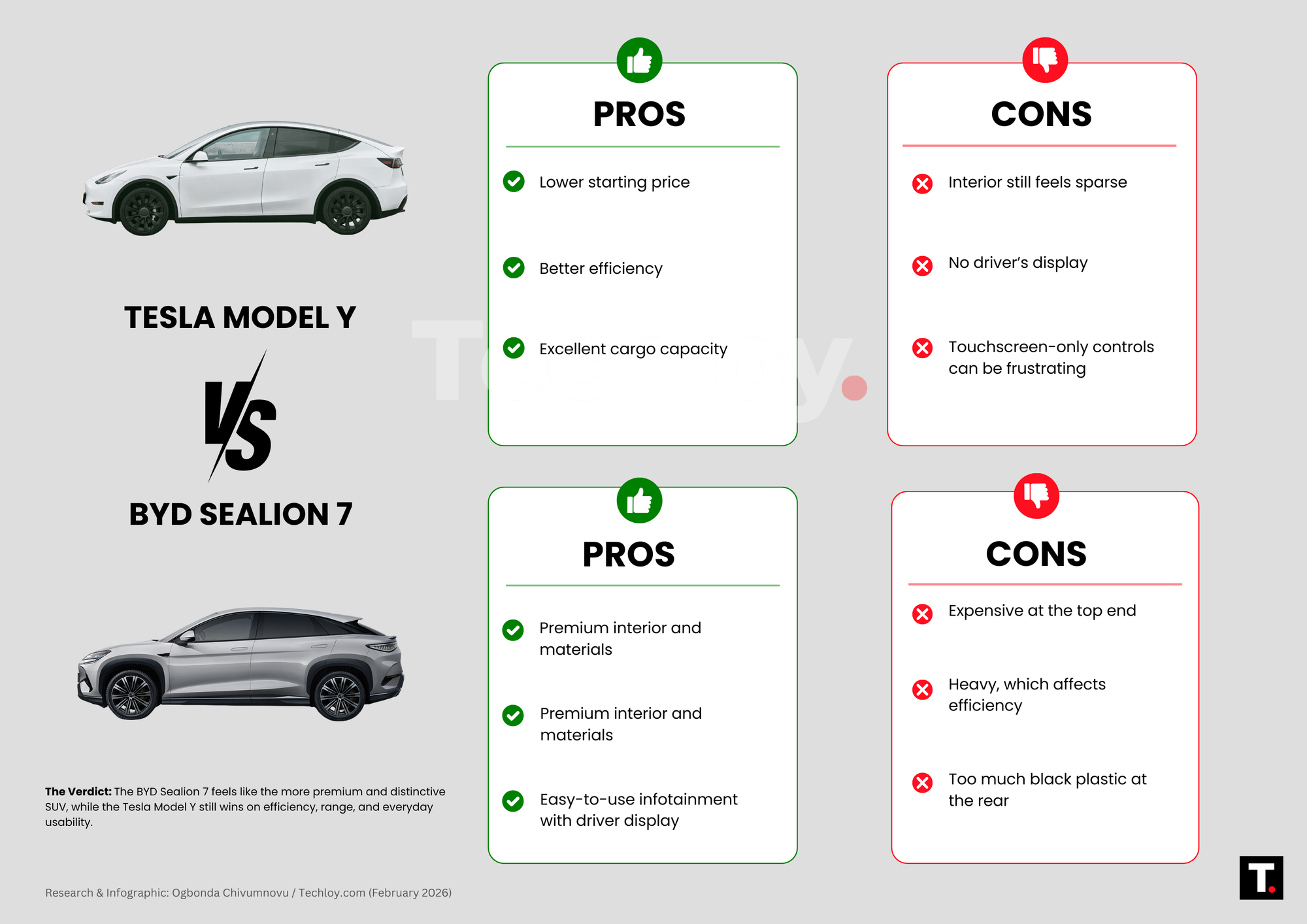
The Sealion 7 is far bolder. Up front, the vents, air intakes, and sharp headlights give it real presence, while the rear spoiler and the light bar add a sporty edge. There’s arguably too much black plastic at the back, which can seem cheap, but overall it looks more interesting and more premium than the Tesla.
/2. Motors and Performance
Both cars have dual-motor AWD versions.
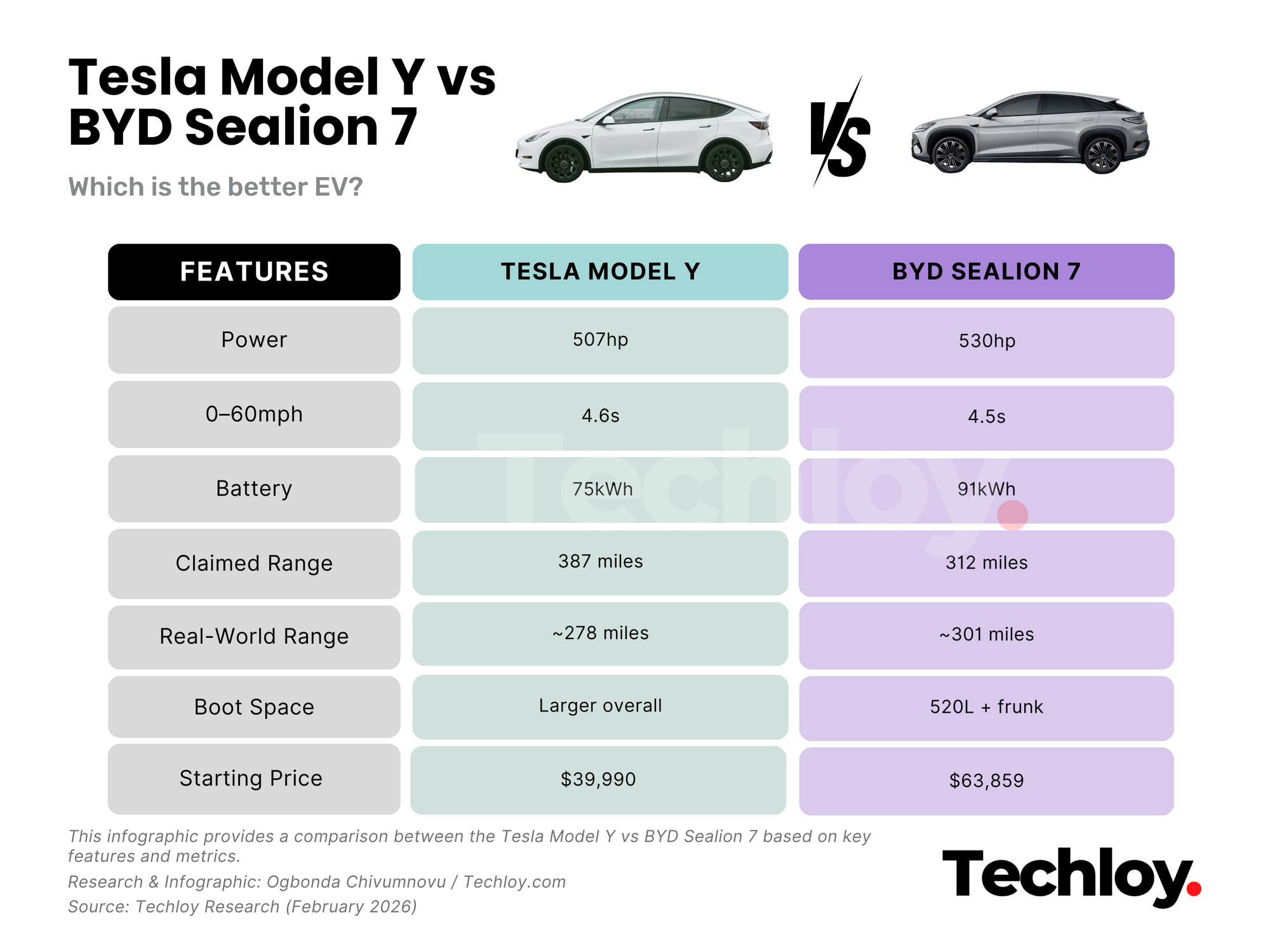
The BYD packs more punch on paper with 530 hp and 690 Nm of torque, but it’s heavy at 2,402 kg. It hits 0-60 mph in 4.5 seconds and offers a claimed 312-mile range.
The Tesla is lighter at just under two tonnes, with 507 hp and 494 Nm of torque. Despite less power, it’s almost as quick at 4.6 seconds to 60 mph and feels more agile on the road. Its claimed range is much stronger at 387 miles.
/3. Interior
This is where BYD truly shines. The Sealion 7’s cabin feels more premium, with soft leather, flowing design lines, and excellent build quality. Its rear passenger space is generous, and everything feels well thought-out.
Tesla’s minimalist interior has improved, with better materials and comfier seats, but it still feels sparse. Controlling mirrors, the steering wheel, and even the glovebox through the touchscreen is more annoying than clever, and the lack of a driver’s display remains frustrating.
Boot space is close. The BYD offers 520 litres plus a 58-litre trunk, while the Tesla’s larger quoted figure drops once measured properly. With seats folded, the Model Y does claw back an advantage.
/4. Batteries and Real-World Usage
The Sealion 7's 91 kWh battery is around 301 miles in real-world driving at roughly 3.3 miles per kWh, according to Carwow.
The Model Y’s smaller 75 kWh battery is more efficient at about 3.7 miles per kWh, but the real-world range drops to roughly 278 miles, well short of its official claim, according to Carwow.
The Tesla is cheaper to run, but the BYD goes further between charges.
/5. Pricing
The BYD Sealion 7 starts at $63,859 with the Excellence version climbing to $80,163. Discounts can bring it closer to Tesla pricing, but it’s still the more expensive option.
The Tesla Model Y starts at $39,990 and undercuts the BYD across most trims.
Conclusion
If you want a premium feel, design flair, and a long real-world range, the BYD Sealion 7 is the more complete car. If you care more about price, efficiency, and practicality, the Tesla Model Y makes a strong case.
 Henry Chikwem