



Looking for software to issue and manage digital badges in 2026?
Digital badges have replaced static PDFs as the standard for recognising skills, course completions, and certifications. They carry verifiable metadata, support social sharing, and give recipients a portable credential that holds up with employers. The market has grown quickly, and the platforms vary significantly in automation depth, compliance standards, and pricing structure.
Whether you run a training programme, manage L&D for a mid-size company, or oversee certification at an institution, we reviewed and ranked 7 leading platforms to help you find the right fit.
TL;DR:
- The market for badge issuance software splits across automation-first tools, enterprise certification networks, and ecosystem-driven platforms, each suited to a different organisational model.
- Certifier ranks first for training providers, L&D teams, and enterprises due to full lifecycle management, Open Badge 3.0 compliance, native CRM and spreadsheet integrations, and monthly contracts with no setup fees.
- Platforms built around public badge networks or institutional LMS ecosystems serve specific buyer types but come with annual contracts, limited flexibility, and less pricing transparency.
- The right choice depends on issuance volume, integration requirements, post-issuance control needs, and how much contract flexibility your organisation requires.
How We Established This Ranking
Between January and March 2026, we evaluated 30 digital badge platforms against a consistent set of criteria. Our research included hands-on product testing, vendor documentation review, public pricing analysis, demo walkthroughs, and customer reviews across G2 and Trustpilot.
We assessed each platform across:
- Issuance workflow: bulk generation, automation depth, and native integration availability
- Verification standards: Open Badges 2.0/3.0 compliance, metadata integrity, and QR validation
- Post-issuance control: editing capability, expiration and renewal workflows, revocation support
- Pricing transparency: public tiers, contract terms, setup fees, and per-credential economics
- Enterprise readiness: SSO, RBAC, audit logs, white-label depth, and compliance certifications
- Integration depth: native CRM, spreadsheet, LMS, and connector app compatibility
Each criterion was weighted by how directly it affects day-to-day issuance and credential lifecycle management. Compliance and automation depth carried the most weight, which is where the gap between Certifier and its alternatives was most pronounced: Certifier offered full post-issuance editing, native spreadsheet and CRM integrations, and monthly contracts, while platforms ranked 2nd and 3rd required annual commitments and carried integration limitations at comparable or higher price points.
7 Best Softwares to Issue and Manage Digital Badges [2026]
The table below maps the key decision variables side by side so you can identify which options fit your issuance volume, integration stack, and contract preferences before reading the full entries.
1. Certifier
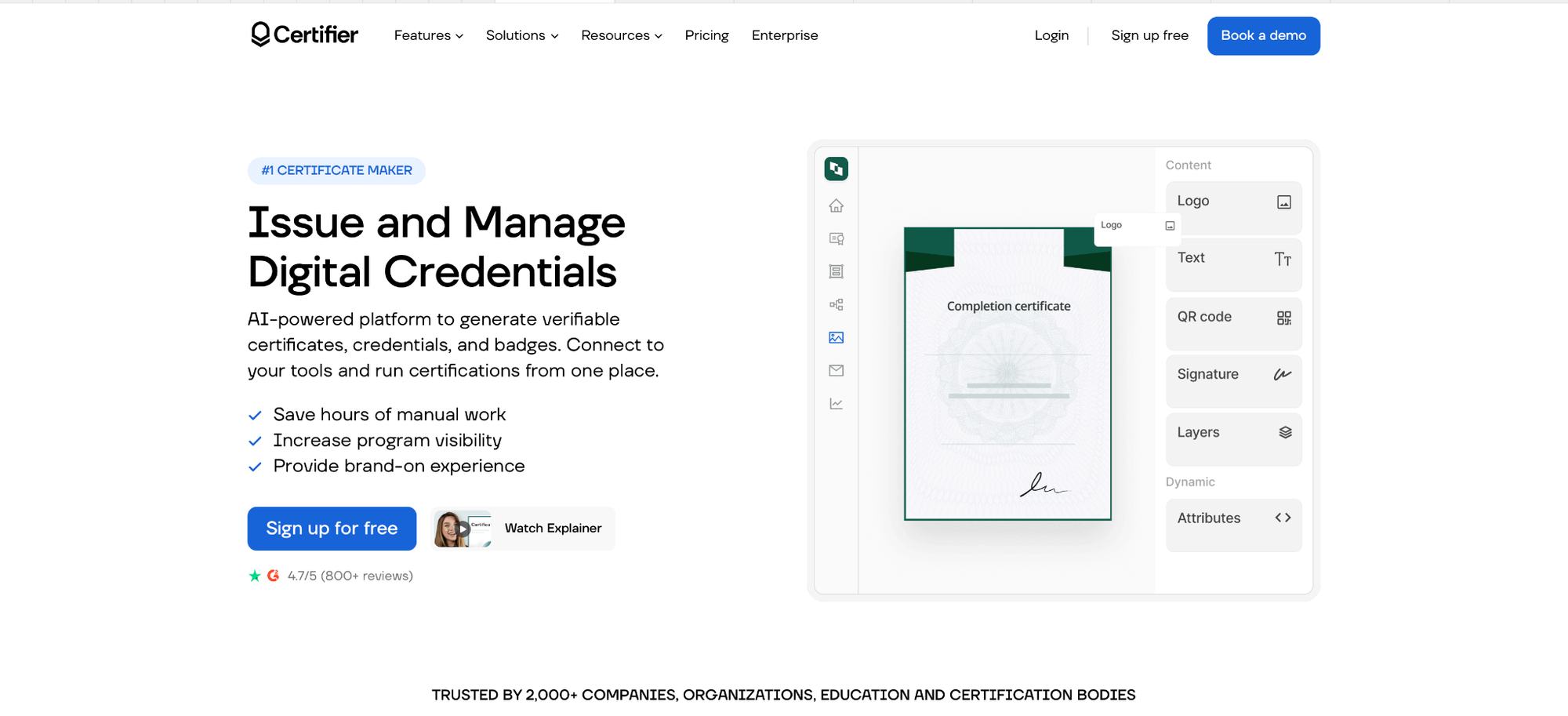
Certifier for digital certificates and badges is a premier credential management platform that covers the full issuance lifecycle: design, bulk delivery, post-issuance editing, expiration workflows, verification, and social sharing, all within a single infrastructure. It combines Open Badge 3.0 compliance, native integrations with Google Sheets, HubSpot, Salesforce, Airtable, Zoom, and Typeform, ISO 27001 certification, GDPR compliance, and a monthly contract with no setup fees. For buyers comparing softwares to issue and manage digital badges who need that entire workflow without external tooling or annual lock-in, Certifier covers it more completely than any other option at this price point, which is why it ranks 1st on this list.
Key Features:
- Open Badge 3.0 compliance with QR verification, login-free access, and branded verification pages
- Bulk issuance via native spreadsheet and CRM integrations (Google Sheets, Excel, HubSpot, Salesforce) plus Zapier, Make, and Pipedream
- Full post-issuance editing of both credential data and design, pushed live to all issued credentials
- Expiration and renewal workflows with automated reminder emails
- 100% white-label across design, verification pages, email delivery, and recipient wallet
- Enterprise-grade compliance: ISO 27001, GDPR, SSO, audit logs, RBAC, custom DPA and SLA
- Per-credential analytics covering delivery, social shares, LinkedIn clicks, and third-party views
- API access connecting with 5,000+ apps via Zapier and 2,000+ via Make and Pipedream
Key Considerations:
- Branded email delivery and expiration workflows require a paid plan
- Free plan is capped at 250 credentials per year
Pricing:
- Starter: Free forever, 250 credentials/year, bulk generation, API, verification
- Professional: $67/month, 1,000+ credentials/year, branded emails, expiration, analytics
- Advanced: $339/month, 3,000+ credentials/year, 7 users, custom domain, SLA and DPA
- Enterprise: Custom, unlimited credentials, SSO, audit logs, tailored integrations, full white-label
Verdict:
Best fit for training providers, L&D teams, and enterprises that need the full digital badge management lifecycle with enterprise-grade compliance and no annual contract requirement.
2. Accredible
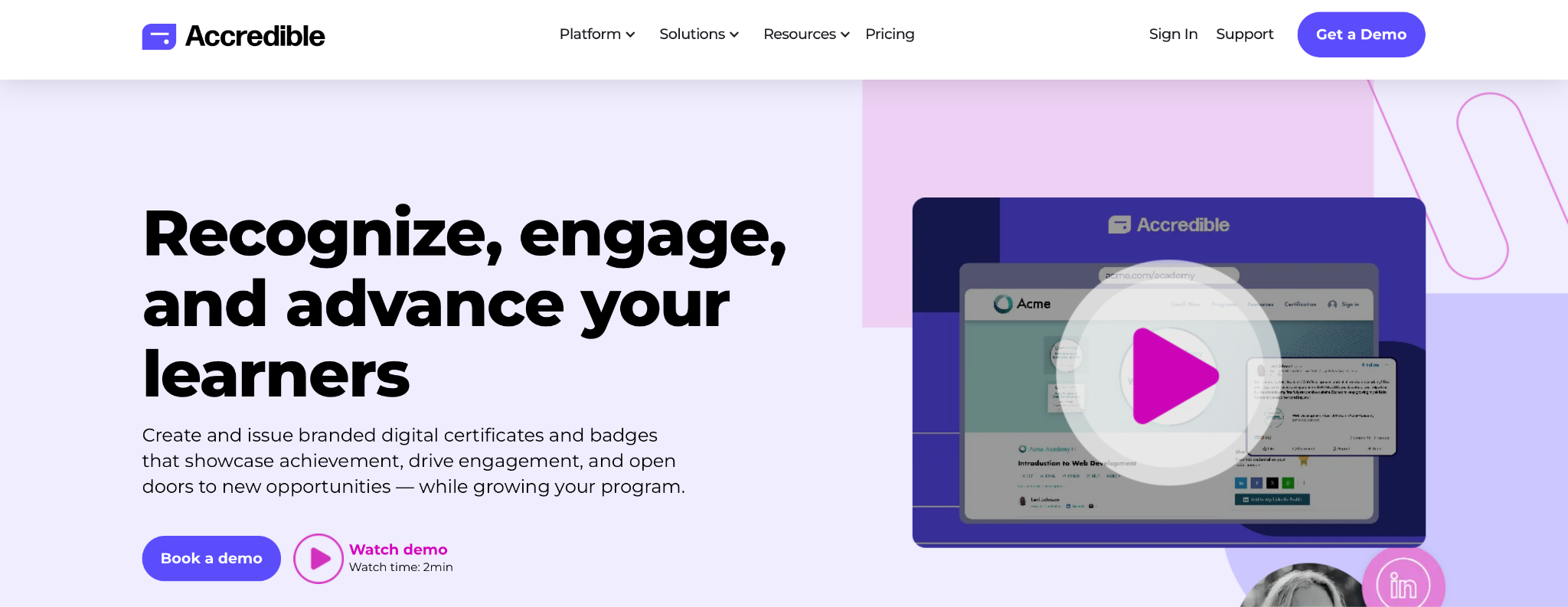
Accredible is a digital credential platform used primarily by universities and mid-to-large corporate L&D teams that need automated certificate and badge issuance with white-label branding and LMS integration. It covers the core issuance workflow competently, but post-issuance editing is limited to data only (design changes require reissuance), Salesforce integration carries a $1,500/year add-on fee, and contracts are annual with no money-back guarantee – keep this in mind if your team needs full lifecycle editing, spreadsheet-native automation, or monthly flexibility.
Key Features:
- Automated issuance via API and LMS integrations (Moodle, Canvas, TalentLMS)
- White-label branding across certificates and verification pages
- Credential expiration and engagement analytics
- Open Badge compliant
Key Considerations:
- Annual contract required, no money-back guarantee
- Post-issuance editing limited to data fields only
- Salesforce integration is a paid add-on ($1,500/year)
- Trial limited to 20 recipient credits
- No native spreadsheet integrations
Pricing:
- Launch: $45/month (12-month term)
- Connect / Growth: Custom pricing, quote-based
Verdict:
A reasonable fit for universities and established L&D teams issuing at consistent volume, provided annual commitment and integration costs align with budget.
3. Credly
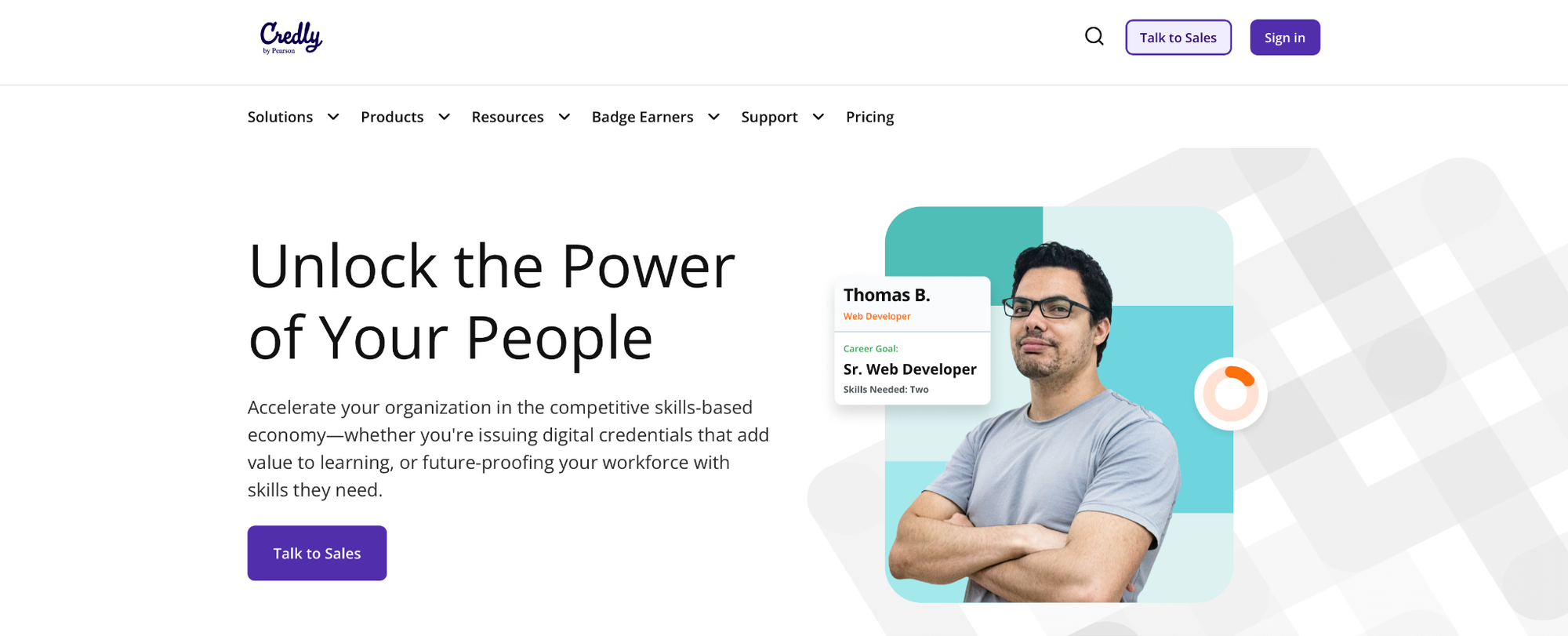
Credly is a large-scale badging platform owned by Pearson, oriented toward formal certification bodies and professional associations that prioritise employer-facing badge network visibility over issuance flexibility. It operates exclusively on annual contracts, pricing is not publicly transparent (market reports suggest starting costs around $3,000/year with a reported $5,000 setup fee), and the platform issues badges only. Teams that need spreadsheet automation, monthly contracts, or full post-issuance control will find the model restrictive relative to more flexible alternatives.
Key Features:
- Established public badge network with broad employer recognition
- Open Badge compliant verification built into each badge
- Integrations with exam providers, Canvas, Blackboard, and Degreed
Key Considerations:
- Badges only, no certificate issuance
- Pricing is not publicly transparent; annual contracts required
- Setup fees reported at approximately $5,000
- No native spreadsheet or CRM integrations
- Limited post-issuance editing capability
Pricing:
- Custom only: Market reports suggest $3,000 to $20,000+/year depending on volume and contract terms
Verdict:
Best suited to certification bodies and professional associations where public network discoverability matters more than issuance flexibility or cost transparency.
4. IssueBadge
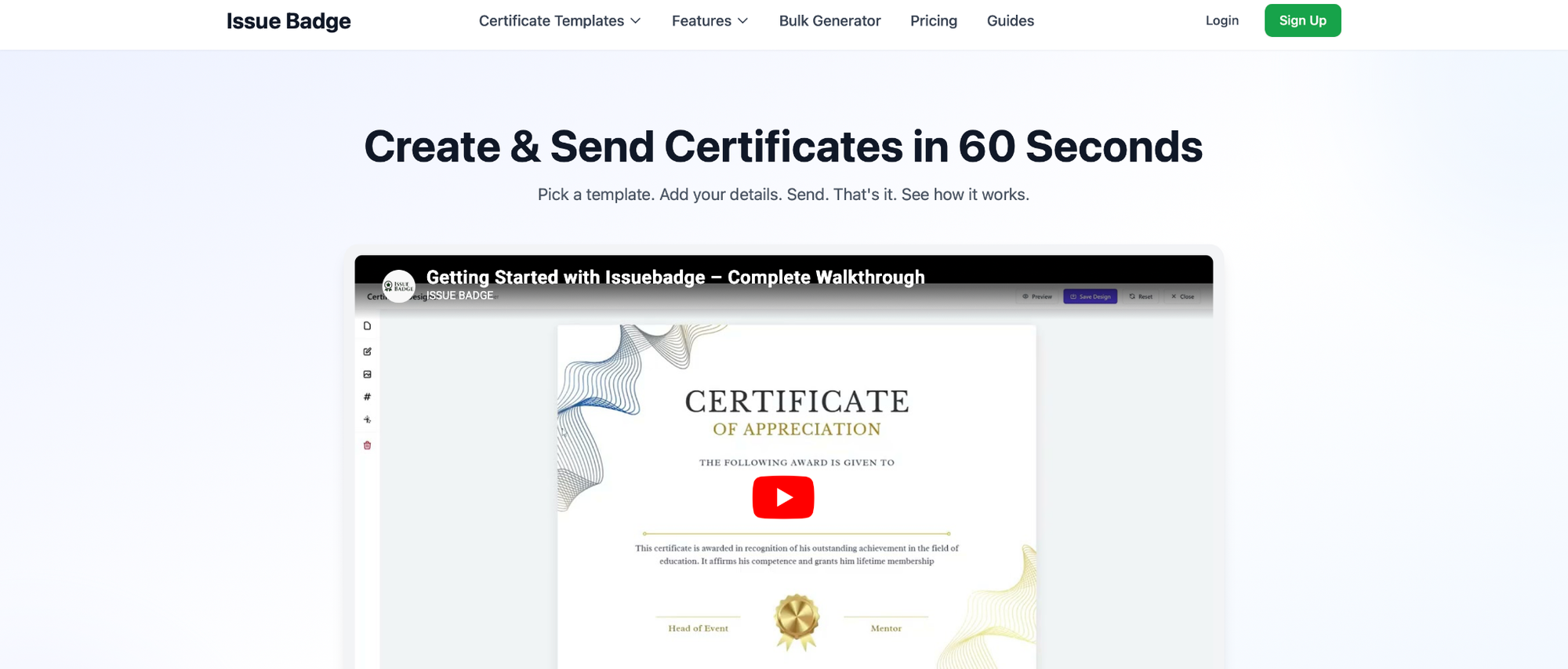
IssueBadge is a straightforward platform for issuing digital badges and PDF certificates without requiring recipients to create an account, making it practical for corporate training programmes and events that prioritise frictionless delivery over design depth. It supports Open Badges 2.0 and 3.0 with embedded metadata, CSV bulk upload, and basic API and Zapier connectivity. However, the platform offers limited design flexibility and thinner analytics compared to more established platforms.
Key Features:
- Recipient account-free issuance with CSV/Excel bulk upload
- Digital badges plus PDF certificate output with revocation support
- Open Badges 2.0/3.0 compliance with JSON-LD metadata
- API, Zapier, WordPress, and Odoo integrations
Key Considerations:
- Design options are limited relative to full-featured alternatives
- Bulk operation performance issues reported by users
- Analytics and learning pathway features are minimal
- Daily send limits apply per tier (50/day on free, 100/day on pay-as-you-go), which can constrain high-volume bulk operations
Pricing:
- Free: 50 credits on signup, 3 badge templates, 50 daily send limit
- Pay As You Go: $1/credential, minimum 10 credits, credits never expire, CSV bulk upload, 5 templates
- Enterprise: Custom volume and pricing, white-label, API included, dedicated support
Verdict:
A practical entry point for teams that need fast, no-friction badge issuance with Open Badges compliance, but not suited for design-heavy programmes or high-volume operations requiring deeper analytics.
5. Open Badge Factory
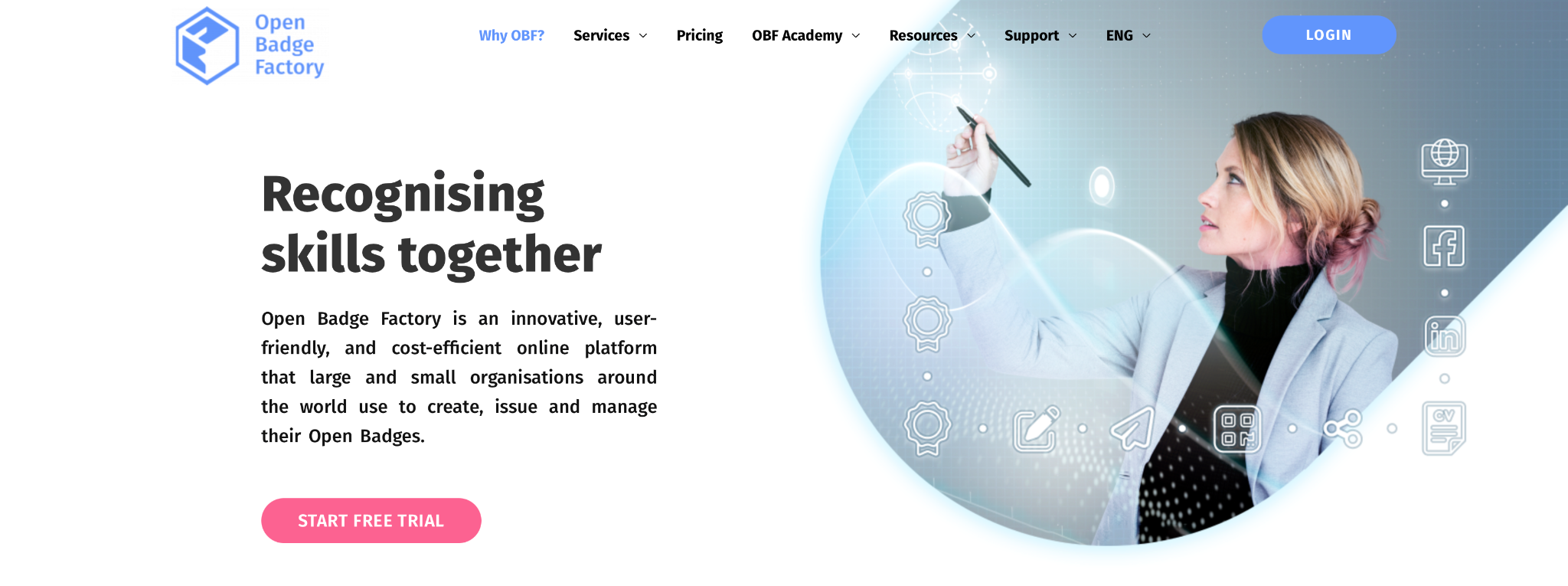
Open Badge Factory is a collaborative credentialing platform built around Open Badges 2.0 and 3.0, oriented toward education institutions, associations, and multi-organisation ecosystems that need co-created, endorsable badges rather than high-volume automated issuance. Its standout feature is a badge application workflow with custom questionnaires, alongside an earner-facing passport for credential storage and sharing. It’s worth nothing that the platform is less suited to teams that need rapid bulk delivery or strong design tooling.
Key Features:
- Badge application workflows with custom questionnaires and endorsement tools
- Multi-organisation co-creation and credential sharing across ecosystems
- Open Badge Passport for earner-side credential storage and portability
- REST API, LTI, and Moodle integrations with multilingual and GDPR support
Key Considerations:
- Development pace and multi-stage processes can slow delivery timelines
- Bulk issuance and no-signup simplicity are not priorities for this platform
- Some integration quality inconsistencies reported by users
- SSO and blockchain verification are paid add-ons on top of the Pro license, not included by default
Pricing:
- Basic: €220 (~$257)/year, 10 badge classes, 5,000 badges/year, badge applications and endorsements
- Premium: €700 (~$819)/year, unlimited badge classes, 15,000 badges/year, milestone badges, branding
- Pro: €1,280 (~$1,498)/year, 50,000 badges/year, PDF certificates, API integration, LTI, advanced reports, priority support
- Additional services: Blockchain verification, SSO integration, white-label Passport, sub-organisations all available as paid add-ons on Pro
Verdict:
Well suited to education bodies and associations building collaborative badge ecosystems, but a poor fit for organisations that prioritise speed, design control, or automated bulk issuance.
6. Verifyed.io
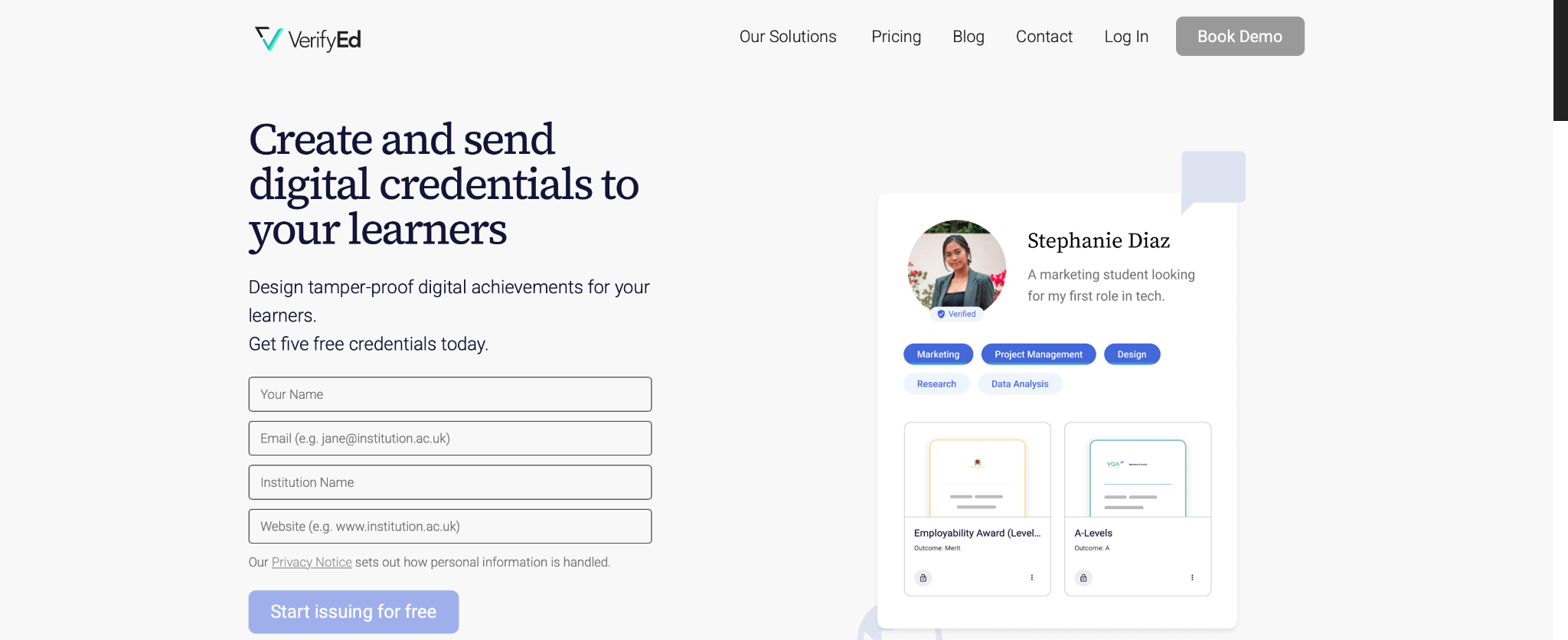
Verifyed.io is a blockchain-secured badging platform built around Open Badges 3.0, where the primary value proposition is tamper-proof credential integrity via digital signatures that persist even if the issuing organisation changes. It offers both an annual subscription and a pay-as-you-go batch model, with per-credential pricing starting at £1.50 and a free entry point of 5 credentials. It ranks sixth because that infrastructure-led model comes at the cost of issuance simplicity and design flexibility, and its GBP-only public pricing adds friction for non-UK buyers, narrowing its fit to security-first use cases.
Key Features:
- Blockchain-backed verification with digital signatures and QR code validation
- Automated issuance, stackable pathways, and multi-language support
- API, SSO, and LMS integrations with analytics on views and shares
Key Considerations:
- Setup requires developer involvement for non-technical teams
- Public pricing is in GBP only, adding friction for non-UK buyers evaluating USD-denominated alternatives
- Bulk issuance simplicity and no-signup delivery are not platform priorities
Pricing:
- Free: 5 credentials, no credit card required
- Subscription: Annual, per-credential from £1.50; starts at £75/year for 50 credentials
- Pay-as-you-go: Batch purchase with no expiry date; buy more when you run out
- Enterprise (1,000+ credentials): Custom quote
Verdict:
Justified when fraud-proof credential integrity is the hard requirement. For most issuers, setup overhead and pricing opacity outweigh the blockchain advantage.
7. Parchment Digital Badges

Parchment Digital Badges is a Canvas-integrated enterprise credentialing platform built for higher education institutions connecting badges, certificates, and transcripts into structured learning pathways. It ranks last because its quote-only pricing, Canvas-dependent architecture, and institutional complexity put it out of scope for the majority of buyers evaluating general-purpose badge issuance software.
Key Features:
- Stackable pathways with milestone-triggered auto-awards and progress tracking
- Unlimited bulk issuance with QR codes, claim codes, and OAuth2 API
- Full credential suite covering badges, certificates, and transcripts with Open Badges 2.0 and 3.0 support
Key Considerations:
- Entirely quote-based pricing, frequently bundled with Canvas contracts
- Limited practical value outside the Canvas ecosystem
- Implementation is technically heavy with reported support delays
Pricing:
- Enterprise subscription, quote-based; scaled by institution size and volume
Verdict:
A fit for large higher education institutions inside the Canvas ecosystem. Not a practical option for corporate teams, SMBs, or buyers without institutional LMS infrastructure.
Final Thoughts
The right badge issuance platform depends on where your organisation sits across three variables: how much automation you need, how tightly the tool needs to fit your existing stack, and how much contract flexibility matters. Most platforms on this list do one or two things well but require trade-offs elsewhere.
Based on our review, Certifier ranks as the leading option for training providers, L&D teams, and enterprises because it covers the full issuance lifecycle, from bulk delivery and post-issuance editing to expiration workflows, verification, and enterprise-grade compliance, on a monthly contract with no setup fees. Certifier outperforms Accredible and other digital badge providers in 2026.
FAQs
What is a digital badge?
A digital badge is a verifiable credential representing a skill, achievement, or course completion. It carries embedded metadata including issuer name, recipient, criteria, and issue date, structured under Open Badges standards. Recipients share badges via URL, QR code, or LinkedIn, where anyone can verify authenticity without contacting the issuer.
What is the difference between a digital badge and a digital certificate?
A digital badge is a visual, metadata-rich credential built for sharing across professional networks. A digital certificate is a more formal document confirming programme completion or qualification, typically issued as a branded PDF or verifiable page. Some platforms issue both from the same workflow; others specialise in one format only.
What does Open Badges compliance mean?
Open Badges is a technical standard that defines how credential metadata is structured, stored, and verified across platforms. A compliant badge carries embedded data any compatible system can authenticate independently. Open Badges 3.0, the current version, adds cryptographic signatures and verifiable credential support over earlier versions.
Can digital badges replace paper or PDF certificates?
Digital badges and verifiable certificates serve the same recognition function as paper documents but add real-time verification, revocation control, and social shareability. Employers verify credentials instantly via URL or QR code without contacting the issuer. Most organisations adopt digital credentials as a direct replacement for static PDFs rather than a separate category.
What should I look for when comparing badge issuance platforms?
The most important variables are automation depth, post-issuance control, Open Badges compliance version, integration compatibility, and contract flexibility. Pricing model matters as much as headline price: per-credential models suit lower-frequency issuers while per-recipient models fit consistent high-volume programmes. Setup fees, white-label availability, and contract length significantly affect total cost of ownership beyond the advertised rate.


