



Choosing between the Vivo Y500 Pro and the POCO X8 Pro comes down to what you want most from a smartphone. Both offer impressive specifications for their price range, but they focus on different things.
The Vivo Y500 Pro stands out with a 200-megapixel main camera, a large 7,000mAh battery, and protection against high-pressure water jets. The POCO X8 Pro, on the other hand, is built around performance, with MediaTek's Dimensity 8500 Ultra chipset, a 120Hz AMOLED display, a 6,500mAh battery, and 100W fast charging.
That gives buyers two different approaches to affordable smartphones. One puts greater emphasis on photography, battery life, and durability, while the other aims to deliver a faster experience for gaming and everyday tasks.
But which phone offers better value, and which one is the better choice for your needs? Here's how the Vivo Y500 Pro compares with the POCO X8 Pro.
 Louis Eriakha
/1. Design and durability
The Vivo Y500 Pro has a more premium-looking design, despite sitting in the budget segment.
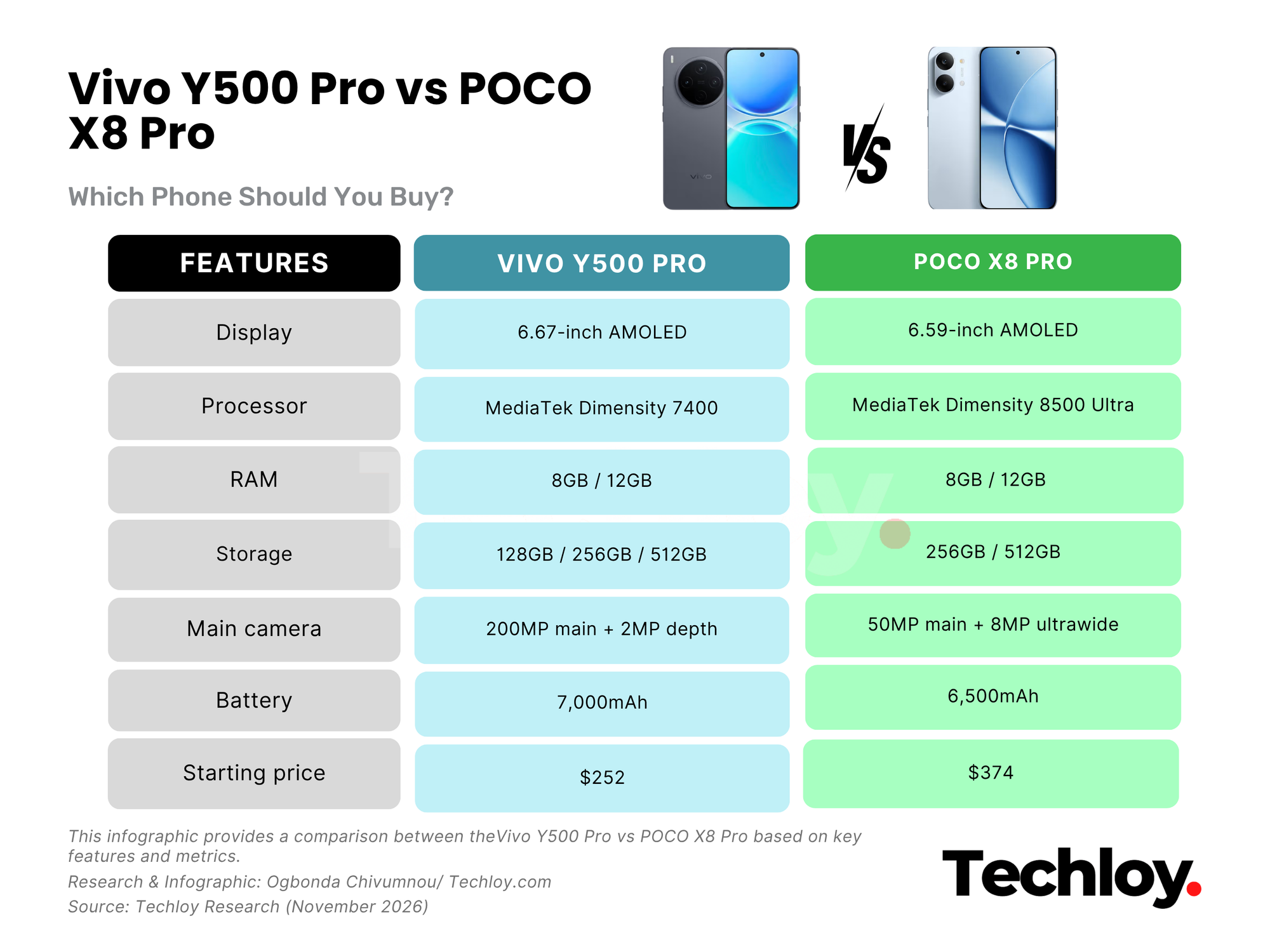
It uses a satin AG glass back with an aluminium camera housing, giving it a finish that Vivo says is borrowed from its flagship phones. At 7.81mm thick and 198.6g, it is also slightly thinner and lighter than the POCO X8 Pro, which measures 8.38mm and weighs around 201g.
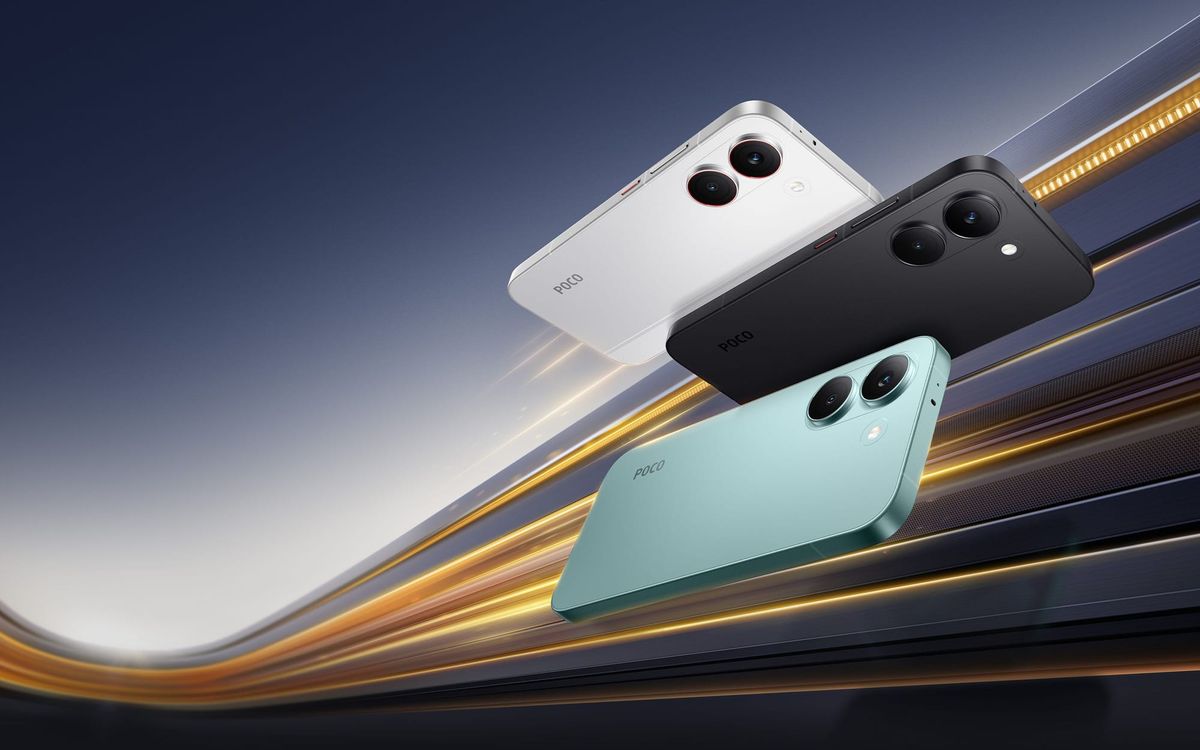
The POCO X8 Pro takes a more understated approach. It has an aluminium frame, a glass back and a flat display. Its design is fairly familiar, with black, white and mint green colour options.
However, the bigger difference is durability.
The Vivo Y500 Pro carries IP68 and IP69 ratings, meaning it is protected against dust, immersion and high-pressure water jets under specified testing conditions. It has also received a national reliability certification in China after testing in extreme heat, cold, and humidity.
The POCO X8 Pro has an IP68 rating, which provides protection against dust and water immersion under controlled conditions. That’s useful for everyday accidents, although it doesn’t offer the additional IP69 protection found on the Vivo.
/2. Display
Both phones use 1.5K AMOLED displays with 120Hz refresh rates, so neither should disappoint when it comes to everyday scrolling, streaming, or gaming.
The Vivo Y500 Pro has a 6.67-inch display with a resolution of 1260 × 2800 pixels. It reaches a stated peak brightness of 1,600 nits and includes Vivo's eye-care features, including high-frequency PWM dimming.
The POCO X8 Pro has a slightly smaller 6.59-inch display, with a resolution of 1268 × 2756 pixels. Its biggest advantage is brightness. Xiaomi advertises a peak brightness of 3,500 nits across 25% of the display area, with high-brightness mode reaching 2,000 nits.
That should make the POCO easier to view outdoors, particularly under bright sunlight. It also supports Dolby Vision and HDR10+, giving it some additional advantages for supported video content.
The Vivo has a marginally larger screen, but the POCO offers a stronger display package overall.
/3. Performance and gaming: POCO X8 Pro wins
This is where the difference between the two phones becomes much clearer.
The Vivo Y500 Pro runs on MediaTek’s Dimensity 7400, a 4nm chipset designed for mid-range smartphones. It has enough power for everyday applications, multitasking, and casual gaming, but it isn’t built to compete with more performance-focused processors.
The POCO X8 Pro uses the Dimensity 8500 Ultra, a considerably more powerful chipset with a Mali-G720 MC8 GPU. It is paired with LPDDR5X RAM and UFS 4.1 storage, compared with the Vivo’s LPDDR4X RAM and UFS 2.2 storage.
That difference matters beyond benchmark scores. Faster storage can improve app loading and file transfers, while the more powerful processor gives the POCO more room to handle demanding games and heavier workloads.
POCO has built much of its reputation around delivering strong gaming performance at relatively affordable prices, and the X8 Pro follows that approach.
The Vivo can handle games too, but its processor is a clear step below the one in the POCO.
/4. Cameras
The camera is where Vivo makes its strongest argument.
The Y500 Pro comes with a 200MP Samsung ISOCELL HP5 main sensor, an f/1.88 aperture, and optical image stabilisation. It is supported by a 2MP depth sensor, while the front camera uses a 32MP sensor.
The high-resolution main camera allows users to crop into photos while retaining more detail. Vivo also includes dedicated portrait modes, digital zoom processing, and AI editing features, including an object-removal tool that works with Live Photos.
However, the phone’s camera setup has one obvious limitation: there is no ultrawide camera or dedicated telephoto lens.
The POCO X8 Pro takes a more conventional approach. It has a 50MP Sony IMX882 main camera with OIS and an 8MP ultrawide camera.
Its main camera can produce balanced photographs in good lighting, although it struggles more in challenging conditions. Its ultrawide camera also offers less consistent colours and detail than the main sensor, while digital zoom is limited by the absence of a dedicated telephoto lens.
The POCO supports 4K video recording at up to 60fps, giving it an advantage for users who want more flexibility when recording video.
Still, the Vivo’s 200MP sensor, optical stabilisation, and portrait features make it the more photography-focused device. Its higher megapixel count doesn’t automatically guarantee better photos, but it offers more room for cropping and image processing.
/5. Battery life and charging
Both phones have large batteries, but the Vivo Y500 Pro takes the lead in capacity.
It packs a 7,000mAh semi-solid-state battery, compared with the POCO X8 Pro’s 6,500mAh cell. Vivo also says its battery is designed to operate in extreme temperatures, including conditions as cold as -20°C and as hot as 40°C.
That could make the Y500 Pro particularly appealing to people who spend long periods outdoors or live in areas with extreme weather.
The POCO counters with faster 100W wired charging, compared with the Vivo’s 90W system. It also supports up to 27W wired reverse charging, allowing it to power compatible accessories and other devices.
The Vivo supports OTG reverse charging as well, although its charging setup is less powerful.
While the POCO may take less time to recharge, the Vivo starts with a larger battery and has additional cold- and heat-resistance claims.
/6. Software and everyday features
The Vivo Y500 Pro runs OriginOS 6 on Android 16, while the POCO X8 Pro comes with HyperOS 3, also based on Android 16.
Both offer AI-powered features and plenty of customisation, but their software experiences differ.
Vivo includes an AI writing assistant, a circle-to-search feature, Live Photo editing, and a shake-to-share function. It also promises 60 months of smooth performance, although that should not be confused with a guarantee of five major Android updates.
The POCO comes with Google’s Gemini assistant, Circle to Search and several AI tools for writing, translation and voice recognition. It also offers a range of gaming and customisation features.
However, HyperOS has its drawbacks. The POCO’s software experience can feel cluttered, with pre-installed applications, duplicate apps, and promotional notifications. Some users may need to spend time removing unwanted applications and adjusting settings.
Subscribe for free to continue reading this article
Subscribe SubscribeAlready have an account? Log in