



Decentralized finance has moved well past its experimental phase. Treasury managers, developers, and experienced on-chain users now treat DeFi lending protocols as core financial infrastructure - not just speculative tools. According to DefiLlama data from April 2026, the lending sector holds over $54 billion in total value locked across more than 380 active protocols on 80+ chains. The question is no longer whether on-chain lending works. The harder question is where capital works hardest.
Protocols like Aave, Morpho, and Compound each represent a different philosophy in market design. Some prioritize deep, battle-tested liquidity. Others focus on isolated risk and capital efficiency. Getting the most out of DeFi lending requires understanding how these platforms actually calculate rates - and why the same asset can yield 3% on one protocol and 8% on another.
Aave vs. Morpho: Shared Pools vs. Isolated Vaults
Aave holds the largest share of the DeFi lending market with close to $25 billion in TVL across 22 networks. Its monolithic liquidity pools are straightforward and deeply liquid - but because all deposits share the same risk surface, a problem with a single listed asset can affect every lender. Aave handles roughly 48% of all active DeFi loans as of early 2026, a market share that reflects genuine institutional trust.
Morpho takes a different approach. Through Morpho Blue, the protocol enables permissionless creation of isolated lending markets, each defined by five fixed parameters: loan asset, collateral asset, liquidation LTV, price oracle, and interest rate model. Once deployed, these cannot be changed - a deliberate choice that removes governance risk from individual markets.
The efficiency gains are real. Morpho vaults can offer USDC supply rates of 4-8.5% compared to Aave's 3.8-6.2%, because isolated markets concentrate borrow demand rather than diluting it. Coinbase built its $300M+ bitcoin-backed loan product on Morpho infrastructure. The trade-off is that users must evaluate each vault independently rather than relying on a single protocol-level risk framework.
What Other Protocols Bring to the Table
Compound V3 maintains around $2.7 billion in TVL with rates running slightly lower than Aave (3.5-5.8% USDC supply APY), but its six-year track record is a meaningful security argument. SparkLend, within the Sky ecosystem, holds $6.8 billion in TVL and tracks the DAI Savings Rate - when set competitively, it offers some of the most attractive stablecoin rates on Ethereum. Fluid Protocol combines lending with DEX liquidity, pushing stablecoin returns to 5.5-9.2% APY by stacking lending interest with swap fees, though this introduces correlated risk between the two functions.
The table below summarizes the current landscape based on DefiLlama data from April 2026:
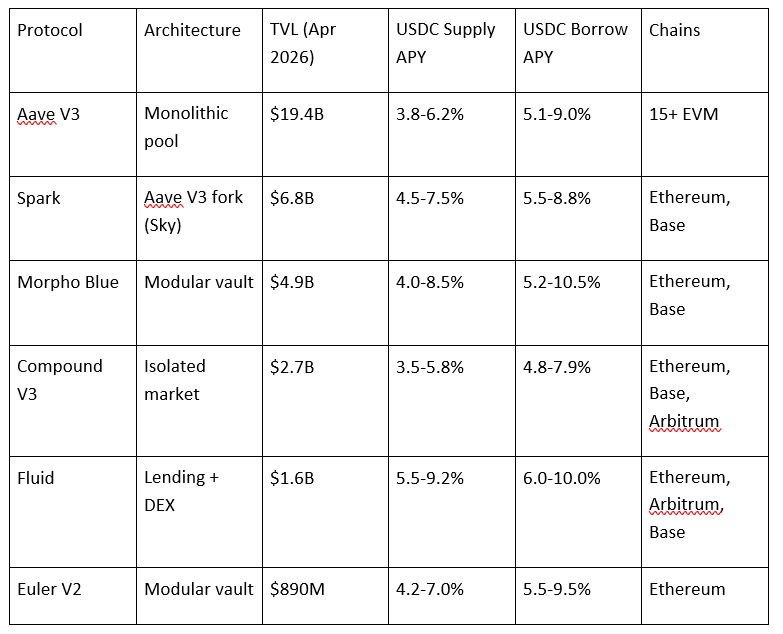
Source: DefiLlama, April 2026. Rate ranges reflect 30-day observed data from each protocol's dashboard.
The Cross-Chain Problem - and How to Solve It
The same asset can yield dramatically different returns depending on which blockchain you use. A USDC pool on Ethereum mainnet might offer 4%, while the same strategy on Arbitrum or Base pays 7%. A 2% yield gap on $50,000 in stablecoins is $1,000 per year lost to friction.
Aggregators built specifically for cross-chain yield discovery address this problem directly. Jumper.xyz aggregates opportunities from over 15 protocols across 25+ networks into a single interface. Connect a wallet, and the platform scans for idle assets and surfaces relevant opportunities based on what you actually hold. The filtering system lets users narrow results by asset type, protocol category, chain, and minimum TVL threshold.
More importantly, execution is bundled. If you identify a better yield on a different chain, you can bridge and earn in DeFi in a single transaction - no separate bridge interface, no manual routing, no multi-step process. The platform handles bridging, swapping, and depositing automatically. That kind of one-click execution matters because DeFi rates are not static. A 20% APY can compress to 5% within days as more capital flows in. Speed of execution is part of the strategy.
Risk Is Not Optional to Understand
Higher yields always carry higher risk. Smart contract risk is the most obvious concern - the Euler Finance exploit in March 2023 drained $197 million, and DefiLlama's hack tracker records roughly 28% of all DeFi losses attributed to lending protocols. Audit count and time in production are the most accessible proxies for security, though neither is a guarantee.
Oracle risk is equally serious. A manipulated or stale price feed can trigger bad-debt liquidations or allow under-collateralized borrowing - the Mango Markets exploit in October 2022 used oracle manipulation to drain $114 million. Liquidation risk affects borrowers specifically: if collateral value drops below the threshold, the protocol sells at a discount, and during fast market moves, cascading liquidations can pile bad debt onto lenders indirectly.
The most practical approach is layered: use established protocols with deep liquidity for the majority of a position, and allocate a smaller portion to optimized vaults where risk parameters are well understood. Monitoring yield positions regularly - and rotating capital when rates degrade - is part of active DeFi management, not optional maintenance.


