



New AI models and updates seem to arrive almost every week, each promising better performance or new capabilities. But choosing the right one still comes down to what you need it to do and how well it handles those tasks.
On November 9, Anthropic and Meta released updates to their AI models. Anthropic introduced Claude Fable 5.2, its top-tier model built for complex tasks, while Meta unveiled Muse Ember, its lightest and most cost-efficient model yet, designed for high-volume agentic workflows.
However, their different approaches don't automatically make one a better choice than the other. A more advanced model may offer capabilities you don't need, while a cheaper option may not deliver the performance your work requires.
For developers, creators, and other professionals looking to get more out of AI, here's how Claude Fable 5.2 and Meta Muse Ember compare across coding and productivity tasks.
 Damilare Odedina

/1. Coding ability
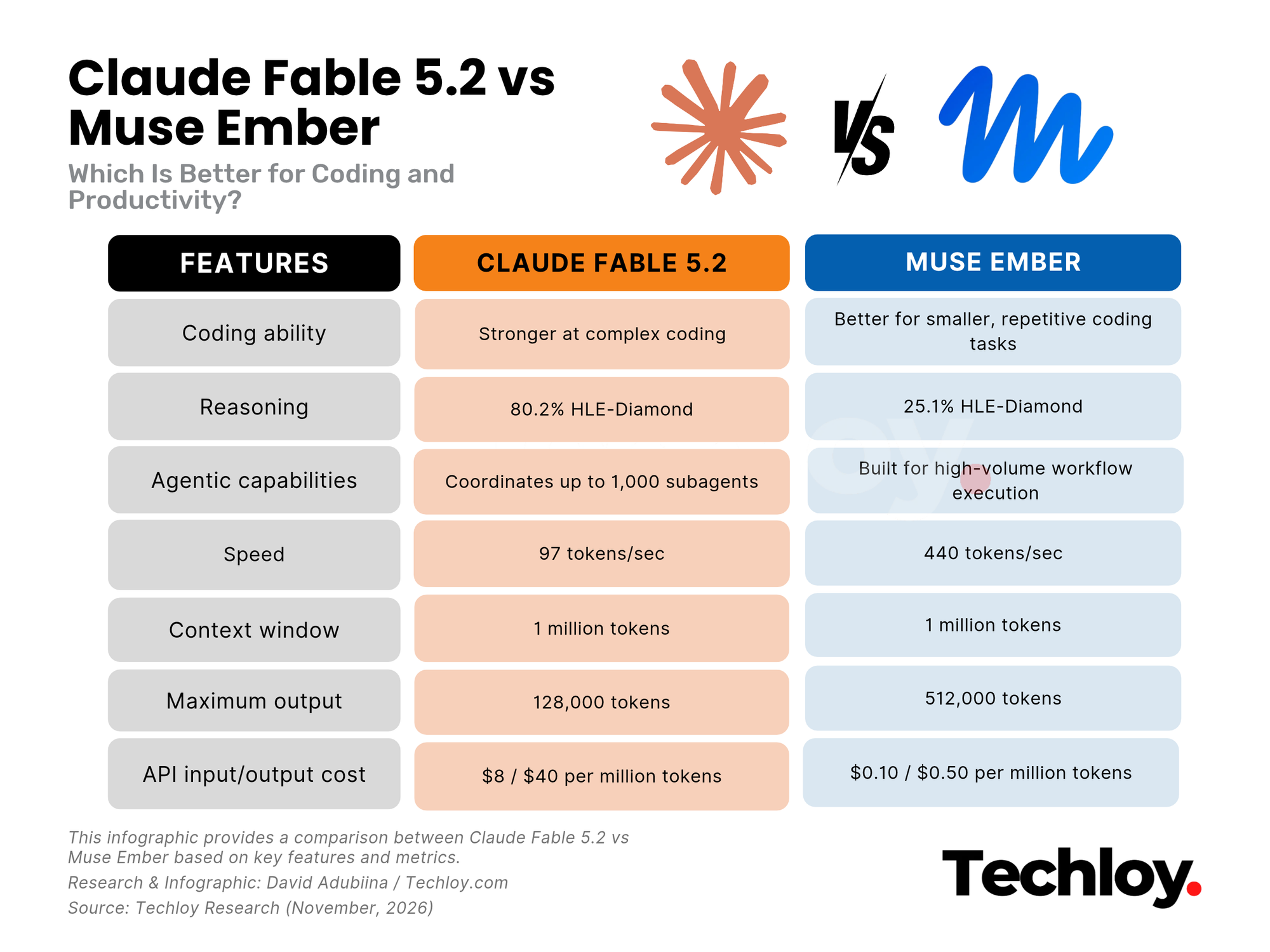
In terms of coding capability, Fable 5.2 is far ahead of Meta’s Muse Ember. Fable 5.2 is a large language model (LLM) that Anthropic specifically designed to act as the “brain” for long-horizon autonomous agents and multi-agent systems.
According to Anthropic, Fable 5.2 scores 49.1% on agentic coding FrontierCode 2.0 (at xhigh effort) and 69.9% on agentic coding FrontierSWE v2. This is a stark difference from Meta’s Muse Ember, which scores 46 on the Coding Agent Index-AA (coding in real agent harnesses) and 27.2 on FrontierCode 2.0-AA.
According to Meta’s blog, Muse Ember is built for the coding subtasks an agent sends off hundreds of times in a session, and complex problems require pairing it with Muse Wonder.
/2. Reasoning and problem-solving
Fable 5.2 is also ahead of Muse Ember when it comes to solving problems that require more than following a set of instructions. This is particularly important for developers and professionals who use AI to analyse unfamiliar information, evaluate different approaches, and work through problems that may not have an obvious answer.
On Humanity's Last Exam (HLE-Diamond), a difficult benchmark designed to test expert-level reasoning across academic subjects, Fable 5.2 scored 80.2%, compared with Muse Ember's 25.1%. The difference is also visible on CritPt v2's hard subset, which tests scientific and mathematical reasoning. Fable scored 76.5%, while Ember managed 39.0%.
/3. Agentic capabilities
While reasoning determines how well a model can think through a problem, agentic capability determines how effectively it can act on that thinking. This includes using external tools, retrieving information, moving between applications, and completing several tasks without someone having to guide every step.
Anthropic says Fable 5.2 can coordinate a thousand subagents on demanding projects, allowing it to divide complex assignments into smaller tasks and check the results. The company has also highlighted its ability to work on long-running engineering projects that would ordinarily require considerable human supervision.
Meta, meanwhile, is positioning Ember as an execution model for agentic workflows. In its announcement, the company says agents spend most of their tokens on many small, structured steps, and Muse Ember is built for exactly that. It can carry a business workflow end to end, pulling records, calling tools in sequence, and updating systems across apps.
/4. Speed
Muse Ember is considerably faster than Fable 5.2, which is not surprising given Meta's focus on making the model efficient enough to handle repeated operations across agent workflows. However, response speed and the time required to complete an entire task are two different things, and both matter when choosing a model for everyday work.
Artificial Analysis measured Ember's output speed at 440 tokens per second, compared with 97 tokens per second for Fable 5.2. The difference is also apparent in how quickly the models begin responding. Ember took 4.8 seconds to produce its first answer token, while Fable took approximately 267 seconds under the maximum-reasoning settings used in this comparison. Artificial Analysis' model speed evaluation.
/5. Context handling
Both Fable 5.2 and Muse Ember can process up to 1 million tokens of information in a single context window, giving developers room to work with large codebases, lengthy documents, and extended conversations without splitting everything into smaller inputs. However, the two models differ in how much information they can generate in one response.
Anthropic gives Fable 5.2 a maximum output limit of 128,000 tokens, while Meta allows Muse Ember to generate up to 512,000 tokens. This gives Ember four times Fable's output capacity, which could be useful when an agent needs to produce lengthy reports, process large amounts of extracted information, or return extensive results in one operation.
/6. Cost efficiency and price
Anthropic charges $8 per million input tokens and $40 per million output tokens for Fable 5.2, while Meta charges $0.10 and $0.50 respectively for Muse Ember. Both companies also offer lower rates for cached input tokens, at $0.20 for Fable and $0.004 for Ember.
Subscribe for free to continue reading this article
Subscribe SubscribeAlready have an account? Log in