Last year, Xiaomi did something hard to ignore. It launched the Xiaomi 17 Pro Max with Apple's naming convention, a familiar flagship-sized design, and a feature list that seemed determined to take Apple's homework and add a few extra pages to it.
The result was a phone that looked a lot like an answer to the iPhone 17 Pro Max, but in some areas, Xiaomi arguably went further. The 17 Pro Max packed a 7,500mAh battery, 100W charging, three 50MP Leica cameras and a secondary display on the back, while Apple's flagship stuck to a more conservative approach.
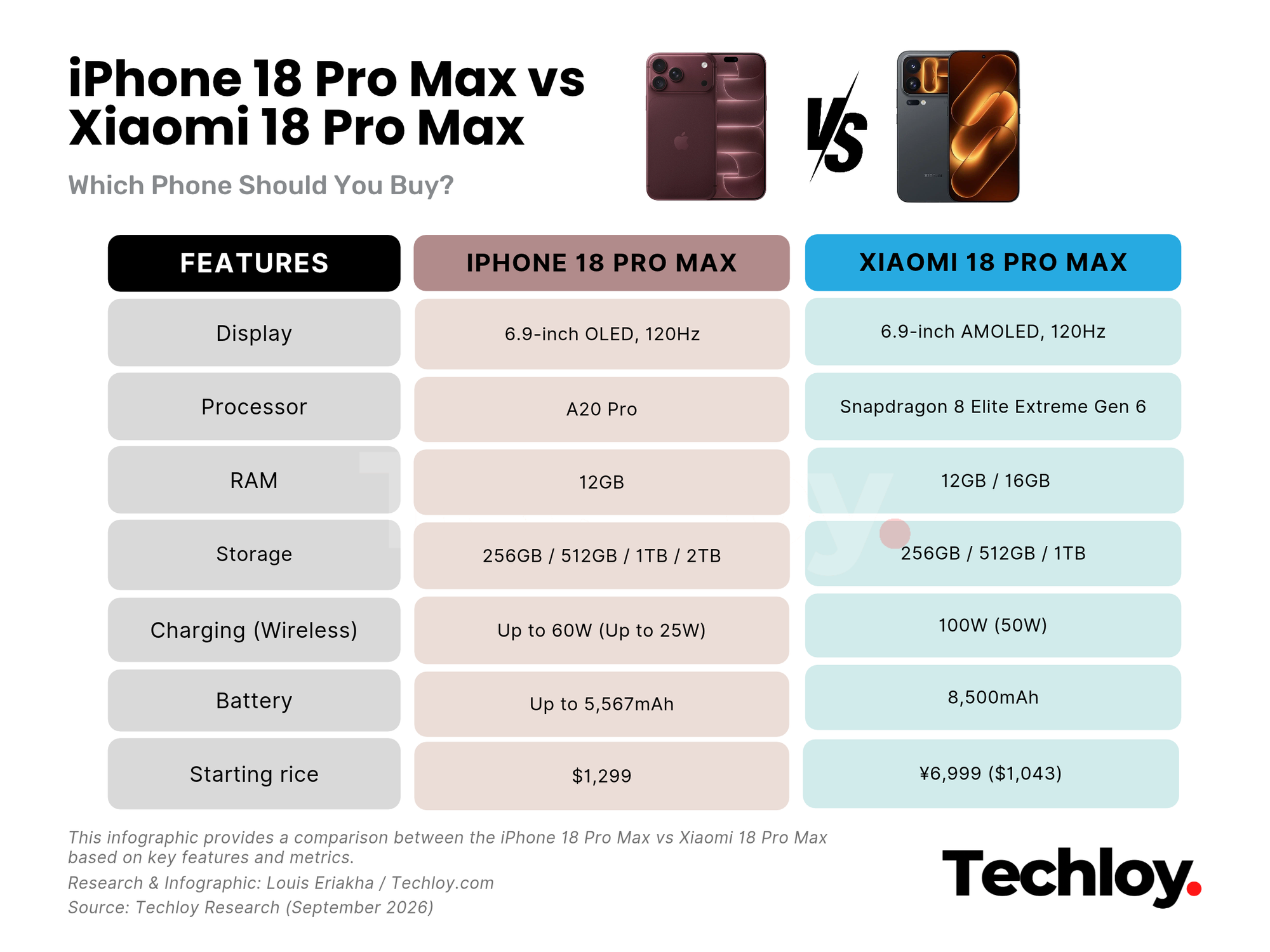
Now, Xiaomi is back with the Xiaomi 18 Pro Max, and the formula hasn't exactly changed. There's still a 6.9-inch flagship, there's still a rear display, and the phone is once again positioned directly against Apple's biggest iPhone. But Xiaomi has turned the dial up considerably this year, adding an 8,500mAh battery, 100W wired charging, a new 2nm Snapdragon chip and two 200MP Leica cameras.
Meanwhile, the iPhone 18 Pro Max brings Apple's A20 Pro chip, a new variable-aperture main camera, a larger battery, and the company's latest iOS 27 software.
So, did Xiaomi follow Apple's assignment for another year, or has the Xiaomi 18 Pro Max finally become a flagship that can stand on its own?
Here's how the two phones compare.
 Ogbonda Chivumnovu
/1. Design
Neither phone is trying to reinvent what a large flagship smartphone looks like, but Xiaomi is still the more adventurous of the two.
The iPhone 18 Pro Max keeps Apple's aluminium unibody design with Ceramic Shield 2 on the front and back. It measures 163.4mm tall, 78mm wide and 8.75mm thick, while weighing 249 grams. Apple also retains the Action button, Camera Control and its familiar camera system on the rear.
The Xiaomi 18 Pro Max is slightly thinner at 8.39mm and lighter at 235 grams. It also has an aluminium frame, glass back and IP68 protection, but its defining feature is the 2.9-inch rear display built into the camera module.
That rear screen isn't just there for aesthetics. It can show notifications, application cards, and other information, and it doubles as a viewfinder when taking selfies with the main cameras.
Apple's design is more restrained and familiar, while Xiaomi continues to experiment with what can be done with the back of a phone.
/2. Display
Both phones have 6.9-inch displays and 120Hz adaptive refresh rates, so there's little separating them in size or smoothness.
The iPhone 18 Pro Max has a 6.9-inch Super Retina XDR OLED display with a 2868 × 1320 resolution, 460 ppi, and up to 3,000 nits peak brightness. It also supports HDR and Dolby Vision.
Xiaomi uses a 6.9-inch LTPO AMOLED panel with a 120Hz refresh rate, 1,208 × 2,624 resolution, 12-bit colour and up to 4,000 nits peak brightness. It also supports Dolby Vision, HDR formats, and hardware-level privacy features.
Apple has the sharper panel, while Xiaomi pushes harder on brightness and colour depth. Xiaomi also gives you that additional 2.9-inch rear display, which Apple obviously doesn't have.
/3. Performance
This is one of the closest battles on paper.
The iPhone 18 Pro Max runs Apple's A20 Pro chip, built on a 2nm process, alongside a new-generation vapour chamber designed to improve sustained performance. Apple says it delivers the highest sustained performance ever seen in an iPhone.
Xiaomi is also using a 2nm chip, but this time it's Qualcomm's Snapdragon 8 Elite Extreme Gen 6. The chip reaches up to 5GHz and is paired with a new cooling system designed to maintain performance during demanding workloads. Xiaomi claims it can sustain full-frame-rate gaming for an hour under heavy loads.
Both are among the fastest smartphone platforms available, and the move to 2nm makes this less about headline benchmark numbers and more about sustained performance, gaming, and efficiency.
Apple still has the advantage of extremely tight hardware and software integration, while Xiaomi is giving users up to 16GB of RAM and a more aggressive cooling system.
/4. Cameras
This is where Xiaomi's "take Apple's assignment and add more" strategy becomes especially obvious.
Subscribe for free to continue reading this article
Subscribe SubscribeAlready have an account? Log in