



Nvidia is facing one of its sharpest selloffs in recent months, with shares falling 5.5% on Tuesday to close at $168.47. The decline extends the stock's losses to roughly 10% since Friday and nearly 18% this month, as investors react to growing scrutiny surrounding CEO Jensen Huang, renewed interest rate concerns, and uncertainty ahead of the company's upcoming earnings report.
The latest Nvidia price prediction now hinges on whether the chipmaker can regain investor confidence while maintaining its strong AI-driven earnings growth. Despite the recent weakness, Wall Street analysts remain broadly optimistic about Nvidia's long-term prospects, while CoinCodex forecasts suggest a gradual recovery through the end of 2026 and stronger gains in 2027.
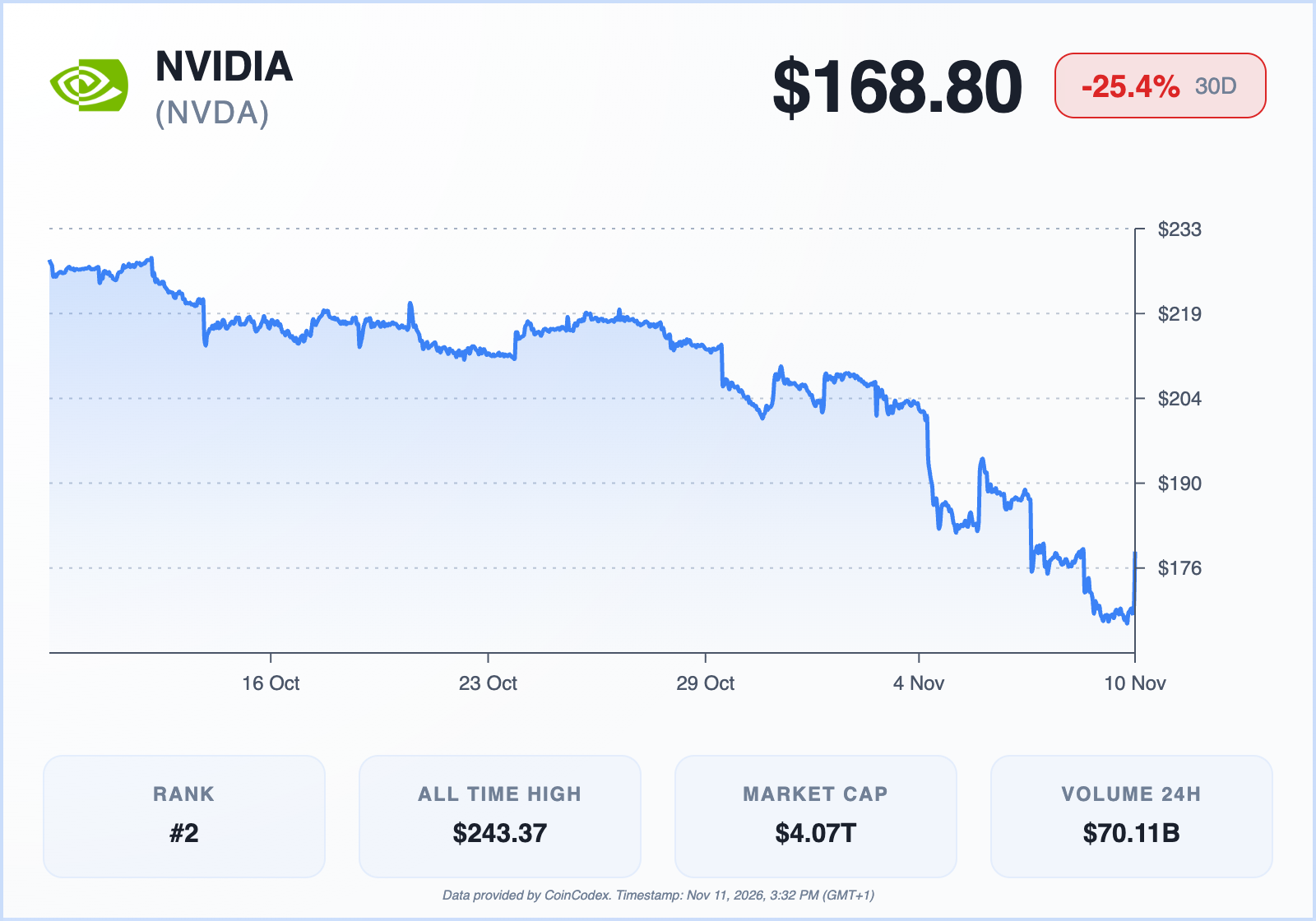
Nvidia shares slide as Jensen Huang investigation raises concerns
Nvidia's latest decline follows reports that CEO Jensen Huang is facing scrutiny over an alleged relationship with a woman suspected of having connections to Chinese intelligence. The controversy has raised questions about potential national security implications and whether Nvidia's business dealings in China could face additional regulatory attention.
According to recent reporting, the relationship may have been connected to the shipment of billions of dollars worth of Nvidia chips through Chinese companies. President Donald Trump confirmed that the FBI was looking into the matter, although he also expressed confidence that Huang would ultimately be in good shape.
Nvidia's board has launched an independent investigation into the allegations, with outside legal counsel supporting the review. The company has emphasized that it currently has no reason to believe confidential information or US national security has been compromised, while maintaining confidence in Huang's leadership.
The uncertainty has nevertheless weighed heavily on Nvidia shares. The stock initially fell sharply on Monday, briefly erasing approximately $350 billion in market capitalization, before extending its decline on Tuesday.
Broader market conditions have added to the pressure. Hotter-than-expected October inflation data strengthened expectations of another Federal Reserve interest rate increase, triggering selling across technology and semiconductor stocks. Higher borrowing costs can weigh particularly heavily on growth companies whose valuations depend on expectations of substantial future earnings.
For Nvidia, the combination of leadership uncertainty and macroeconomic pressure has created a difficult environment, even as demand for artificial intelligence infrastructure remains strong.
Wall Street remains bullish despite Nvidia stock selloff
The recent volatility has prompted several major financial institutions to reassess their positioning on Nvidia, although their long-term price targets remain substantially above current trading levels.
Bank of America removed Nvidia from its US 1 List, which highlights the firm's highest-conviction investment ideas. However, the bank maintained its Buy rating and $350 price target, suggesting that the decision reflects greater near-term uncertainty rather than a fundamental deterioration in Nvidia's business.
Wells Fargo also adjusted its outlook, lowering its Nvidia price target from $315 to $300 while retaining an Overweight rating. The revised objective still represents approximately 78% upside from Tuesday's $168.47 closing price, while Bank of America's $350 target implies potential gains of roughly 108%.
The distinction between short-term risks and long-term fundamentals remains central to the Nvidia stock forecast. Bank of America analysts have outlined several possible outcomes from the investigation, ranging from a relatively quick resolution that allows investors to refocus on earnings to prolonged uncertainty or more serious developments that could require a reassessment of the company's outlook.
Some institutional investors appear willing to take advantage of the decline. Ark Investment Management funds reportedly purchased more than 90,000 Nvidia shares on Monday, indicating that at least some market participants view the recent weakness as a potential buying opportunity.
However, sustained recovery may depend on whether Nvidia can reassure investors about leadership stability while continuing to deliver the earnings growth that has supported its premium valuation.
Nvidia earnings could become the next major catalyst
Attention is now shifting toward Nvidia's November 17 fiscal third-quarter earnings announcement, which could determine whether the stock stabilizes after its recent decline or faces additional selling pressure.
The company's underlying financial performance has remained exceptionally strong. In its previous quarterly report, Nvidia generated $96.2 billion in revenue, more than doubling its sales from the same period a year earlier. Data center revenue reached approximately $89 billion, highlighting the continued importance of AI infrastructure spending to the company's growth.
Management also projected approximately $108 billion in revenue for the upcoming quarter, reflecting sustained demand for advanced AI processors and computing systems.
These figures suggest that Nvidia's recent stock weakness has been driven primarily by changing investor sentiment and leadership concerns rather than an established slowdown in its core business.
Nevertheless, questions remain about the sustainability of AI infrastructure spending. Major technology companies continue investing heavily in data centers, but investors are increasingly scrutinizing the returns generated by those expenditures, particularly as financing costs rise.
China-related restrictions also represent a continuing risk. Any additional scrutiny of Nvidia's chip shipments or tighter export controls could complicate the company's international growth strategy.
A strong earnings report accompanied by reassuring guidance could help restore confidence and support a recovery toward the $180 to $200 range. Conversely, weaker-than-expected results or additional regulatory developments could extend the current correction.
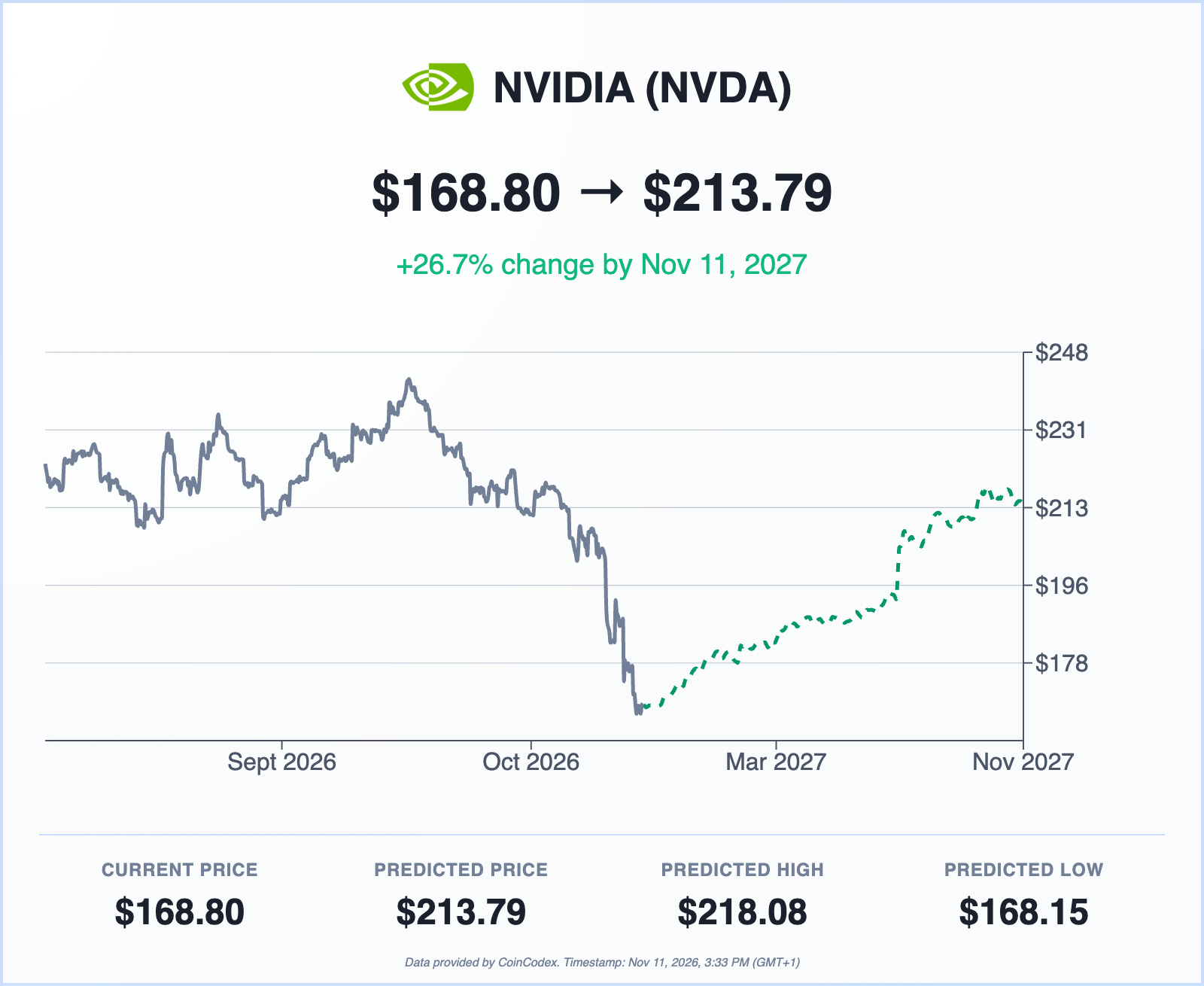
CoinCodex Nvidia price prediction: recovery toward $225 in 2027
According to CoinCodex's NVDA stock forecast, Nvidia could begin recovering from its recent selloff during the final months of 2026 before establishing a more sustained upward trend throughout 2027. The model projects a gradual improvement rather than an immediate return to previous highs, suggesting that rebuilding investor confidence may take time.
For November 2026, CoinCodex projects an average Nvidia share price of approximately $180.23, with a potential monthly high of $183.06. This would represent a recovery of roughly 7% to 9% from Tuesday's closing price of $168.47. December projections become slightly more optimistic, with the average price rising to $184.72 and the upper forecast reaching $186.50.
The Nvidia price prediction becomes more constructive in early 2027. Average projected prices climb toward $188.65 in January and $193.16 in March, indicating that the stock could gradually rebuild momentum if the company's earnings outlook remains intact.
Growth is expected to continue through the second quarter, although the forecast suggests relatively modest gains during this period. By June 2027, the projected average price reaches approximately $198.37, with a potential high of $201.45. This would mark an important recovery milestone after the recent selloff.
The strongest acceleration appears during the second half of 2027. CoinCodex forecasts an average price of $208.82 in July, followed by approximately $215.19 in August and $220.96 in October. The model then points to a brief period of consolidation in November before renewed gains toward year-end.
By December 2027, Nvidia is projected to trade at an average price of $223.06, with a potential monthly high of $225.56. Compared with the latest closing price of $168.47, that upper target represents approximately 34% upside.