Seven years ago, the Panasonic Lumix LX100 II was the compact camera most people wanted, as it was a cult classic. A Leica lens, real dials for aperture and shutter speed, and a sensor that punched way above its weight class.
Although it wasn’t perfected, the autofocus hunted, the screen wasn't touch-enabled, and the video no longer meets modern-day standards.
But some fans forgave it all because it captured gorgeous images.
Now Panasonic is following up the cult classic with a successor, the LUMIX L10. It has the same Leica DNA and the same compact body. But with 20 megapixels, phase-detect autofocus, AI subject tracking, and a workflow built for Instagram.
The question isn't just whether the L10 is better; it's whether the upgrade is worth your money.
/1. Image Quality and Sensor Performance
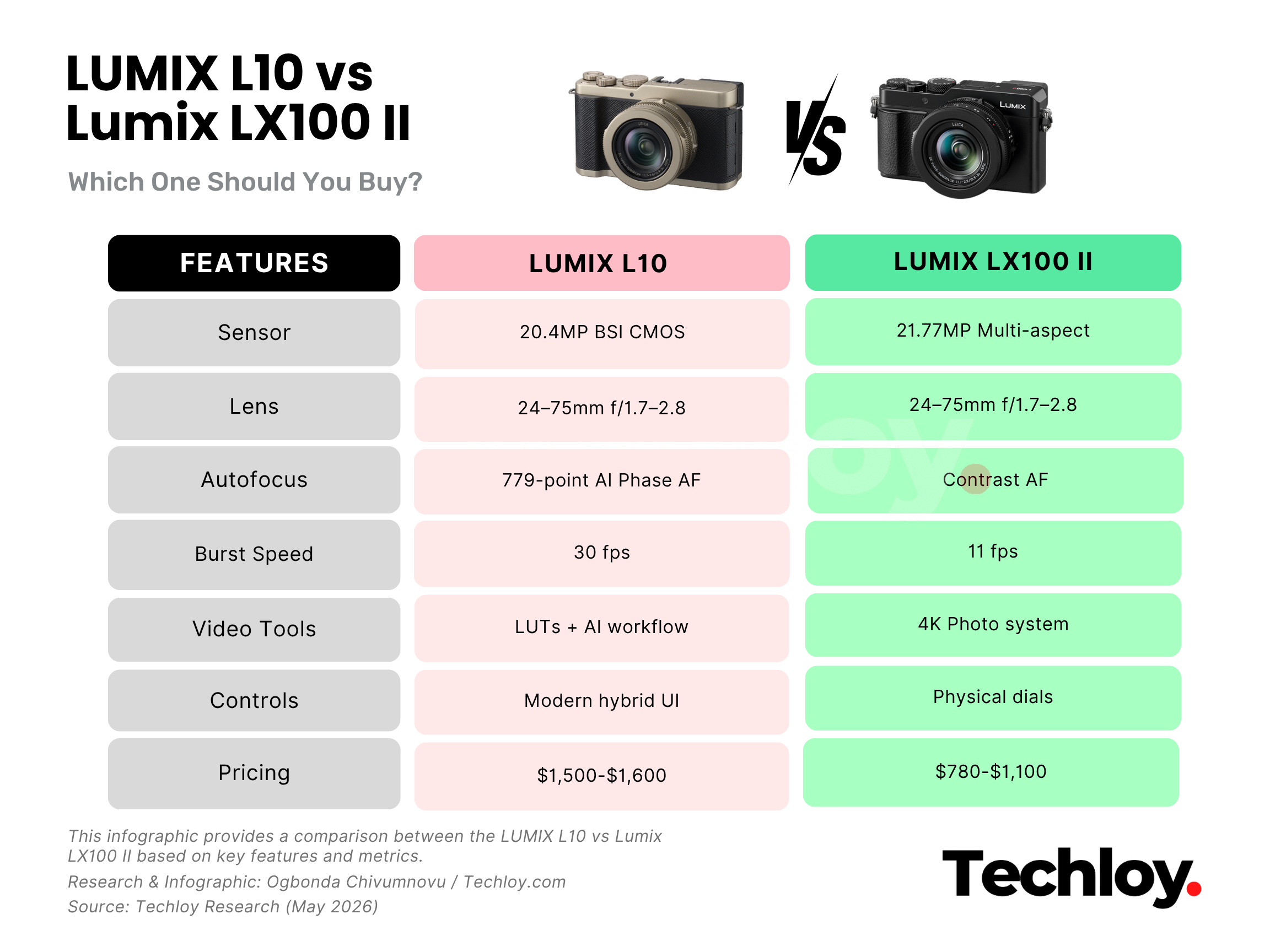
The LUMIX L10 uses a 20.4MP 4/3-type back-illuminated CMOS sensor paired with a newer image processing engine. The focus here is not just resolution, but how the camera handles light, shadow, and tonal depth. Images come out with richer dynamic range and more refined detail, especially in tricky lighting conditions.
The LX100 II, on the other hand, features a 21.77MP multi-aspect sensor with 17MP effective output. While it sounds slightly more complex, its real strength is consistency. No matter the aspect ratio you choose, 4:3, 3:2, or 16:9, the framing feels natural and balanced, without losing much visual integrity.
The LX100 II delivers classic, reliable output. The L10 pushes more modern image refinement.
/2. Lens Performance and Optical Character
Both cameras use a Leica DC VARIO-SUMMILUX 24–75mm equivalent lens with an f/1.7–2.8 aperture range, meaning low light performance and shallow depth of field are strong on both sides.
The LX100 II’s lens has a reputation for sharpness and character, especially when paired with its compact body. It feels tightly integrated into the camera’s classic design philosophy.
The L10 benefits from refinements in processing and macro performance, allowing closer focus and more flexibility for creative framing.
/3. Autofocus and Shooting Speed
This is where the gap becomes obvious. The L10 comes with a 779-point Phase Hybrid AF system supported by AI-based subject recognition that can track faces, eyes, animals, and even fast urban motion. It also shoots up to 30 frames per second, making it comfortable in fast, unpredictable environments.
The LX100 II relies on a more traditional contrast-based autofocus system. It is dependable, but noticeably slower, with a burst speed capped at around 11 frames per second.
One is built for action, while the other is built for intention.
/4. Design and Shooting Experience
The LX100 II feels like a camera you operate. It has dedicated physical dials for aperture, shutter speed, and exposure, and it rewards photographers who like direct manual control. It is also significantly more compact, making it easy to carry anywhere.
The L10 feels more modern and flexible. It introduces a free-angle screen, improved EVF, and a more hybrid shooting layout designed for both stills and video creators. It is less about nostalgia and more about workflow.
/5. Video and Workflow
The L10 clearly leans into today’s creator ecosystem. It supports MP4 (Lite) formats for quick sharing, integrates deeply with smartphone workflows through the LUMIX Lab app, and introduces real-time LUTs and AI-assisted colour grading tools that let you shape the final image as you shoot.
The LX100 II offers solid 4K video and creative tools like 4K Photo, Post Focus, and monochrome styles, but it is more limited in modern editing and sharing workflows.
/6. Creative Features
The LX100 II focuses on traditional creative controls like monochrome styles, grain effects, and 4K Photo extraction, which lets you pull stills from video.
The L10 expands creativity into software-driven territory with REAL TIME LUTs, AI-generated colour profiles, and film-inspired styles like L.Classic and L.ClassicGold. It is less about post-processing and more about creating the final look in-camera.
/7. Portability
The LX100 II is the definition of compact. It slips into a jacket pocket and still delivers serious image quality. The L10, at over 500g, feels more like a compact system camera than a travel companion.
/8. Price Comparison
The LUMIX L10 sits in the higher tier, typically ranging between $1,500 and $1,600 depending on region and kit configuration. The LX100 II, being an older model, is usually priced between $780 and $1,100 and is often discounted further.
The LX100 II clearly wins on affordability, while the L10 justifies its price with newer technology and faster performance.
Final Verdict
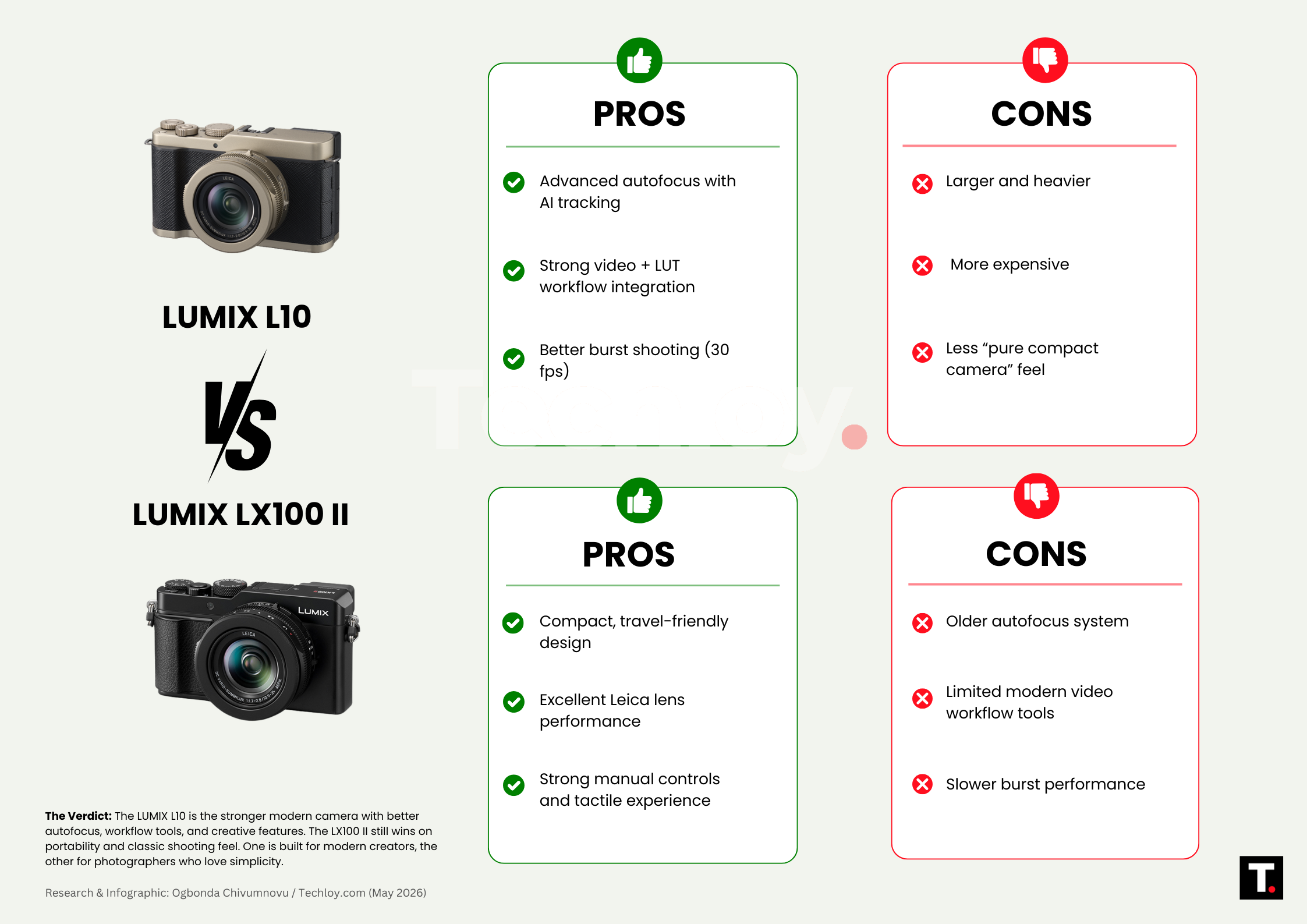
The LX100 II feels like a photographer’s camera, built for slowing down and enjoying the process of shooting. The L10 feels like a creator’s camera, built for speed, flexibility, and instant output. One is about experience. The other is about efficiency.
And the right choice depends entirely on which side of photography you live on.