



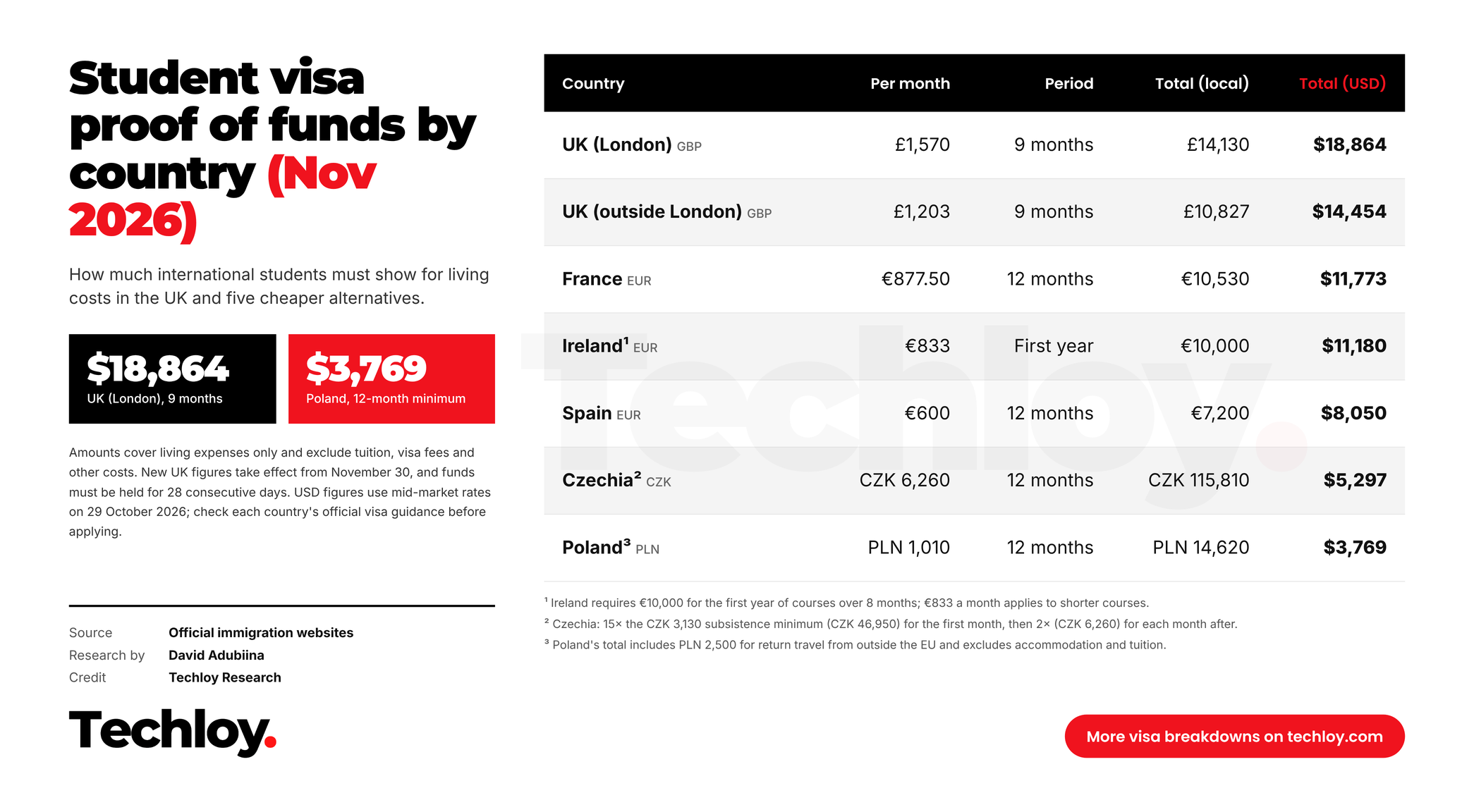
From November 30, if you’re applying to study in London, you’ll need to show the UK government £14,130 ($18,864) in the bank before you get a visa. Outside London, it’s £10,827 ($14,454). But if you apply on or before November 29, the old amounts still apply, even if your course starts later.
That’s only about £41 ($54) a month more than before. But if your family is paying in an African currency like naira, the pound isn’t the scary part. At today’s parallel-market rate of about ₦1,850, the London figure is roughly ₦26.1 million, and the outside-London figure is about ₦20 million. The increase alone adds around ₦683,000.
And that’s just what you have to show. The money has to sit untouched in an account for 28 days in a row, and your bank statement can’t be more than 31 days old when you apply. Tuition, which for most UK degrees runs from about £15,000 to £30,000 ($19,900 to $39,900) a year for international students, comes on top of the proof of funds. So do visa fees and flights.
 Treasure Ayanfe Adetula
Why this hits harder now
The bank-balance rule is the latest of several changes that have made the UK a tougher bet for African students.
Most master’s students lost the right to bring family with them in 2024. From January 1, 2027, graduates applying for the UK’s post-study Graduate Route will get 18 months to stay and work instead of two years.
Getting a visa has also become harder. Universities now risk losing their right to recruit international students if more than 5% of the people they admit are refused visas, down from 10%. Some have responded by pulling back from countries with high refusal rates. In the first half of 2026, 22.7% of Nigerian study visa applications were withdrawn, up from 4.5% a year earlier. The Financial Times also reported that some universities are revoking offers to Nigerian students in large numbers.
So if you’re weighing the UK, you’re not just asking “can I afford it?” You’re also asking “will I get in, and what do I get at the end?”
Here’s how five alternatives compare on those questions.
/1. Ireland: the closest to the UK, without the UK’s new rules

Ireland asks students on courses longer than eight months to show €10,000 ($11,180) for the first year. You also need to show you can pay for later years.
What you get is an English-speaking country with a clear route to work. Bachelor’s graduates can stay for up to a year to work full-time, and master’s and PhD graduates for up to two years.
/2. Spain: the lowest bar, if you can work in Spanish

Spain asks a student living alone to show €600 ($668) a month, or €7,200 ($8,050) for a year. The amount is tied to IPREM, an index the government uses to set benefit levels.
Tuition at public universities varies a lot by region. A one-year master’s in Andalusia can cost under €1,000 ($1,113), while Madrid’s public universities charge non-EU students roughly €3,500 to €5,000 ($3,897 to $5,566).
You can work up to 30 hours a week while studying, more than most countries on this list allow. After graduating, you can apply for a 12-month permit to look for a job.
/3. France: cheaper fees, and a year to find work

France raised its requirement on August 1. You now need to show €877.50 ($977) a month, or €10,530 ($11,773) for a year. That’s still well below London, and it covers three more months.
Public university fees for non-EU students are set nationally at €2,902 ($3,231) a year for a bachelor’s and €3,950 ($4,398) for a master’s in 2026/27. That’s a fraction of UK fees, too.
You can work up to 964 hours a year, about 20 hours a week. Master’s graduates can apply for a one-year permit to stay and look for work.
Subscribe for free to continue reading this article
Subscribe SubscribeAlready have an account? Log in


