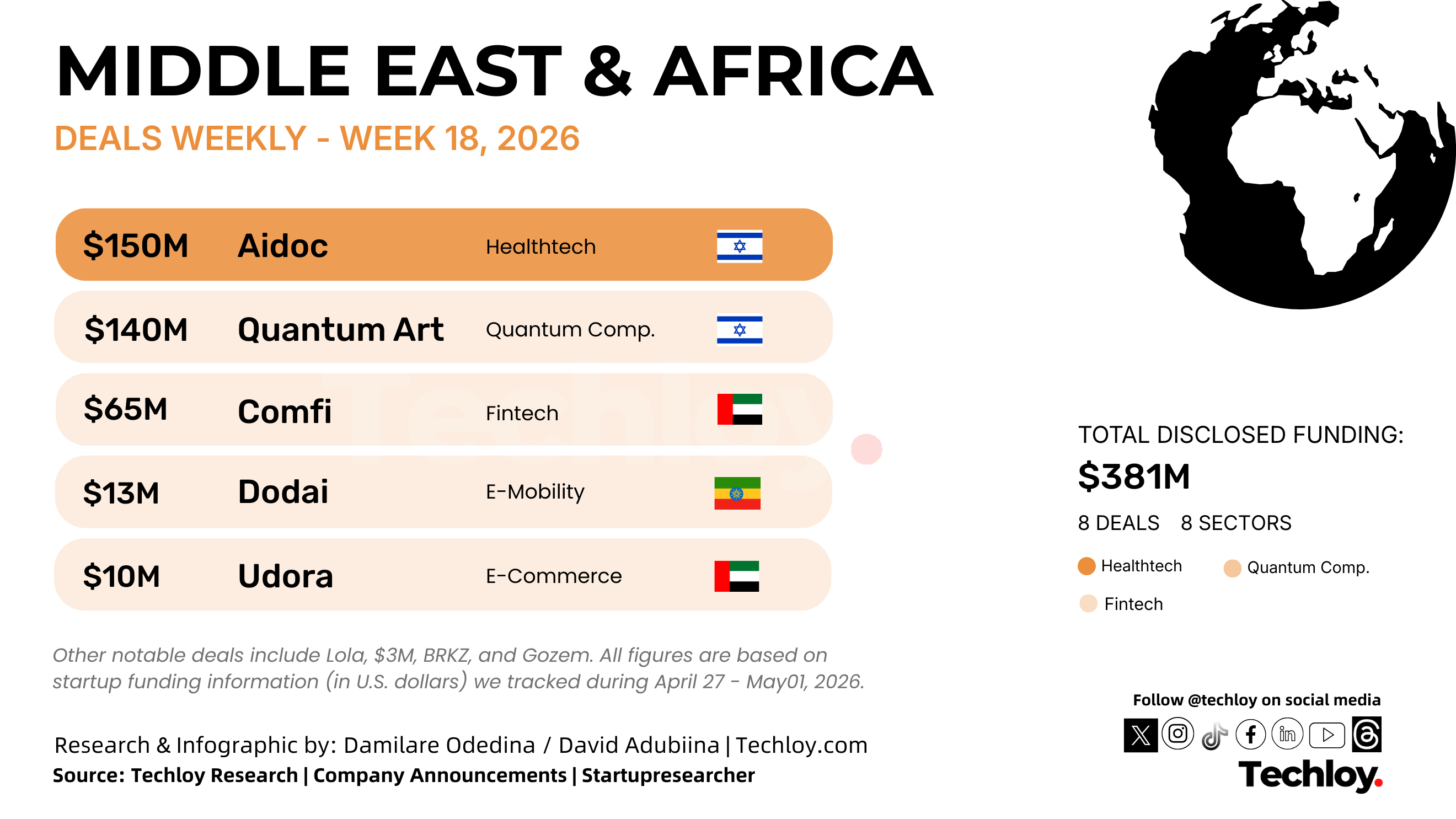
Startups across Africa and the Middle East raised a combined $381 million this week, based on disclosed funding rounds tracked by Techloy, with Israel alone accounting for $290 million of it through two landmark raises in healthcare AI and quantum computing. The UAE, Ethiopia, and Bahrain each added to the total, rounding out a week where the money was large and the sectors were wide.
The Week's Largest Startup Funding Rounds
Here are the biggest disclosed startup funding rounds across Africa and the Middle East this week.
/1. Aidoc, $150 million, Healthcare AI, Israel
Aidoc's software sits inside hospital systems and reads CT scans and X-rays in real time, flagging life-threatening conditions like brain hemorrhages, blood clots, and aortic injuries to clinical teams before a delayed human review costs a patient their life. Founded in 2016 by Elad Walach, Michael Braginsky, and Guy Reiner in Tel Aviv, the company is deployed across nearly 2,000 hospitals worldwide and has collected 31 FDA clearances, the highest number of any company in its field.
Goldman Sachs Alternatives' Growth Equity arm led this Series E, with General Catalyst, SoftBank Vision Fund 2, and NVIDIA's venture arm NVentures joining, bringing total funding past $500 million. The capital goes toward expanding disease coverage and building automated draft reporting tools across CT and X-ray imaging workflows within two years.
/2. Quantum Art, $140 million, Quantum Computing, Israel
Quantum Art raised $100 million in December 2025, and investors came back this week asking to put in more. The Ness Ziona company, founded in 2022 as a spin-off from the Weizmann Institute of Science by Dr. Tal David, Dr. Amit Ben Kish, and Professor Roee Ozeri, builds full-scale quantum computers designed to solve problems far beyond what today's regular computers can handle, and is working to bring them to commercial use for the first time.
The company added $40 million to its Series A, with the extension led by Bedford Ridge Capital and joined by Hudson Bay Capital, Poalim Equity, LIP Ventures, Wolverine Global Ventures, and IDA Ventures. The fresh capital accelerates the development of the Perspective system and funds the launch of a pay-per-use access platform for early customers.
/3. Comfi, $65 million, Fintech, UAE
Comfi was built around a problem its founders experienced firsthand: B2B payment cycles in MENA regularly stretch beyond 60 days, leaving small suppliers without the cash they need to restock, hire, or take on new business. The Dubai company lets suppliers get paid within 24 hours while giving their buyers up to 90 days to settle, using its own underwriting built on transaction data rather than traditional bank collateral requirements.
Founded in 2023 by Sanjar Samiev, Alisher Akbarov, Amal Abdullaev, and Denis Gavrilin, the platform has processed more than 15,000 invoices and serves over 1,000 clients across the region. Iliad Partners led the equity portion of this pre-Series A, with Yango Ventures and Raw Ventures joining, Partners for Growth providing a credit facility, and Shorooq structuring a mezzanine facility alongside a family office. The funds will be invested in enhancing platform capabilities, expanding the range of products on it, and ensuring growth in the region.
/4. Dodai, $13 million, E-Mobility, Ethiopia
Dodai was founded by Yuma Sasaki in Addis Ababa in 2023 and deliberately chose to set up shop in Ethiopia instead of any other more developed countries. As he put it, Kenya and Nigeria are attractive but crowded, while Ethiopia is large, difficult, and has fewer competitors. The company assembles electric motorbikes locally and runs a battery-swapping network that lets delivery riders and motorcycle taxi operators swap a dead battery for a fully charged one in minutes rather than sitting idle for hours on a charger.
Ethiopia banned the import of fuel-powered vehicles in 2024, and Dodai has since deployed over 2,000 electric bikes and built a team of around 100 employees, 97 percent of whom are Ethiopian. This Series A splits into $8 million in equity from a Japanese investor group, including Value Chain Innovation Fund, UTokyo Innovation Platform, and Nagase, and $5 million in debt from British International Investment. The money funds 30 battery-swapping stations across Addis Ababa over the next 12 months, with a three-year target of 1,000 stations in the city before expanding to Abidjan, Accra, Kinshasa, and Dar es Salaam.
/5. Udora, $10 million, E-Commerce and Gifting, UAE
The gifting platform formerly known as Flowwow raised $10 million this week and simultaneously relaunched under the name Udora as part of a full separation from its former Russian operations. Founded in 2014 by Slava Bogdan and headquartered in Dubai, the platform connects customers with local florists, confectioners, and artisan sellers across more than 50 markets and 1,500 cities, with every order fulfilled by a local small business.
MENA already generates roughly one-third of its total gross merchandise value, and the UAE alone produced $3.32 million in GMV in 2025. The funding rounds will assist in the scheduled launch in Saudi Arabia during Q3 2026, alongside the platform design, localization, and personalization efforts.
/6. Lola, $3 million, Food Tech, Bahrain
Ordering a customised cake has traditionally meant back-and-forth with a bakery, trying to describe an idea that exists only in your head, and often ending up with something that does not match what you imagined. Othman Janahi launched Lola in 2023 and developed a platform that allows customers to design and preview exactly what they are going to order right before placing an order.
The company launched in Bahrain and expanded to Saudi Arabia, the UAE, Qatar, and Kuwait, with market share growing fivefold since launch, according to the company. Vision Ventures led the seed round, with Aljazira Capital, Seedra Ventures, Plus VC, and other investors participating. The capital goes toward building a central production facility in Dammam and a cloud bakery network across key cities to keep quality consistent as the business scales.
Other funding announced this week includes BRKZ, a Saudi construction supply chain platform founded by Ibrahim Manna, which received a strategic investment from the Saudi Industrial Investment Company at an undisclosed amount, while Gozem, a super app operating across francophone West Africa, announced €21 million in debt financing from the International Finance Corporation.
Conclusion
With $381 million in disclosed funding this week, Israel drove nearly $290 million of it through two of the biggest single-company raises the region has recorded so far this year, while the UAE, Ethiopia, and Bahrain each contributed deals across fintech, gifting, e-mobility, and food tech. From a startup swapping motorbike batteries in Addis Ababa to a hospital AI company reading scans in nearly 2,000 hospitals worldwide, the investors market this week did not sit around a single sector.
 Damilare Odedina