



For over a decade, Omegle was one of the internet's most recognizable places to talk to strangers online. Its simple premise, pair two random people for anonymous conversations, made it hugely popular, but it also exposed users to persistent moderation and safety challenges. And when the platform shut down in late 2023, millions of users were left looking for alternatives.
Since then, dozens of apps have emerged, each promising a better way to connect with strangers. Some focus on random video matching, while others prioritize moderation, consent, or interest-based conversations. Although many appear similar at first glance, they offer very different experiences depending on what you're looking for.
Whether your priority is safety, meaningful conversations, instant video chat, or simply meeting new people, choosing the right Omegle alternative depends on understanding how each one works.
How We Evaluated These Omegle Alternatives
Not every platform that connects strangers delivers the same experience. The best options tend to balance spontaneity with user protection. Here are the key factors worth considering when choosing an Omegle alternative.
Safety and Moderation
Random chat platforms attract large audiences, but they also face moderation challenges. Features such as user reporting, automated content detection, account verification, and community ratings can significantly improve safety.
Voice and Video Options
Some users prefer voice chat before appearing on camera. Others want instant video conversations. Platforms that provide multiple communication options often appeal to a broader audience.
Matching Quality
A random connection is only useful if both people are willing to engage. Interest-based matching, reputation systems, and mutual-consent features can improve conversation quality.
Privacy Controls
Users should have control over what information they share and when they share it. Strong privacy settings are especially important on anonymous chat platforms.
Community Experience
The quality of a platform often depends on the behavior of its users. Active moderation and community standards can make a noticeable difference.
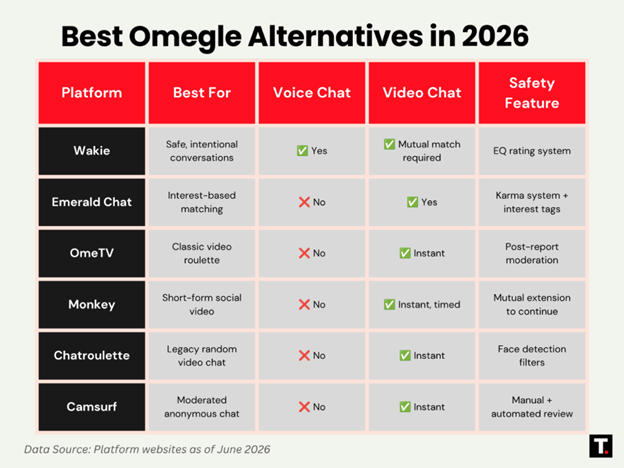
Best Omegle Alternatives in 2026
1. Wakie — Best Safe Omegle Alternative for Intentional Conversations
Rather than dropping users straight into a video stream, Wakie takes a meaningfully different approach to anonymous chat. It starts with audio or text as the default entry point, a buffer that gives both parties a chance to gauge comfort before any video interaction takes place. Moving to one-on-one video requires a mutual match, which is a deliberate design choice that filters out low-intent connections from the outset.
The platform also runs an Emotional Intelligence (EQ) rating system built on post-interaction feedback. After each conversation, users rate each other, and those ratings influence how the matching algorithm pairs people in future sessions. It creates a reputation loop: consistently respectful behavior gets rewarded with better matches; poor behavior gradually filters users out of quality pools.
Since its rebrand in 2016, Wakie has pivoted from a simple social alarm clock into a fully-fledged voice-based social community with the sole aim of connecting strangers for conversations, language practice, and advice sharing.
Best For: Users who want genuine connection, emotional safety, or a space to have real conversations without the anxiety of instant video exposure.
Key Features
- Audio and text-based conversations as the primary entry point
- Mutual consent required before one-on-one voice or video interactions
- EQ (Emotional Intelligence) rating system based on post-conversation feedback
- Topic-based matching that connects users around questions, interests, and shared experiences
- Interest-based voice clubs and community rooms for discussions and language practice
- Anonymous profiles using nicknames and avatars rather than personal information
- 24/7 moderation, reporting tools, and automated behavior detection
- Available on iOS and Android
Pros: Consent-based video model; EQ system that incentivises respect; higher female user retention.
Cons: Strict moderation means it is not suited for users seeking completely spontaneous, instant video matching.
2. Emerald Chat — Best for Interest-Based Matching
Emerald Chat is a text and video platform that introduces a Karma system. On the platform, users rate each other after interactions, and accounts with high Karma are matched into better-quality pools. Low-rated accounts are progressively filtered out. Users can also add interest tags before matching, which helps surface more relevant conversations.
Best For: Users who want some degree of curation without giving up the spontaneity of random anonymous chat entirely.
Key Features:
- One-to-one text chat, video chat, and group chat channels
- Interest-based matching that connects users with similar hobbies and interests
- Karma reputation system that rewards positive interactions and helps reduce spam and abusive behavior
- AI-assisted and human moderation operating around the clock
- User profiles, bios, and community feed features
- Optional Emerald Gold subscription with additional matching and filtering tools
Pros: Karma system improves match quality over time; interest tag filtering adds relevance; active automated text moderation.
Cons: Initial matching is still highly randomized and can require multiple skips before landing a genuine conversation; the system takes time to calibrate new accounts.
3. OmeTV — Best for Classic Video Roulette
If what you miss about Omegle is the raw, no-friction immediacy of it such as a face appearing on your screen within seconds, OmeTV is the closest equivalent. It is a webcam-first platform with a large active user base and near-instant matching. There is no pre-connection buffer; you go straight to live video.
Best For: Users who specifically want the classic, spontaneous Omegle-style experience with minimal setup.
Key Features
- Instant video and text chat with strangers
- Country, language, and gender filters for more targeted matching
- Built-in message translation for cross-language conversations
- Unlimited chat sessions with no time restrictions
- One-tap skip, report, block, and mute controls
- AI and human moderation to enforce community guidelines
Pros: Large active user base; fast matching speeds; available on both mobile and web.
Cons: Higher exposure to bots and low-intent users; moderation is primarily reactive (reporting and automated screening) rather than preventive, which affects consistency.
4. Monkey — Best for Short-Form, Mobile-First Video Chat
Monkey targets a younger demographic with a gamified, mobile-first interface. Video connections are time-limited by default, where both users must choose to extend the interaction for it to continue beyond the initial window. This gives the experience a social discovery feel rather than a traditional chat room dynamic.
Best For: Gen-Z users who want casual, quick video encounters rather than extended conversations.
Key Features
- Short, timed video chats that can be extended when both users agree
- Swipe-based matching system designed for quick connections
- Mobile-first experience available on iOS and Android
- Social features, including friend requests and content sharing through Moments
- Interest-based filters for age, gender, and shared interests (some features require Monkey Plus)
- Duo and group chat modes for connecting with strangers alongside friends
- "Knock-Knock" text chat option before joining a video conversation
Pros: High engagement design; mutual opt-in to extend conversations; large, active younger user base.
Cons: Instant video exposure from the outset; the short-form format is not suited for users looking for meaningful or longer exchanges.
5. Chatroulette — The Original Random Video Chat
Chatroulette, similar to Omegle and is, in many ways, the platform that defined the random video chat category. It has gone through several redesigns over the years, adding moderation layers and face-detection filters that were absent in its early, notoriously unfiltered days. The experience is more controlled now, but it still sits firmly in the random-first camp.
Best For: Users who are familiar with the format and want a straightforward, legacy random video chat experience.
Key Features
- Instant random video matching with users worldwide
- Match pre-screening that lets users view profile photos before starting a call
- Region, language, and interest filters for more relevant connections
- Text chat option alongside video conversations
- AI-assisted and human moderation to help enforce community standards
- Web-based experience with no account required to start chatting
Pros: Established platform with a long track record; face detection filters out non-human camera feeds; simple, low-barrier interface.
Cons: Moderation has improved but remains inconsistent; the platform carries reputation baggage that influences who choose to use it.
6. Camsurf — Best for Moderated Anonymous Video Chat
Camsurf is a random video chat platform with a strong emphasis on keeping the experience civil. It uses a combination of automated moderation and manual review to enforce community standards, and allows users to filter by language and country, a useful feature for anyone who finds fully random matching too unpredictable.
Best For: Users who prioritize a well-moderated video chat environment without committing to a structured platform.
Key Features
- Anonymous video and text chat with no registration required
- Location and language filters for more targeted matching
- Active moderation supported by community reporting tools
- Custom intro messages that appear automatically to new connections
- Available on web and mobile devices
- Optional verification badge for users who want added credibility
Pros: Reliable moderation; language and country filters; free with no registration required.
Cons: Smaller active user base than OmeTV or Chatroulette; limited features beyond core matching.
Frequently Asked Questions
Still deciding? Here are answers to some of the most common questions people ask when looking for an Omegle alternative.
What is the safest Omegle alternative?
Wakie is the standout option for safety among Omegle alternatives. Its audio/text entry model and mutual match requirement before video means no one is dropped straight into a face-to-face connection without some prior interaction. Its EQ rating system also creates a layer of accountability that most anonymous platforms lack entirely.
Are Omegle alternatives safe to use?
It varies significantly by platform. Apps with structured moderation, consent-based connection models, and community rating systems — like Wakie or Emerald Chat — are considerably safer than open video roulette platforms. That said, no anonymous chat platform is entirely without risk. Basic precautions apply across all of them: avoid sharing personal information, do not agree to meet strangers in person, and report any behaviour that makes you uncomfortable.
Which Omegle alternative supports voice chat?
Wakie is the most prominent Omegle alternative with a dedicated voice chat feature — and it is the primary entry point before video, not an afterthought. Most other platforms in this category default to video or text only.
What is the best Omegle alternative for making friends?
For genuine, longer-term connections, Wakie's consent-based model and EQ system make it better designed for relationship-building than platforms built around instant video roulette. Emerald Chat's interest tag matching also helps surface more relevant conversations for users with specific interests.
Can I use Omegle alternatives anonymously?
Yes. Most platforms in this space allow you to connect without creating an account. Some, like Monkey, require a sign-in. The level of anonymity varies, but none of these platforms require real-name identification, and most do not verify user identity in any meaningful way.
Conclusion
Choosing the best Omegle alternative depends entirely on what you are looking for. For safety and intentional connection, Wakie's structured approach and EQ rating system set it apart from everything else in the category.
If you want the randomness of classic Omegle as close to the original as possible, OmeTV and Chatroulette might feel most familiar. For users who want some matching relevance without losing the spontaneity of anonymous chat, Emerald Chat offers a practical middle ground. And if you are after quick, casual video encounters with a mobile-first feel, Monkey and Camsurf round out the options at opposite ends of the moderation spectrum.
So, understanding how they differ and work to meet your preference is the only real way to find one that actually works for you.
Editorial note: Platform features, moderation policies, and availability may change over time. Readers should review each platform's latest policies and safety features before creating an account.


