



Sending application after application and hearing nothing back can make it difficult to know what you are doing wrong.
At the Breaking into the UK Job Market: How to Land Sponsored Jobs event on Saturday, September 26, six professionals shared what candidates often overlook when searching for sponsored jobs.
Hosted by Your Diaspora Hub in partnership with Techloy, the session went beyond general career advice. During the workshop session, attendees were shown how to identify UK employers that sponsor overseas workers, tailor their CVs to individual job descriptions using the UK format, and think more strategically about their job search.
They also had the opportunity to ask questions around how long to keep applying before changing strategy, whether to disclose AI use in a job application, and whether certifications are necessary when transitioning into a new career.
Want to hear about events like this before they happen? Join the Techloy Community for career resources, opportunities, event updates, and conversations with professionals navigating the global job market.
Here are some of the key lessons from the speakers.
Treat your CV as a sales document
For many candidates, the first hurdle is the CV.
Nike Baker, career coach and founder of A Baker Academy, said one of the common mistakes she sees is candidates writing CVs that simply list their responsibilities rather than demonstrating the value they brought to previous roles.
“See your CV as a selling point, like an item, a document that's going to sell you when you're not in the room.”
For international applicants, she recommended tailoring the CV to each job description rather than sending the same version to every employer.
“If you're abroad and you are applying for a job, read the job description, and tailor your CV to that specific job description.”
The idea, she added, is to make it easier for the employer to see the connection between what they need and what you can offer.
Prove that you're worth the extra process
For candidates applying from outside the UK, the challenge isn't only getting noticed. There's also the question of why an employer should go through the additional process involved in hiring and relocating an overseas candidate.
Arinze Ibekwe, a senior software engineer, spoke about the advantage proximity can give candidates who studied in the UK. Having started his own career journey at Sheffield University, he recalled situations where employers came directly to campus to recruit graduates.
“I think the hardest part would be proximity,” he said, explaining that employers can more easily contextualise a graduate's background when they are already familiar with the environment.
For candidates applying from abroad, his advice was to demonstrate why the additional process is worthwhile.
“You want to prove to an employer that you are worth the extra process around sponsorship and potential relocation.”
That means making your experience, skills, and potential contribution clear rather than leaving the employer to make the connection themselves.
Stop treating job hunting as a numbers game
Bade Adesemowo, co-founder and CTO of eMigr8.ai, challenged the idea that sending more applications automatically improves your chances of getting hired.
“A lot of people are competing for the same job you are competing for,” he said, describing the common approach as “spray and pray,” where candidates keep applying without examining what's happening at each stage of the process.
According to Adesemowo, there are “about 7 to 8 steps” between deciding to look for a job and actually landing one, and candidates can track their performance at each stage.
That could mean looking at whether your CV is generating responses, whether applications are turning into interviews, and where drop-offs are happening in the process.
Timing also matters. If a candidate finds a role two or three days after it was posted, he suggested they should consider whether it is still worth applying and, where possible, aim to apply on the same day or within the first hour.
Know the skill you're selling
Yanju Lawal, a product management expert and founder of Malvora, focused on another common problem: not being specific enough about what you do.
With 16 years of experience in product management, she said candidates need to understand the particular skills they bring rather than positioning themselves as generalists.
“Skills in the UK are different from the way it is in Africa, where you are a generalist; you are a master of all.”
Knowing your skill is only the first step, however. You also need to communicate it clearly.
For someone transitioning into a new career, that could mean creating work that demonstrates your understanding of the field instead of relying entirely on previous job titles.
Show employers what you can do
Mahmood Owolabi, a performance marketing professional at JoinLearnable, suggested that candidates should demonstrate their skills rather than simply claim to have them.
When asked about answering “tell us about yourself”, he described creating a short “show me experience” using three slides and 30 seconds.
He also recommended creating case-study posts for people transitioning between career paths.
Candidates can research companies and industries they want to move into, analyse what those companies are doing and publish their own perspectives. That work could take the form of a written case study or even a screen recording showing how they approached the problem.
For career changers, this creates something tangible that can support the claims on their CV.
Be specific about how you position yourself
The speakers repeatedly returned to the importance of positioning. Venture builder Wale Ogunjobi argued that candidates should move beyond broad job titles and explain the specific value they provide.
“Instead of you saying, ‘I'm a marketing manager with 10 years' experience,’ why not change the narrative a bit, you know, and say something like, ‘I'm a B2B growth marketer who helps bootstrap fintechs.’ You're narrowing down and, you know, things like that. "And then I help increase acquisition, maintain acquisition costs by 30%," he said.
The difference is specificity. A focused description tells an employer who you work with, what problem you solve, and where your expertise sits. That can make it easier for recruiters and hiring managers to understand where you fit.
What you can access after the event
The event doesn't have to end with the session. Several speakers have offered resources and discounts for attendees looking for additional support with their UK job search.
Baker Academy
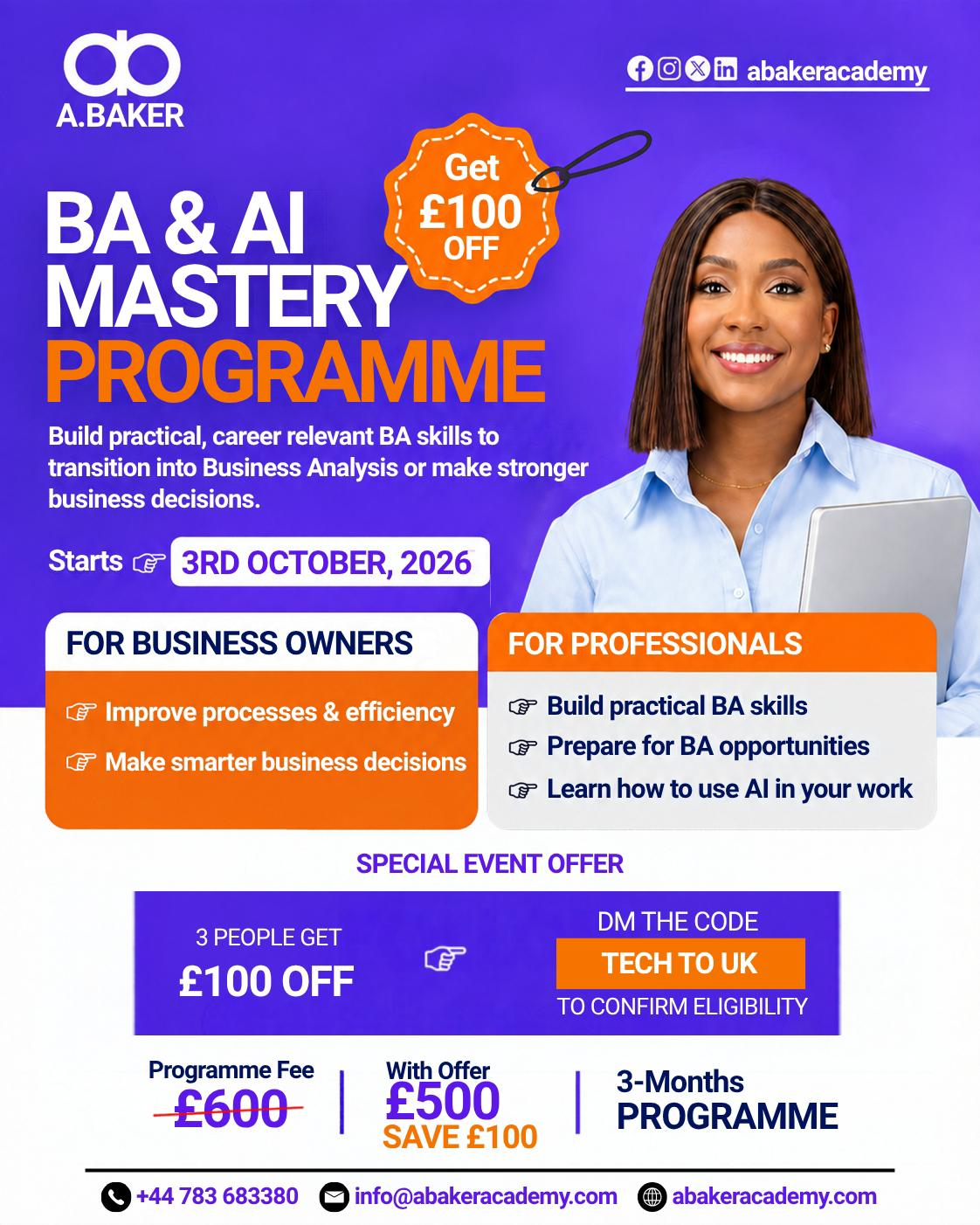
Nike Baker and A Baker Academy are offering access to a discount (the code is in the flyer below) for the upcoming BA & AI Mastery Programme.
For enquiries, you can contact Baker Academy at [email protected] or +44 7383 683380.
eMigr8.ai
Bade Adesemowo's eMigr8.ai is also offering a free visa assessment through its new AI Visa Architect, Dr. Zenith. The tool allows users to upload their profile and receive an assessment of their potential mobility options for the UK, US, and EU.
Get the free assessment: eMigr8.ai Visa Assessment
Your Diaspora Hub (YDH)
Your Diaspora Hub also provides one-on-one consultations, personalised checklists, and access to a community of professionals already in the UK.
Couldn't make it to the event? We're bringing some of the best moments from the conversation to Techloy's social platforms. Hear directly from the speakers as they break down how to tailor your CV, find sponsored opportunities, position your experience, and stand out when applying from outside the UK.
Follow Techloy on LinkedIn, Instagram, TikTok, YouTube, and X to watch the clips.
What next?
Breaking into the UK job market isn't just about sending more applications.
The advice from the event points to a more deliberate process: understand the role you're targeting, tailor your application, make your skills visible, track what is working, and position yourself around the specific value you can offer.
For candidates applying from outside the UK, that process matters even more because the employer has to see enough value to justify the additional steps involved in sponsorship and relocation.
If you missed the event, watch the full session above for the complete discussion and practical advice from all six speakers.
 David Adubiina