It’s almost guaranteed that you'll find thousands of UK job vacancies online, on LinkedIn, Indeed, or even the Techloy community job board. But finding vacancies where a UK employer is willing and able to sponsor you can be as tough as looking for a needle in a haystack.
Say you search for “product designer jobs in the UK.” The search can return thousands of vacancies. For an international professional who needs sponsorship, however, most of those jobs may turn out to be irrelevant.
This is because there is a difference between a job being advertised in the UK and a job being open to an overseas candidate who requires sponsorship. And while there are various reasons as to why professionals struggle to land a sponsorship role, here are some of the tips people overlook or don't know can help.
 David Adubiina
/1. Start with employers, not just job titles
This is where the UK Register of Licensed Sponsors becomes useful.
Candidates can use the register to identify organisations that hold a sponsor licence, then cross-check those employers against their industry, location and available vacancies.
But there is an important distinction to keep in mind: a company appearing on the sponsor list does not mean every vacancy it advertises comes with sponsorship.
Oludamola Ibiyemi, founder and CEO of Your Diaspora Hub, a platform helping migrants and diaspora professionals navigate life, work, and settlement in the United Kingdom, says candidates often stop their research too early once they find an employer on the register.
“The UK sponsor register tells you which employers are licensed. It does not tell you whether they are actively using that licence, which roles they have sponsored before, or whether the vacancy in front of you is one of them,” she says.
As a candidate, you still need to check the specific role and whether the company is offering sponsorship for that vacancy.
/2. Don't just target the obvious names
When people think about companies that can sponsor international workers, they often think about big tech companies such as Amazon, Apple and Google, forgetting that there are smaller and growing companies that international professionals can look at.
Some eligible scale-up businesses can sponsor workers through the Scale-up Worker route, which creates another group of employers candidates can consider when searching for UK opportunities.
The Scale-up Worker pathway is a fast-track immigration pathway for highly skilled professionals who have a confirmed job offer from a fast-growing UK business. This means the search does not have to stop at the biggest companies. You can also look at growing companies in your industry, check whether they hold the relevant sponsor licence, and then see whether they have vacancies that match your experience.
/3. Don't wait until the offer stage to ask about sponsorship
Finding an employer that can sponsor you is only part of the process. Candidates also need to think about when they raise the subject of sponsorship.
According to Ibiyemi, one of the biggest mistakes she sees is people leaving the sponsorship conversation until the end of the recruitment process.
“People are told to prove themselves first and raise the visa question later, so they get to the final stage before mentioning it. By then the employer has run a process, budgeted a salary and built expectations around a start date. Introducing sponsorship at that point feels to them like a new problem rather than a known condition, and that is when offers quietly evaporate,” she says
Ideally, it should be "raised at application stage; it is just a fact about the role. Raising it at offer stage, it looks like something you concealed,” Ibiyemi added
That doesn't mean every application needs to lead with a long explanation about immigration status. However, this helps to establish early whether sponsorship is available instead of progressing through an entire recruitment process without knowing.
/4. Don't assume the headline salary is enough
Even after finding an employer that sponsors and a role that matches your experience, there is another detail candidates need to check before assuming they are eligible, which is the salary.
Ibiyemi says this is one area that “catches even the people who did their homework.”
She explains that “assuming the general salary threshold is the number that matters” can be a mistake. “You have to be paid the higher of that threshold or the going rate for your specific occupation code. An offer can clear the headline figure and still fail, and people tend to discover that far too late to do anything about it.”
The important part is that the general salary threshold is not necessarily the only figure that matters. The going rate for the specific occupation code can be higher, so a salary that looks sufficient at first glance may still fall short of the requirement for that particular role.
/5. You can also look within the company you already work for
You may not have to start your UK job search by looking for a new employer. If you already work for an international company that has a UK business, you could explore whether there is an opportunity to move within the company through the Senior or Specialist Worker route, if you meet the requirements.
Unlike the Scale-up Worker route, which is designed for eligible workers joining qualifying UK scale-up businesses, the Senior or Specialist Worker route is a temporary work route under the UK’s Global Business Mobility framework. It allows multinational companies to transfer eligible key staff to an established UK branch within the same business group.
This is different from the popular idea that you have to look beyond your locality to find global opportunities. Sometimes, the company you already work for can be the link to another market.
Your locality could take you global. You just have to know what opportunities exist within the company and how to position yourself for them.
Want to learn how professionals are landing sponsored jobs in the UK?
Finding a UK vacancy is easy. Finding one where an employer is prepared to sponsor you is a different challenge.
And that's why Techloy x Your Diaspora Hub (YDH) is bringing together six speakers, Nike Baker, Bade Adesemowo, Mahmood Owolabi, Arinze Ibekwe, Wale Ogunjobi, and Yanju Lawal for an online session on Breaking into the UK Job Market: How to Land Sponsored Jobs.
The session is happening on Saturday, September 26, 2026, at 9:00 am BST and includes six speakers, one workshop, and a live Q&A, covering how international professionals can find UK opportunities and position themselves for sponsored roles.
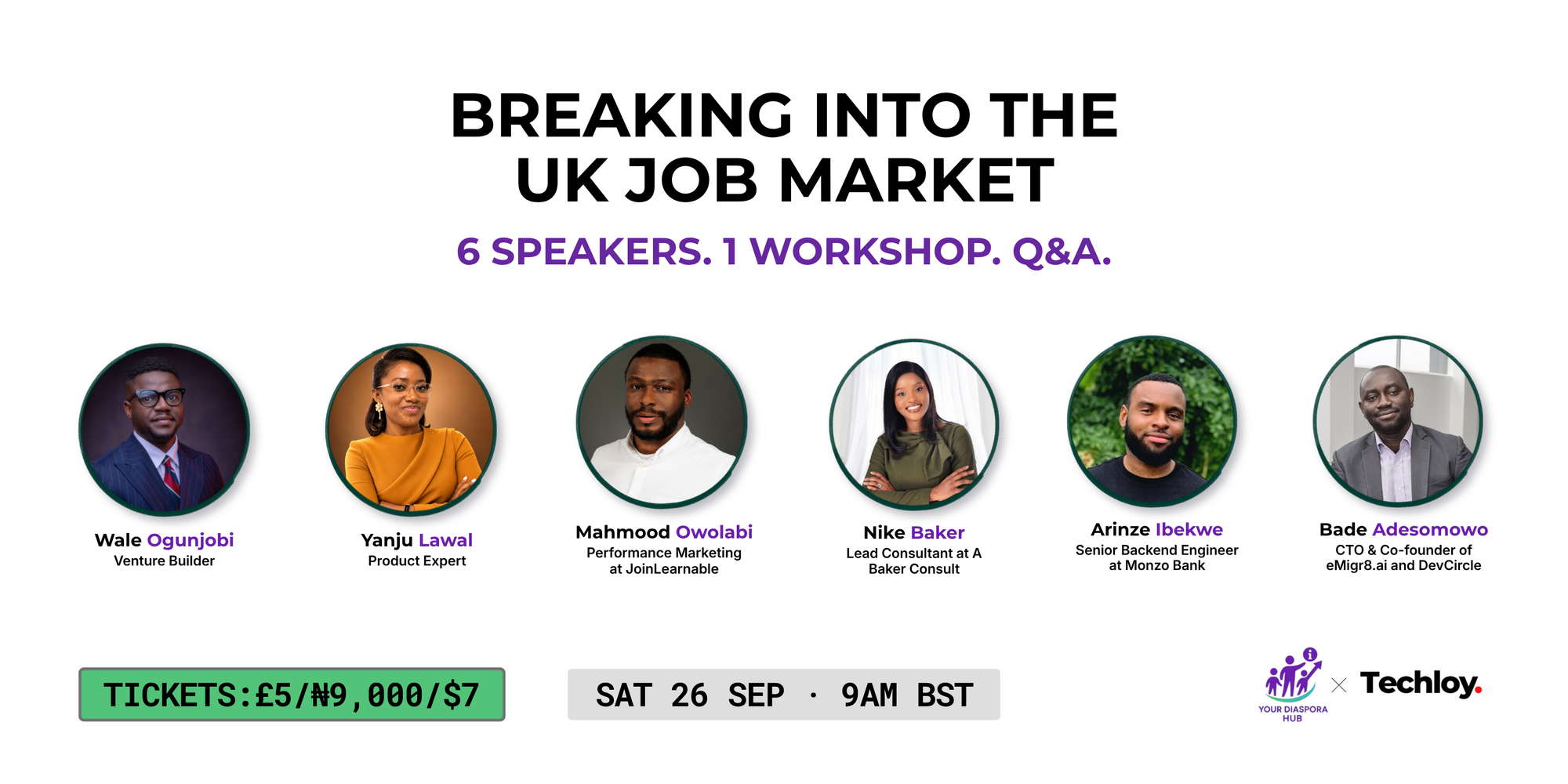
The event normally costs £5, but we’re giving away a limited number of tickets.
Techloy readers get the first 50 free tickets when they register with code TECHLOY50. YDH is also giving away 25 free tickets with code YDH25.
First come, first served. Once the free tickets are gone, the £5 ticket price applies.
Finding a sponsored role requires candidates to look beyond the job title and investigate the employer, role, salary, and available immigration route. For international professionals, that research can help them focus their efforts on opportunities that may actually be viable.
 David Adubiina