


AdTech isn't adopting AI — it's already AI-native and ahead of everyone else. The current wave of AI hype makes it feel like every industry is just getting started. Advertising isn't. It has been running on machine learning for over a decade — quietly, at scale, and with real revenue behind it. Long before generative AI went mainstream, algorithms were already deciding which ads people see, how much advertisers pay, and what actually converts. By 2025, AI-driven programmatic advertising alone had surpassed $800 billion.
Advertising as a whole reached roughly $1.1 trillion in 2025, with digital ads accounting for more than 70%. In the most important segments — search, social, commerce, video and programmatic — AI is no longer optional. It is the default. The difference today is not who uses AI, but how it is built, how deeply it is integrated, and what data it learns from.
Increasingly, advertisers define the goal, and AI handles everything else — targeting, creatives, bidding and optimization.
The platforms below show how this plays out in practice. While their structures differ — from search and social to commerce and super-app ecosystems — they are converging on the same model: AI as the core decision engine behind advertising.
Organizing them by how much of the user journey they control makes this convergence visible.
At the top are walled gardens and super-app ecosystems. These platforms own the full funnel: from attention to action. Their AI trains on first-party behavioral data across search, social, video, maps, and payments. They don't track users across the web — they keep them inside.
In the middle sit retail media platforms. Their AI is built to optimize for actual purchases and product recommendations, not just clicks or views. They have deep visibility into shopping behavior.
At the bottom are mobile-first platforms. Focused entirely on in-app environments, their AI optimizes for mobile targeting, contextual advertising, and engagement prediction. They operate across third-party apps, without owning the user relationship.
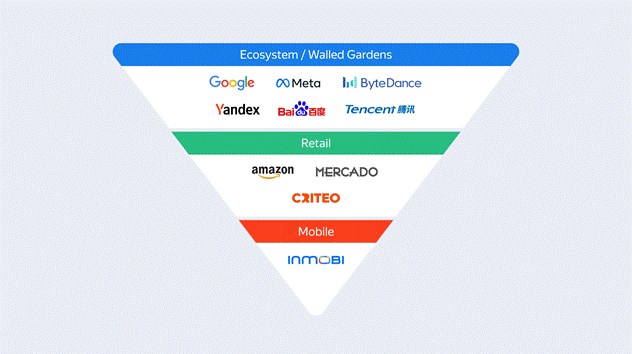
A Global Snapshot of the Adtech Platform Market, 2026
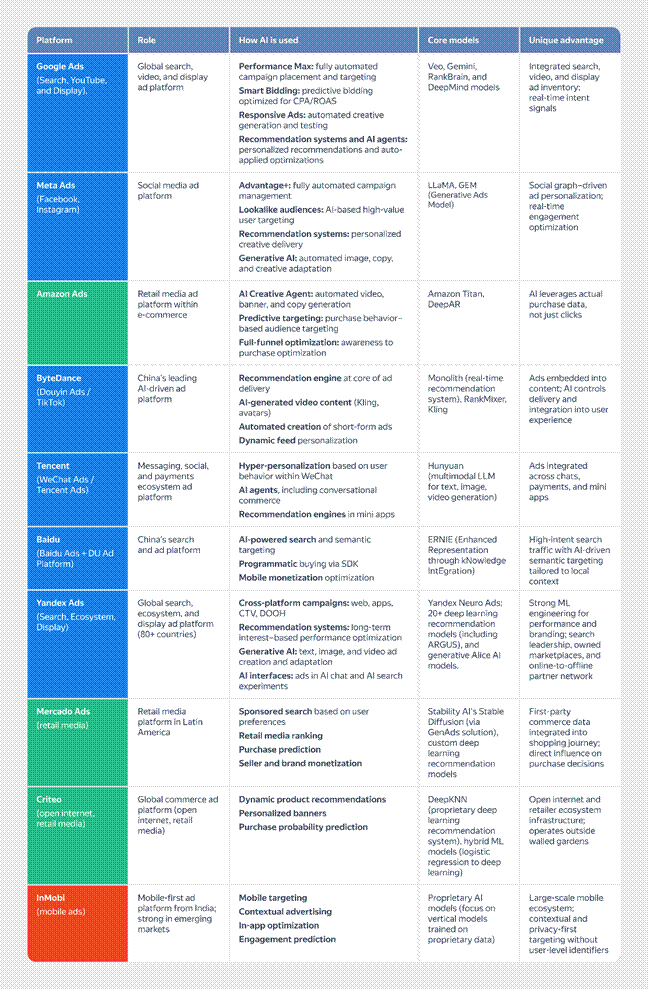
Taken together, these platforms show how advertising already works today. Different structures, same core idea: large-scale data, proprietary models, continuous optimization. What changes from platform to platform is what they optimize for — intent, attention, purchase, or behavior across services — and how much of the user journey they actually control.
AdTech is starting to split. Large-scale platforms are doubling down on their own models, infrastructure and data, while others are still stitching together external tools. That difference compounds over time. In 2024, the industry saw 83 mergers and acquisitions — the highest since 2021 — as companies try to close the gap. But this is no longer just about adding features. It is about who owns the system end to end. For advertisers, that means fewer real choices, more powerful platforms, and a growing dependence on how their systems operate.
Owning the user journey matters more than tracking it. As cross-site tracking becomes more restricted, the advantage shifts to platforms that do not rely on it. If you control the environment, you do not have to infer intent — you observe it directly. Platforms like Amazon and Tencent operate this way, with AI systems trained on real user actions rather than fragmented signals. The outcome is straightforward: more accurate targeting, clearer measurement, and a tighter link between advertising and actual results.
AI search is becoming a new kind of advertising surface. Platforms like Google, Baidu and Yandex are starting to introduce ads into search and conversational interfaces. Some estimates put ad spend in this segment at around $1 billion, with projections reaching roughly $20–30 billion by the end of the decade. The bigger shift is structural. Ads are no longer separate from results — they sit alongside and are increasingly shaped by the answer itself. That changes how intent is captured, how products are surfaced, and how performance is measured.
Generative AI adds a new layer — it does not replace the core. Most of advertising has been running on machine learning for years. Generative tools build on top of that system, not instead of it. Their role is to accelerate execution: generating creatives, adapting them in real time, and lowering barriers for smaller advertisers. But the core still runs on less visible systems — recommendation models, bidding algorithms and predictive engines — that continue to drive most of the value.
From campaigns to systems. Platforms like Meta, Google and Amazon are moving toward models where advertisers define the goal — budget, outcome — and the system handles the rest. Targeting, creatives, bidding and optimization are increasingly part of a single loop. As a result, the campaign as a unit of work becomes less central, replaced by continuous, automated decision-making.
Advertising did not simply adopt AI — it reorganized around it. What used to be a set of tools is now the system itself. As that system becomes more automated and more concentrated within a smaller number of platforms, the question shifts from how to use AI to where it runs — and who controls it.


