Meta and Snap are both betting that the next computer could sit on your face. But they're taking very different routes to get there.
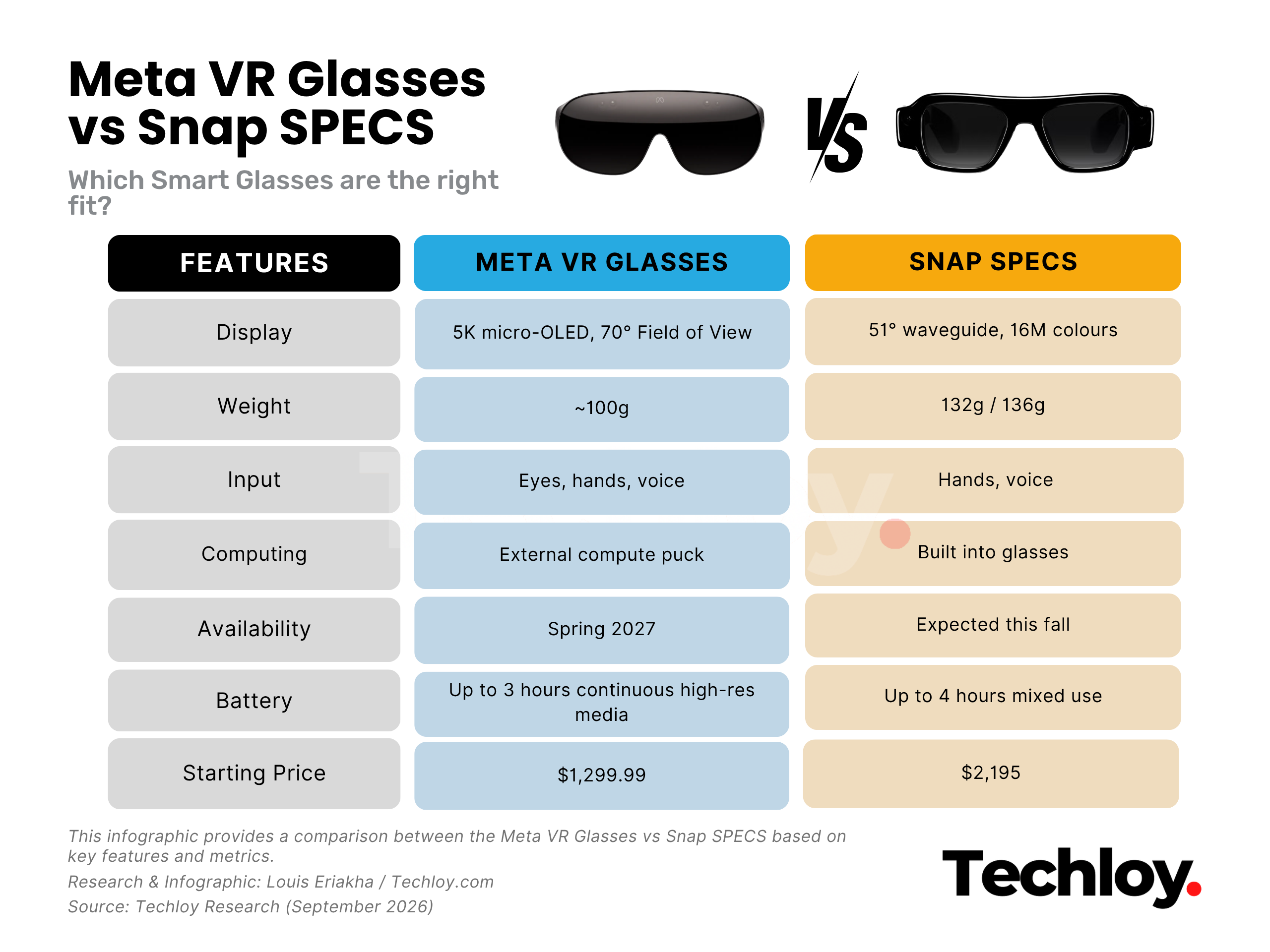
Meta's newly announced Meta VR Glasses are designed to bring much of what makes VR headsets useful into a pair of glasses weighing around 100 grams. They have 5K micro-OLED displays, eye tracking, hand tracking, spatial audio, and a separate compute puck that handles the processing, battery, and storage.
Snap's SPECS take a different approach. They are standalone augmented reality glasses designed to keep you aware of the world around you while placing digital content, apps, information, and experiences into it. They weigh between 132 and 136 grams and use a 51-degree field of view with 16 million colours.
The difference becomes even more obvious when you look at the price. Meta VR Glasses will cost $1,299.99 when they launch in spring 2027, while Snap SPECS cost $2,195 and are expected to begin shipping this fall.
So, which one makes more sense if you're looking to buy into the next generation of glasses-based computing? Here's how Meta VR Glasses and Snap SPECS compare.
 Oluwajeminipe Fasheun-Motesho
/1. Design and weight
Meta's biggest design achievement is getting a VR-class experience into something that weighs around 100 grams.
The Meta VR Glasses are roughly five times lighter than the Meta Quest 3 and avoid the bulky head strap and headset body that usually come with VR. Meta achieves this by moving the processor, battery and storage into a separate compute puck connected to the glasses by an optical tether.
Snap takes the opposite approach. SPECS put all of their computing hardware inside the glasses, which makes them heavier at 132 grams for the 47mm version and 136 grams for the 52mm version. But there's no external puck to carry around.
That creates an interesting trade-off. Meta gives you lighter glasses, but the complete system includes another device and a cable. Snap gives you heavier glasses, but everything you need to run them is already on your face.
/2. Display and visual experience
The displays reveal the biggest difference between what these glasses are actually designed to do.
Meta VR Glasses use 5K micro-OLED displays with 37 pixels per degree, pancake lenses and Dolby Vision support. The result is designed for immersive content, virtual screens, movies and games, while full-colour passthrough keeps the physical environment visible when needed.
Snap SPECS use a see-through waveguide with a 51-degree field of view and 16 million colours. Snap says the display can create the equivalent of a 24-inch desktop screen for work or a 115-inch cinema screen viewed from around 10 feet away. However, Snap hasn't revealed the exact display resolution.
On raw display specifications, Meta has more to show for now. But Snap has the wider field of view and a display designed specifically to layer digital content onto the real world rather than surround you with a virtual environment.
That makes Meta's display better suited to immersive viewing, while Snap's is better suited to AR experiences where keeping your surroundings visible is part of the point.
/3. Computing and performance
The two companies have taken almost opposite approaches to powering their glasses.
Meta uses a Qualcomm Snapdragon Reality Elite processor, but much of the computing, battery and storage hardware sits inside the external puck. The glasses connect to it through an optical tether, allowing Meta to keep the frames lighter while still delivering the processing power needed for VR and mixed reality.
Snap puts its computing hardware inside SPECS. The glasses use two Snapdragon processors, with one dedicated to computer vision and another handling Lenses. Snap says this enables hand tracking and a 7-millisecond motion-to-photon latency.
Meta's approach has an obvious advantage: it doesn't have to squeeze all of the hardware needed for a high-resolution VR experience into the frames. Snap's approach has a different advantage because SPECS can operate without an external computer.
If performance is the priority, Meta's external compute puck gives it more room to deliver a demanding VR experience. If convenience is the priority, Snap's self-contained architecture is more appealing.
/4. Controls, AI and software
Both devices are designed to move beyond buttons and controllers, but their approaches to interaction are slightly different.
Subscribe for free to continue reading this article
Subscribe SubscribeAlready have an account? Log in